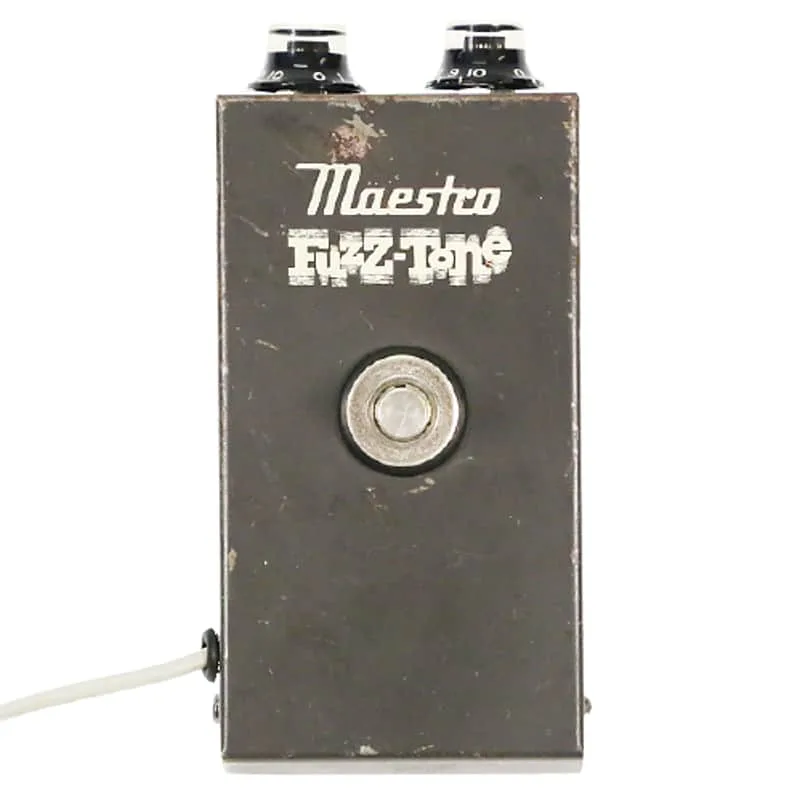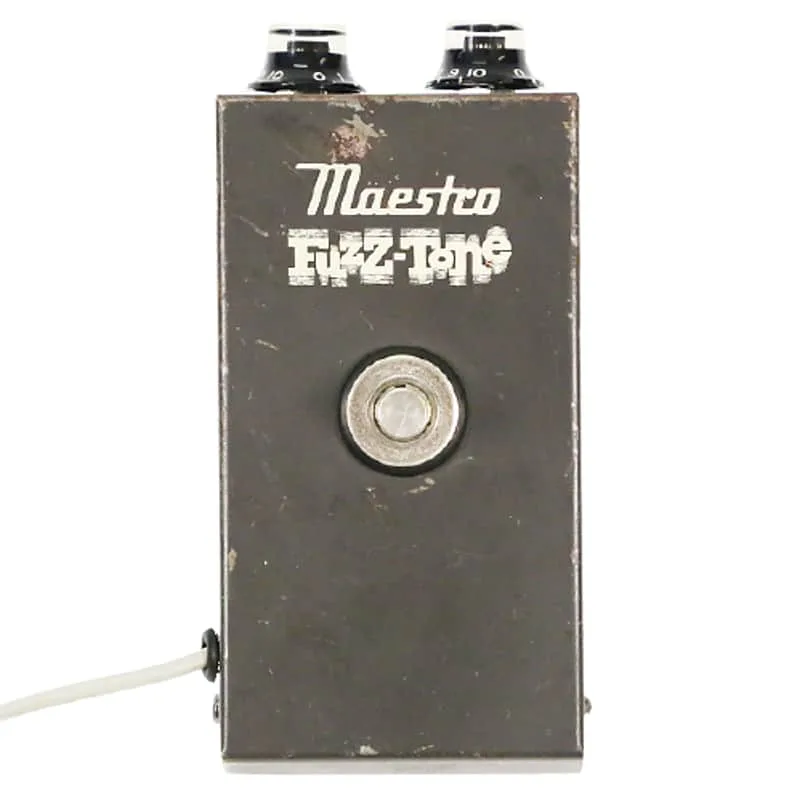


The Gibson Maestro Fuzz-Tone is a fuzz pedal introduced in 1962 by Gibson's subsidiary Maestro, and it is widely described as the world's first fuzz pedal, the first guitar pedal produced for mass consumption, and the first transistor distortion pedal123. Before it, the fuzz sound lived in busted amps; with the Fuzz-Tone, that sound moved onto the pedal platform4. Its most famous appearance is the riff of "Satisfaction" by The Rolling Stones, the example Performer Mag gives when explaining what a fuzz pedal sounds like5.
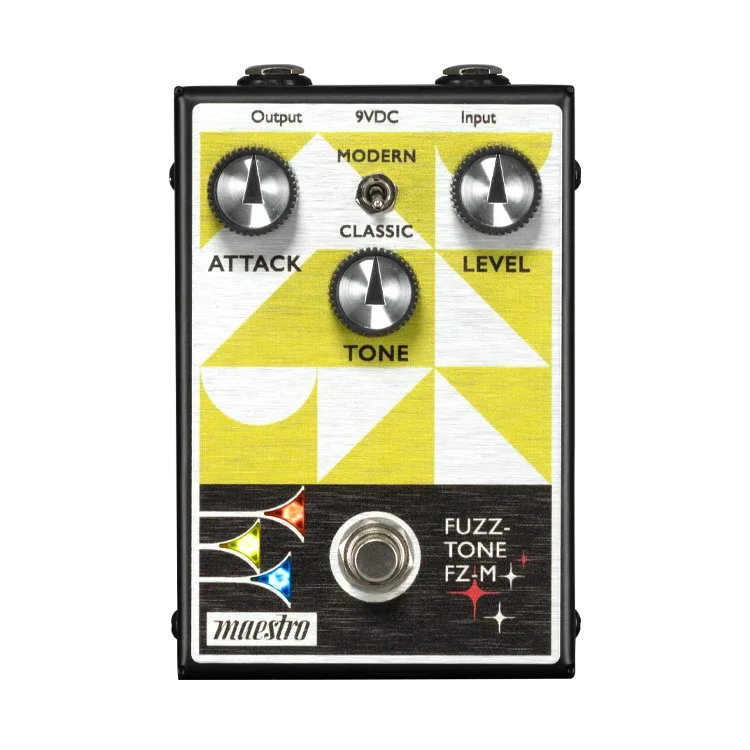
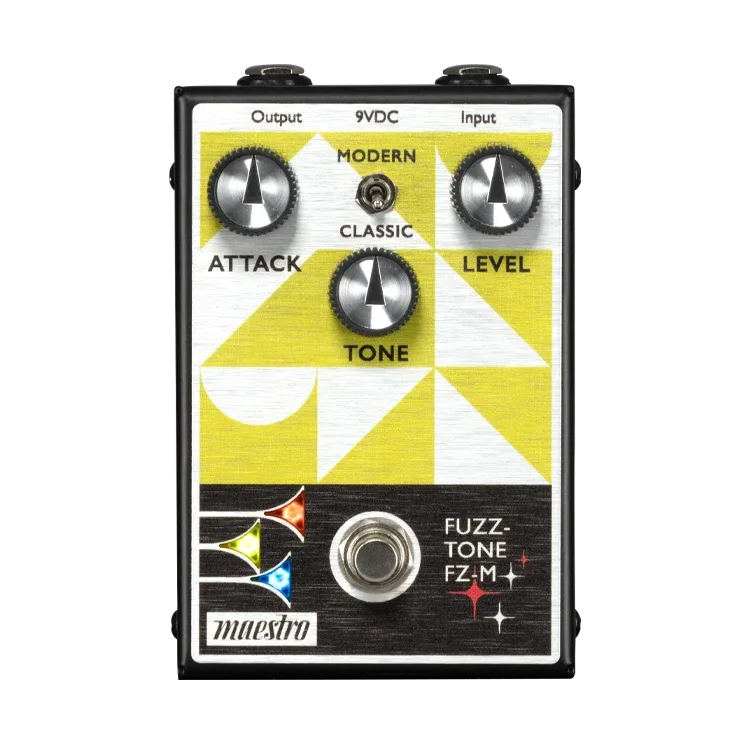
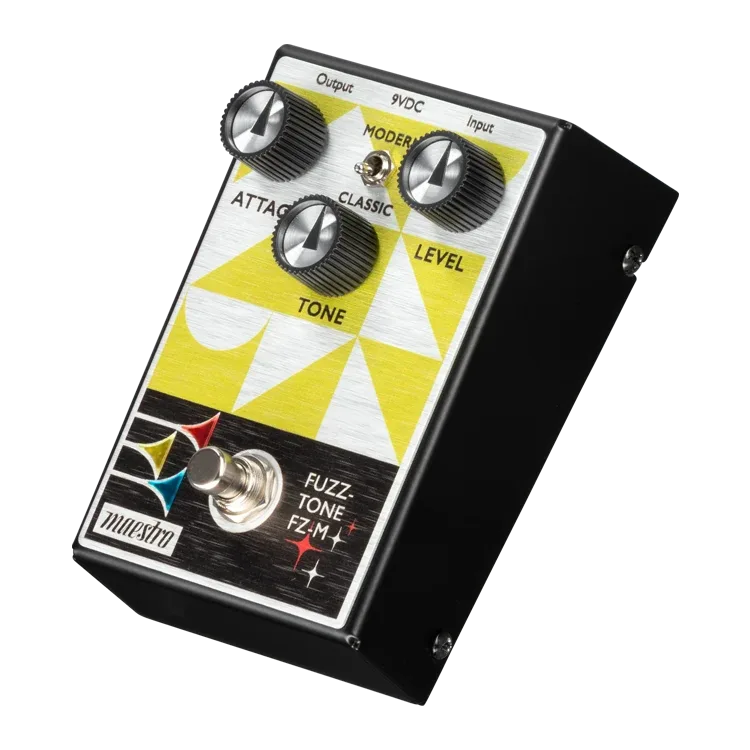
Gibson revived the Maestro brand in 2022 with a line of five all-analog pedals, and the Fuzz-Tone returned among them as the FZ-M, a pedalboard-friendly reissue that pairs an FZ-1 inspired fuzz sound in its Classic mode with a thicker, more modern fuzz tone16.
What the Fuzz-Tone is and what it does
A fuzz pedal takes the guitar's signal and clips it hard, producing a saturated, sustaining tone that sits at the extreme end of the gain spectrum compared with overdrive and distortion pedals. The Fuzz-Tone was one of the earliest commercially available fuzz effects for guitars, and it was originally marketed as a device to make electric guitars sound like brass instruments1213.
Its place in history was sealed by one song. Performer Mag's buying guide names the Maestro Fuzz-Tone used on "Satisfaction" by The Rolling Stones as its example of the fuzz sound5. Jimmy Page, in a MusicRadar interview, named the Maestro FZ-1 as arguably the first commercially available distortion/fuzz pedal when recalling how Roger Mayer introduced him to the distortion pedal14.
Vintage Maestro Fuzz-Tone pedals are sought after by collectors and musicians, and the originals are considered classics2.
Who designed it
The Fuzz-Tone was invented by Glenn Snoddy, an engineer at Owen Bradley's Quonset Hut recording studio in Nashville2. According to guitar.com's history of overdriven guitar tones, Snoddy teamed up with Gibson and another engineer, Revis Hobbs, to create the unit15. Vintage Guitar magazine's account, drawing on the people involved, reports that "together we worked out the details of the Fuzz-Tone"9.
The 2022 revival has its own designer: Craig Hockenberry, Gibson's director of engineering and lead designer of the revamped Maestro line6.
History and versions: from the FZ-1 to the FZ-M
Gibson launched the FZ-1 under its Maestro brand name in 1962910. One Guitar Player account dates the first commercially available fuzz pedal, the FZ-1, to 1963, but the great weight of sources, from Gibson's own product page to Guitar World, Vintage Guitar and fuzzboxes.org, puts the introduction in 19621391612.
The line then evolved through several variations:
| Version | What it was |
|---|---|
| FZ-1 | The original 1962 fuzz pedal, Gibson's first Maestro stompbox1017 |
| FZ-1A | A refined version released in late 1965, using 2N2614 or 2N2613 transistors powered by a single 1.5-volt battery39 |
| FZ-1B | A first-generation model alongside the FZ-1A2 |
| FZ-1S and FZ-1S "Big Box" | Later variations of the Fuzz-Tone2 |
| FZ-1S Super-Fuzz | A Fuzz-Tone designed by Tom Oberheim18 |
| FZ-1a reissue | Gibson's 1990s reissue, since discontinued3 |
| FZ-M | The 2022 revival, with Classic and Modern modes619 |
Guitar World's history notes that the design changed again in 19683, and gearnews.com reports that Gibson released three reissue Fuzz Tones in the '60s and '70s, all differing from the original 1962 units, before briefly reissuing the pedal as the FZ-1a in the 1990s20.
The 2022 revival
The FZ-M's Classic mode is said to be based on the FZ-1A sound19. Craig Hockenberry told GuitarPlayer: "The sound is based on the FZ-1A in Classic mode. And it uses discrete transistors, but it's actually more"6. Guitar World's review describes the pedal as equipped with two distinct sounds, a nod to the past in "Classic" plus a "Modern" mode19.
The circuit: germanium transistors
The original Maestro Fuzz-Tone was a germanium transistor fuzz. Robert Keeley's technical analysis groups it with the early Arbiter Fuzz Face and the Dallas Rangemaster as classic effects that used germanium transistors11. The later FZ-1A revision moved to 2N2614 or 2N2613 transistors, powered by a single 1.5-volt battery3.
The Fuzz-Tone was an American product, predominantly sold in the United States16, which is part of why British players of the era turned to homegrown units like the Tone Bender instead.
What reviewers said about the FZ-M
GuitarPlayer's review of the FZ-M called it "a good all-around fuzz that can deliver circa-'60s tones as well as heavy rock grind"6. Pedal of the Day echoed the maker's description of the pedal offering both an FZ-1 inspired fuzz sound and a thicker, more modern fuzz tone8.
"A good all-around fuzz that can deliver circa-'60s tones as well as heavy rock grind."
Videos
Sweetwater
Gibson TV
VINTAGEGEARHOLLYWOOD
Questions
Who designed the Maestro Fuzz-Tone?
The Fuzz-Tone was invented by Glenn Snoddy, an engineer at Owen Bradley's Quonset Hut recording studio in Nashville, who teamed up with Gibson and another engineer, Revis Hobbs, to create the unit. The 2022 FZ-M reissue was designed by Craig Hockenberry, Gibson's director of engineering and lead designer of the revamped Maestro line.
Was the Maestro Fuzz-Tone the first fuzz pedal?
Yes. Introduced by Gibson's Maestro brand in 1962, it is widely described as the world's first fuzz pedal and the first guitar pedal produced for mass consumption, and as the first transistor distortion pedal. One Guitar Player account dates its introduction to 1963, but most sources say 1962.
Is the Gibson Maestro Fuzz-Tone still made?
The original Maestro Fuzz-Tone models are no longer in production, and Gibson's 1990s FZ-1a reissue has also been discontinued. Gibson revived the Maestro brand in 2022 with the FZ-M Fuzz-Tone, a pedalboard-friendly reissue that offers an FZ-1 inspired fuzz sound in its Classic mode alongside a thicker, more modern fuzz tone.
Is the original Maestro Fuzz-Tone a transistor fuzz?
Yes. The original Fuzz-Tone was a germanium transistor fuzz, one of the classic early effects to use germanium transistors alongside the Arbiter Fuzz Face and the Dallas Rangemaster. The later FZ-1A revision used 2N2614 or 2N2613 transistors powered by a single 1.5-volt battery.
Sources (20)
- Maestro Fuzz-Tone FZ-M, Gibson (www.gibson.com)
- The Maestro Fuzz-Tone, tru-fi.com
- The history and origins of the iconic Maestro FZ-1 Fuzz-Tone, Guitar World, 2021-10-20
- FUZZCYCLOPEDIA : A Side-by-Side Comparison of EQD Fuzz Boxes, EarthQuaker Devices, 2021-08-10
- WHAT ARE THE DIFFERENCES BETWEEN FUZZ, OVERDRIVE AND DISTORTION PEDALS?, Performer Mag, 2023-01-24
- Maestro FZ-M Fuzz-Tone Review, GuitarPlayer, 2022-04-06
- Fuzz-Tone FZ-M by Maestro, RockBoard PedalPedia, 2026
- Maestro Fuzz-Tone FZ-M, Pedal of the Day, 2023-02-17
- Maestro Fuzz-Tone, Vintage Guitar magazine, 2015-12-08
- Five Rare British Vintage Fuzzboxes (That Aren't Tone Benders or Fuzz Faces!), GuitarPlayer, 2021-08-31
- Germanium vs. Silicon Transistors, Keeley Electronics Guitar Effects Pedals, 2013-09-11
- FUZ-1 | Guitar Player (October 2005) | Demeter Amplification, Guitar Player, 2005-10
- The evolution of distortion: how advances in gear paved the way for heavy music, Guitar World, 2020-03-16
- Jimmy Page talks about Roger Mayer bringing the distortion pedal into his life, MusicRadar, 2019-09-19
- The history of overdriven guitar tones, guitar.com, 2021-01-15
- Gary Hurst Tone Bender 'MKI' • Fuzzboxes, fuzzboxes.org, 2021-05-20
- Interview: "It's arguably the first guitar effects pedal ever", MusicRadar, 2022-02-21
- Maestro™ FZ-1S™ Super-Fuzz™ Clone: Schematic & Layout, General Guitar Gadgets, 2014-05-14
- Maestro Fuzz-Tone FZ-M review, Guitar World, 2022-05-09
- The new Maestro Electronics Fuzz-Tone promises to give you Satisfaction!, gearnews.com, 2022-01-06
 Keith Richards