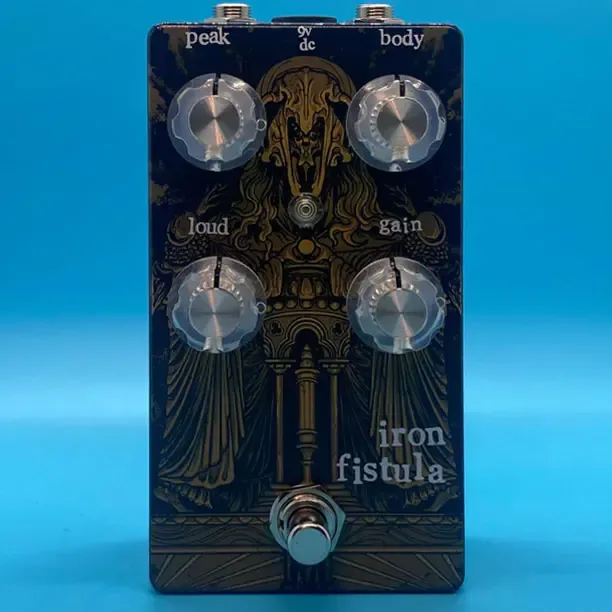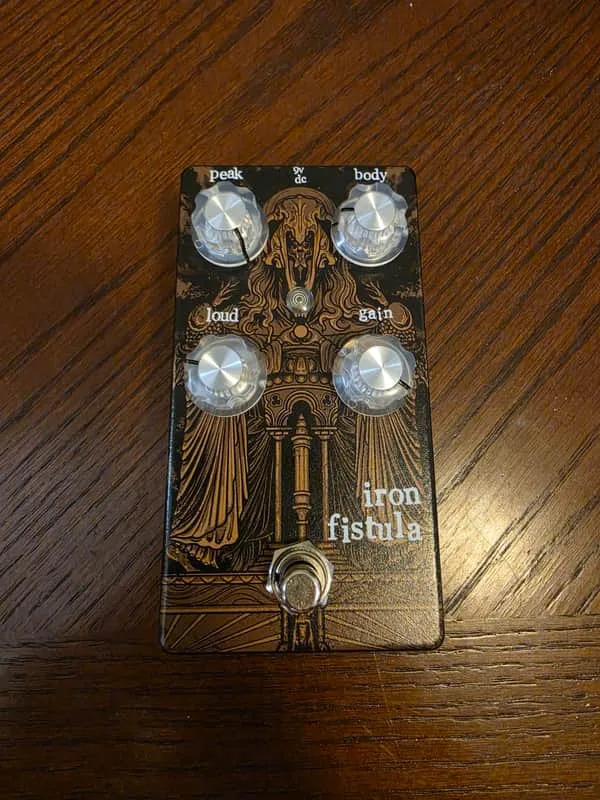


The Malaise Forever Iron Fistula JFET Preamp Drive is a JFET transistor-based overdrive/preamp pedal from Malaise Forever, released in August 2022 as the builder's third pedal. Delicious Audio's Paolo De Gregorio describes it as joining "the numerous club of Plexi-style overdrives", built to emulate the saturation of a plexi-era amp rather than the mid-humped character of pedals like those compared in Boss SD-1 vs Ibanez TS9 Tube Screamer. It sits in the broader family covered on Overdrive Pedals, with a preamp side of its character that also touches Preamp Pedals territory.12
A Plexi-style drive built on JFETs
De Gregorio frames the pedal in personal terms:
"my love letter to the plexi-drives of yore. JFETs are able to emulate tube amp saturation with surprising accuracy, making them perfect for amp-in-a-box style circuits"
The maker describes the Iron Fistula as "my love letter to the plexi-drives of yore," explaining that "JFETs are able to emulate tube amp saturation with surprising accuracy," which makes them well suited to amp-in-a-box style circuits.1 In other words, the pedal is built to reproduce the character of an overdriven Marshall-style amp rather than act as a general-purpose boost, with the JFET transistors doing the work that vacuum tubes do in the amplifier it is modeled on.2
The controls: Loud, Gain, Body and Peak
| Control | What it does |
|---|---|
| Loud | Controls output volume1 |
| Gain | Sets the level of breakup; interacts with Body, and with both maxed the circuit can be driven into much fuzzier territory than JFET overdrives typically reside in12 |
| Body | Active tone filter placed before the Gain control; dials in large amounts of low end that affects the character of the clipping. Counter-clockwise is thinner with less bass, clockwise is more bass and a more blown-out sound1 |
| Peak | Low-pass filter between the two gain stages; neutral when maxed out, progressively cutting more high and high-mid frequencies when turned anti-clockwise1 |
The Body control is the heart of the pedal's character. Because it sits before the Gain stage, the bass it adds stimulates extra clipping, with fuzzier results as more low end is pushed in.1 Pedal of the Day adds that the presence of low end increases as gain is increased, and that the Body setting significantly affects how hard the circuit clips; the control is calibrated to boost low-end frequencies significantly without muddying the overall sound.2
With Gain and Body both maxed, the Iron Fistula can move into much fuzzier territory than JFET overdrives typically occupy, so it reaches toward Fuzz Pedals and Distortion Pedals ground at the top of its range.2
Circuit: bass filter, low-pass filter and JFET buffer
The signal path runs gain stages first, then the output filtering, then a buffer12:
- The EQ section places the active Body bass control just before the Gain control, where added low frequencies stimulate extra clipping.1
- The output of the circuit uses a passive variable frequency filter that subtly sets the Peak of the treble frequencies.12
- Just after that filter sits a JFET buffer which minimizes output impedance.1
The JFET buffer at the end matters for players who run long cable runs or pedalboards: by minimizing output impedance it helps the pedal's signal carry downstream without high-frequency loss, a role covered more broadly on Buffer Pedals.1
Videos
collector//emitter
ambienttrash
Pedal of the Day
Questions
What does the Body knob do on the Iron Fistula?
Body is an active tone filter placed before the Gain control. It dials in large amounts of low end, and that bass affects the character of the clipping: counter-clockwise gives a thinner sound with less bass, clockwise brings more bass and a more blown-out character. Pedal of the Day notes the low end increases as gain is increased, and that the Body setting significantly affects how hard the circuit clips, boosting low frequencies without muddying the overall sound.
What does the Peak control do?
Peak is a low-pass filter placed between the two gain stages. Delicious Audio describes it as neutral when maxed out, progressively cutting more high and high-mid frequencies as it is turned anti-clockwise. Pedal of the Day describes the output filter as a passive variable frequency filter that subtly sets the Peak of the treble frequencies, just before the JFET buffer.
Is the Iron Fistula a Plexi-style overdrive?
Yes. Delicious Audio's Paolo De Gregorio describes it as joining the club of Plexi-style overdrives, and calls the pedal his love letter to the plexi-drives of yore. It is built as an amp-in-a-box style circuit that uses JFET transistors to emulate tube amp saturation, and it works as both an overdrive and a preamp.
Why does the Iron Fistula use JFET transistors?
JFET transistors are able to emulate tube amp saturation with surprising accuracy, according to Delicious Audio's Paolo De Gregorio, which makes them well suited to amp-in-a-box style circuits like this one. That is why the Iron Fistula is built around them rather than around op-amps or other clipping arrangements.
Does the Iron Fistula have a buffer?
Yes. The output of the circuit runs through a JFET buffer, which Delicious Audio says minimizes output impedance. That sits after the passive variable frequency filter that sets the Peak of the treble frequencies.
Sources (2)
- New Pedal: Malaise Forever Iron Fistula Drive, Delicious Audio, 2022-08-22
- Malaise Forever Iron Fistula JFET Preamp Drive, Pedal of the Day, 2022-08-22