

The Malekko Goatkeeper is a two-stage polyrhythmic analog tremolo pedal from Malekko Heavy Industry. The core of the pedal is an all-analog tremolo circuit built around a THAT Corp VCA, the same type of voltage-controlled amplifier used in professional audio level control1. What sets it apart from a standard tremolo is its LFO system: instead of one low-frequency oscillator shaping the volume, there are two stages, each with its own multiplier values and waveform selection1.
That two-stage design is where the polyrhythm comes in. When the two stages run at different speeds, the effective waveform becomes a composite of the two, producing tremolo sounds from percussive to smooth, from big fat pulses to tiny blips and bleeps and anything in between12.
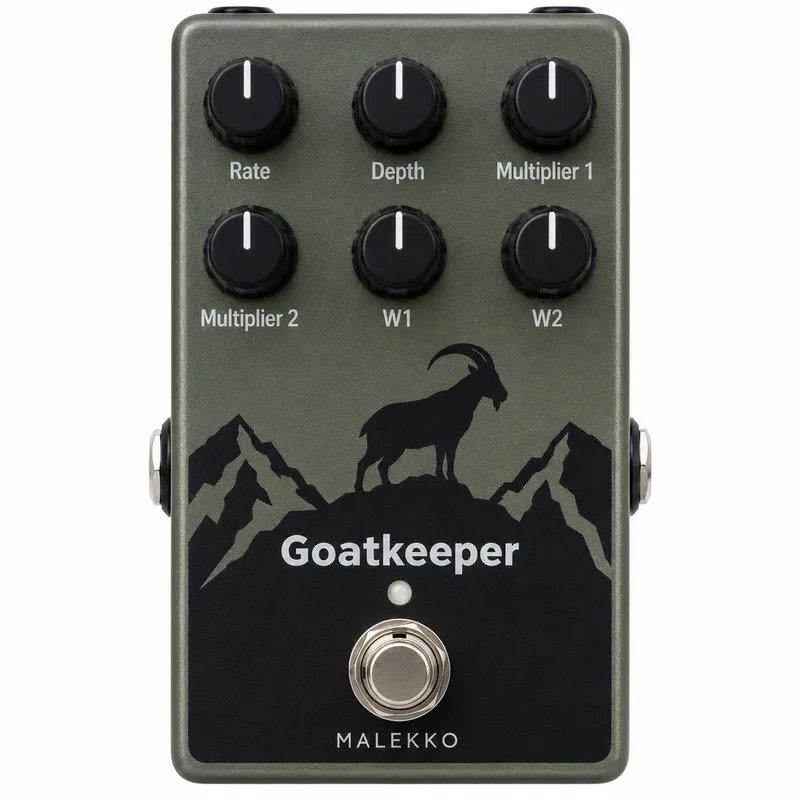
The controls: Rate, Depth, two multipliers and two waveform knobs
The Goatkeeper's front panel is built around six controls. The Rate knob is shared between the two stages and sets the overall tempo of the tremolo, which can also be controlled via the Tap/Sync jack2. The Depth knob varies the intensity of the effect, from subtle to high intensity, described by Pedal of the Day as ranging "from subtle to wickedly pulsing and vibrating"12.
The two 12-position multiplier controls are where the polyrhythmic character lives. Each selects the speed of its own stage's oscillation in note values, whole note, half note, quarter note and so on, so the two stages can be locked to different rhythmic subdivisions against the shared tempo1.
The two W knobs, W1 and W2, each select the shape of the LFO for its own tremolo circuit, and they also select the mode functionality that determines how the two stages interact1.
| Control | What it does |
|---|---|
| Rate | Sets the overall tempo, shared by both stages; can also be set via the Tap/Sync jack12 |
| Depth | Varies the intensity of the effect, from subtle to high intensity12 |
| Multiplier 1 | 12-position switch selecting the speed of the first stage's oscillation in note values1 |
| Multiplier 2 | 12-position switch selecting the speed of the second stage's oscillation in note values1 |
| W1 | Selects the first stage's LFO shape and the mode functionality1 |
| W2 | Selects the second stage's LFO shape and the mode functionality1 |
Both sides offer the same five LFO shapes: sine, saw, ramp, square, and pulse1. Pedal of the Day lists the waveforms as sine, square, pulse, long square, ramp up and ramp down, set individually on each stage2.
The modes: Single, Sequential, Composite and Modulation
There are four modes that the two stages can run in, and the mode is what turns the Goatkeeper from a straightforward tremolo into a pattern generator2.
- Single: The first stage only, for classic tremolo1.
- Sequential: The two stages run one after the other, alternating W1 with W212.
- Composite: The two stages run simultaneously and the effective waveform is a polyrhythmic composite of the two1.
- Modulation: The two stages run simultaneously and the second waveform modulates the first waveform1.
Single mode is the entry point: one stage, one waveform, one speed, and the pedal behaves like a conventional tremolo. Sequential mode alternates between the two stages' settings, creating rhythmic patterns rather than a steady pulse. Composite and Modulation are the deepest modes, running both stages at once so their waveforms interact, which is what produces the polyrhythmic composite patterns the pedal is named for1.
Tap tempo and the Tap/Sync input
Tempo can be set with the Rate knob or with the Tap/Sync input1. The Tap/Sync input accepts a Malekko Lil' Buddy footswitch for tap tempo control, or an analog clock or metronome signal, so the pedal can be synced to an external timing source rather than tapped by hand1.
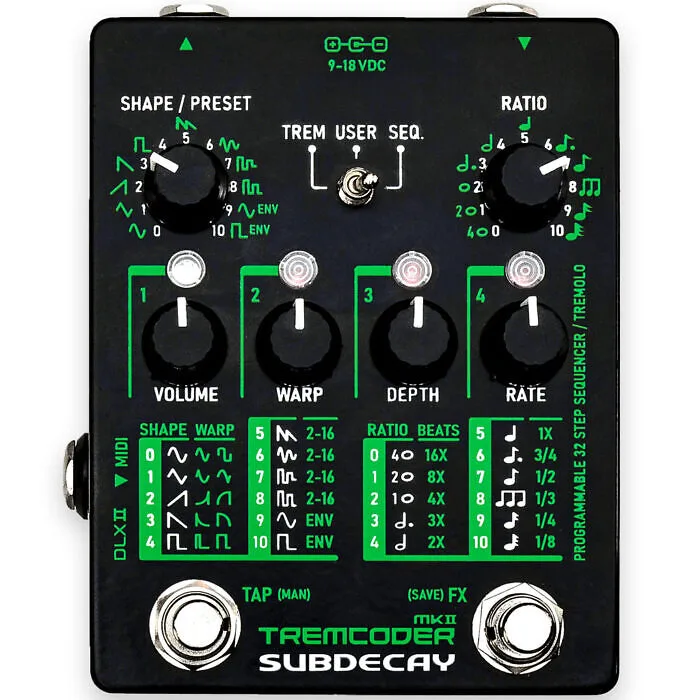
The Goatkeeper has no onboard tap tempo footswitch. Guitar Pedal X noted in its comparison with the Subdecay TremCoder that the Goatkeeper "loses out in not having onboard tap-tempo or stereo output", so tapping requires an external switch such as the Lil' Buddy plugged into the Tap/Sync jack3.
From the Lightfoot Labs Goatkeeper to the Malekko redesign
The Malekko Goatkeeper is a completely redesigned version of the Lightfoot Labs Goatkeeper, first released in 20071. Guitar Pedal X describes it as a completely redesigned, miniaturized and compact version of the original3. Pedal of the Day reported that Malekko Heavy Industry was releasing the new, smaller version2.
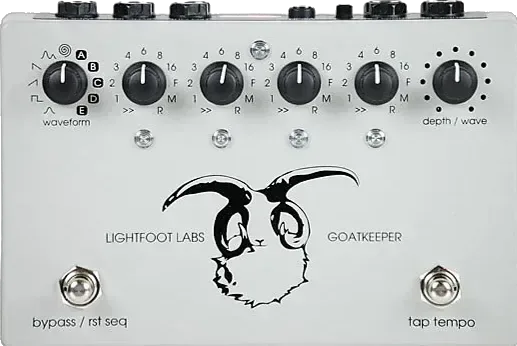
The original Lightfoot Labs Goatkeeper 3 was an all-analog signal path, tap tempo tremolo and sequencer pedal4. Its LFO rate was set by tap tempo, requiring two or more taps, by an expression/CV input, or by an external sync input, and each sequencer step could be set to rest, full amplitude, or random4. The third and final version of the Goatkeeper 3 was limited to just 25 pedals5.
What reviewers said
Delicious Audio called the Goatkeeper "obviously a very interesting device that's bound to inspire textural and creative guitarists"1. Guitar Pedal X compared it head to head with the digital Subdecay TremCoder as two compact pattern tremolos, noting the Goatkeeper's analog circuit and relay true bypass with LED indicator alongside its lack of onboard tap tempo and stereo output3.
Videos
Malekko HeavyIndustry
Pedal of the Day
Dennis Kayzer
Questions
Is the Malekko Goatkeeper true bypass?
Yes. The Goatkeeper uses relay true bypass with an LED indicator, so the analog signal path is fully switched out of the chain when the effect is disengaged. Relay switching also means the footswitch itself is not carrying the audio signal, which typically makes for a quieter, more reliable bypass than a mechanical true bypass arrangement.
Does the Malekko Goatkeeper have stereo output?
No. The Goatkeeper is a mono pedal with a single output. In a 2019 comparison against the Subdecay TremCoder, Guitar Pedal X noted that the Goatkeeper lacks stereo output, along with onboard tap tempo, though tempo can still be set externally through the Tap/Sync input.
Is the Malekko Goatkeeper analog or digital?
It is analog. The core of the pedal is an all-analog tremolo circuit built around a THAT Corp VCA, the same chip family used in studio-grade level control. The two-stage LFO system that drives the VCA is what gives the Goatkeeper its polyrhythmic capability.
What tap tempo pedal works with the Malekko Goatkeeper?
The Tap/Sync input accepts the Malekko Lil' Buddy footswitch for tap tempo control. The same jack also takes an analog clock or metronome signal, so the Goatkeeper can be synced to an external source rather than tapped by hand.
What waveforms does the Goatkeeper have?
Both LFO stages offer five shapes: sine, saw, ramp, square, and pulse. Each stage selects its own waveform independently, and in Composite or Modulation mode the two shapes interact to produce the polyrhythmic patterns the pedal is known for.
Sources (5)
- Malekko Goatkeeper, Delicious Audio, 2023-01-23
- Malekko Heavy Industry Goatkeeper Analog Tremolo, Pedal of the Day, 2019-08-12
- Guitar Pedal X, Guitar Pedal X, 2019-06-16
- Goatkeeper by Lightfoot Labs, RockBoard PedalPedia, 2026
- Lightfoot Labs Goatkeeper 3 Analog Tap Tremolo/Sequencer, Pedal of the Day, 2016-10-11