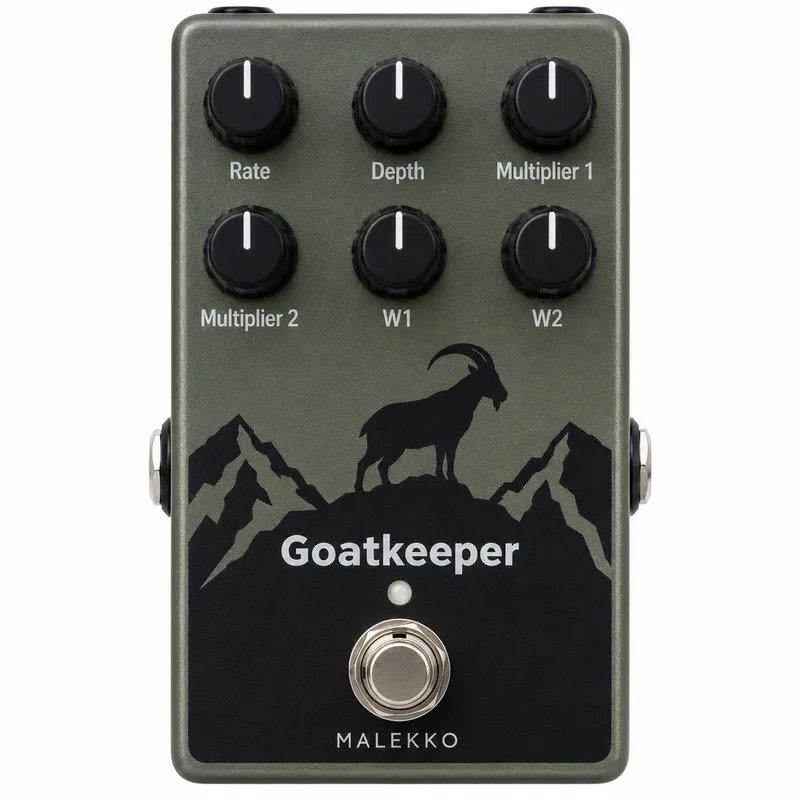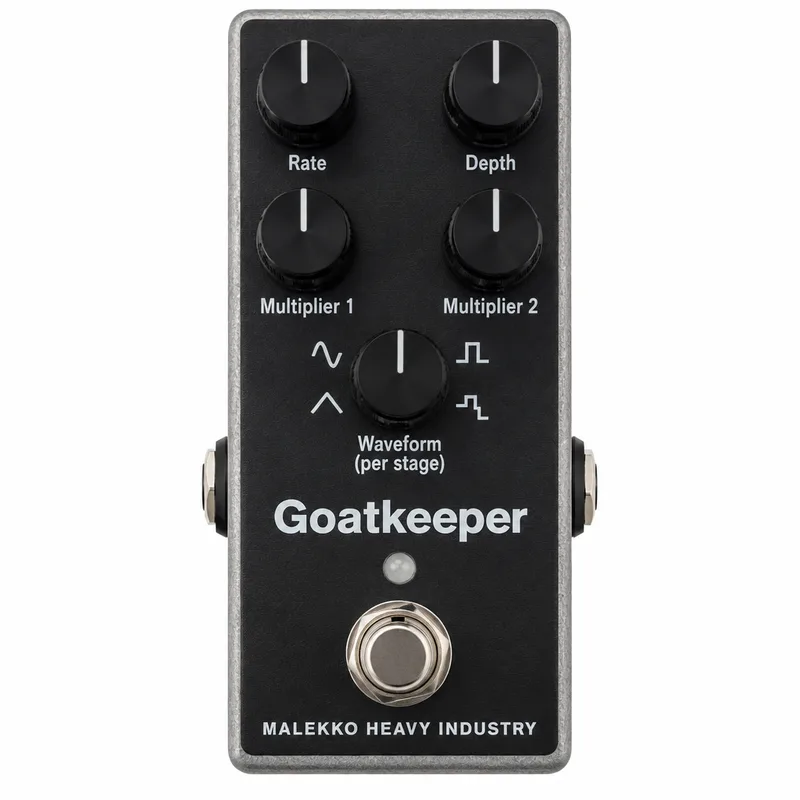


The Malekko Heavy Industry Goatkeeper is an all-analog tremolo and sequencer pedal, a redesigned and miniaturized version of the Lightfoot Labs Goatkeeper that Malekko released in 20191. Where a standard tremolo turns your volume up and down at one steady rate, the Goatkeeper runs two LFO stages, each with its own speed multiplier and waveform, so it can produce everything from a simple pulse to layered, polyrhythmic patterns1.
The core of the pedal is an analog tremolo circuit built around a THAT Corp VCA (voltage-controlled amplifier), the same approach Malekko used in its other VCA-based designs2. Delicious Audio presented it as a "2-Stage Polyrhythmic Analog Tremolo," and its combination of two stages with selectable waveforms "can produce tremolo sounds from percussive to smooth"2.
What it does to your sound
A conventional tremolo gives you one rate and one depth. The Goatkeeper's LFO generation consists of two stages, each with a range of multiplier values and a waveform selection1. Because each stage can run at a different subdivision of the shared tempo, the two can interact: Pedal of the Day describes the range as "big, fat pulses, tiny blips and bleeps and anything in between," from subtle depth all the way to what its reviewer called "wickedly pulsing and vibrating"1.
The controls: Rate, Depth, multipliers and waveforms
The front panel keeps the familiar tremolo controls, with a shared Rate knob and Depth control, and adds the two-stage machinery on top of them23.
| Control | What it does |
|---|---|
| Rate | Sets the overall tempo of the tremolo; can also be controlled via the Tap/Sync jack1 |
| Depth | Varies the intensity of the effect, from subtle to hard pulsing and vibrating1 |
| Multiplier 1 | 12-position control selecting the speed of stage 1's oscillation (whole note, half note, quarter note, etc.)2 |
| Multiplier 2 | 12-position control selecting the speed of stage 2's oscillation; multipliers run 1 to 9, with stage 2 adding 10 and 11 at its end21 |
| Waveform 1 | Waveform selection for stage 1, set individually1 |
| Waveform 2 | Waveform selection for stage 2, set individually1 |
The Rate knob is shared between the two stages, and it can be set via external tap tempo2. The two 12-position multiplier controls then let you choose the speed of each side's oscillation in note values, whole note, half note, quarter note and so on, which is what makes polyrhythms possible: set one stage to quarter notes and the other to a value that does not divide evenly against it and the two patterns cycle against each other2.
The waveform lists differ between sources. Pedal of the Day lists sine, square, pulse, long square, ramp up and ramp down, set individually on each stage1. Delicious Audio lists sine, saw, ramp, square and pulse on both sides2.
Four modes: Sequential, Composite, Modulation and Single
The two stages can run in four modes1:
- Sequential: The two stages run one after the other; the W1 setting alternates waveform 1 with waveform 221
- Composite: The two stages run simultaneously, and the effective waveform is a polyrhythmic composite of the two; the W2 setting adds its waveform to the W1 waveform21
- Modulation: The two stages run simultaneously, and the second waveform modulates the first2
- Single: The W2 setting removes waveform 2 from the signal, leaving a single-stage tremolo2
Sequential and Single behave like a conventional tremolo with one LFO at a time. Composite and Modulation are where the pedal earns its "polyrhythmic" label, since both stages act on the signal at once and the resulting pattern is the interaction of the two21.
Tap tempo and syncing
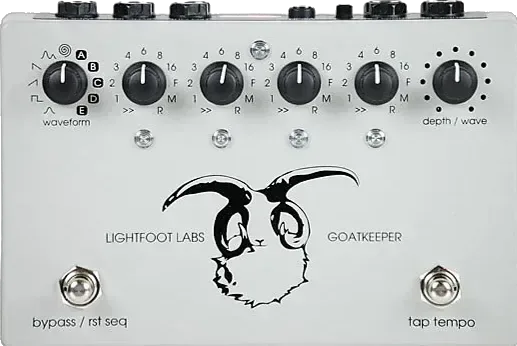
Tempo can be set with the Rate knob or with the Tap/Sync input2. The Tap/Sync jack accepts a Malekko Lil' Buddy footswitch for tap tempo control, or an analog clock or metronome signal, so the pedal can be synchronized to other gear rather than tapped by hand2. This carries over from the original Lightfoot Labs Goatkeeper 3, whose LFO rate was set by tap tempo requiring two or more taps4.
From the Lightfoot Labs Goatkeeper 3 to the smaller Malekko version
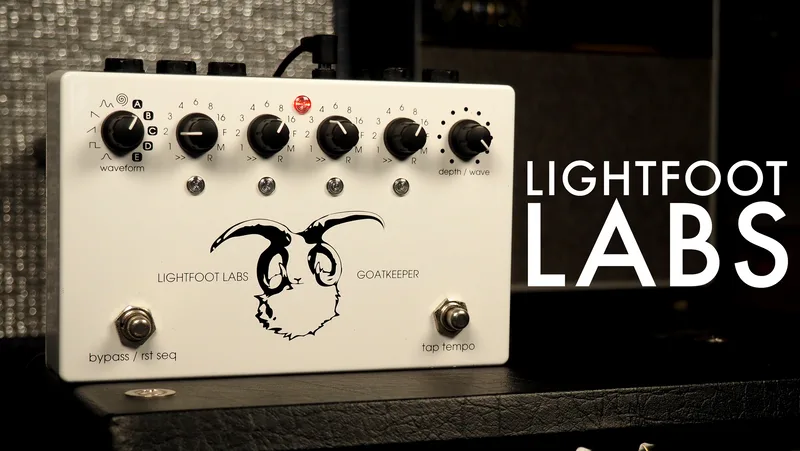
The Goatkeeper line began with the Lightfoot Labs Goatkeeper, first released in 20072. The Lightfoot Labs Goatkeeper 3 was an all-analog signal path, tap tempo tremolo and sequencer pedal with customizable waveforms: six standard waveforms plus five more that could be created and saved with a waveform recorder function4. That third and final version was limited to just 25 pedals5, and it is now out of production, hard to find and expensive6.
The Malekko version is a completely redesigned, miniaturized take on the original circuit, released in 2019 in a smaller, pedalboard-friendly size13. Pedal of the Day reviewed it as "an excellent reimagining of a classic effect, one that needs to be on more recordings and in more rigs," with what the reviewer considered a reasonable price tag overall1.
The Goatkeeper and the Subdecay TremCoder
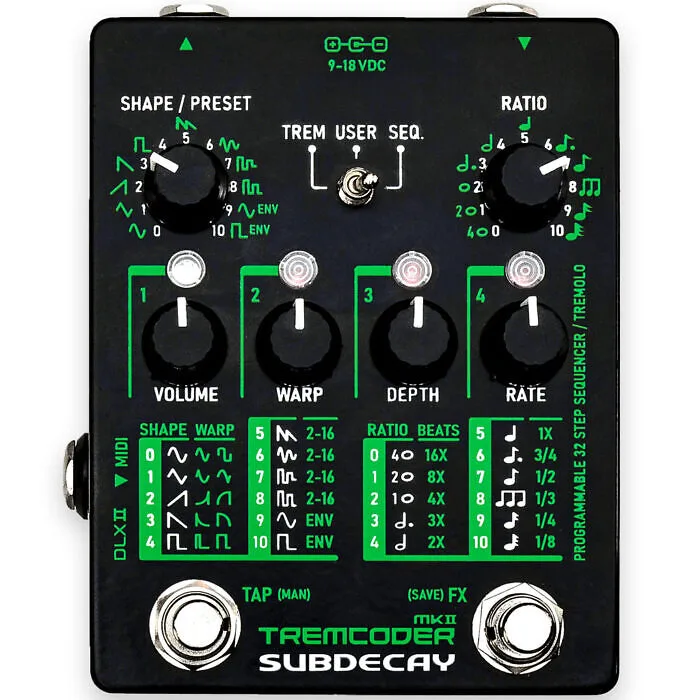
Guitar Pedal X compared the Malekko Goatkeeper with the Subdecay TremCoder as two compact polyrhythmic pattern tremolos, listing the Goatkeeper at £2173. The key difference between them is the circuit: the Goatkeeper is analog, built on a THAT Corp VCA with two analog LFO stages, while the TremCoder is digital21. Both aim at the same goal, tremolo patterns beyond a single steady rate, but the Goatkeeper gets there with analog multiplier stages rather than digital pattern programming.
Videos
Malekko HeavyIndustry
Pedal of the Day
Dennis Kayzer
Questions
Can you tap tempo the Malekko Goatkeeper?
Yes. The overall tempo can be set with the Rate knob or through the Tap/Sync input, which accepts a Malekko Lil' Buddy footswitch for tap tempo control or an analog clock and metronome signal. The two multiplier controls then divide or multiply that shared tempo independently for each stage.
Is the Malekko Goatkeeper analog or digital?
It is all analog. The core of the pedal is an analog tremolo circuit built around a THAT Corp VCA, and the LFO generation uses two stages, each with its own multiplier values and waveform selection. The original Lightfoot Labs Goatkeeper 3 was likewise an all-analog signal path.
How is the Malekko Goatkeeper different from the Subdecay TremCoder?
Guitar Pedal X compared the two as compact pattern tremolos: the Malekko Goatkeeper is analog, while the Subdecay TremCoder is digital. Both create polyrhythmic tremolo patterns, but the Goatkeeper does it with two analog LFO stages feeding a VCA rather than digital pattern generation.
What waveforms does the Goatkeeper have?
Sources describe the waveform sets differently. Pedal of the Day lists sine, square, pulse, long square, ramp up and ramp down, set individually on each stage. Delicious Audio lists sine, saw, ramp, square and pulse on both sides. Either way, each of the two stages gets its own waveform selection.
Sources (6)
- Malekko Heavy Industry Goatkeeper Analog Tremolo, Pedal of the Day, 2019-08-12
- Malekko Goatkeeper, Delicious Audio, 2023-01-23
- Guitar Pedal X, Guitar Pedal X, 2019-06-16
- Goatkeeper by Lightfoot Labs, RockBoard PedalPedia, 2026
- Lightfoot Labs Goatkeeper 3 Analog Tap Tremolo/Sequencer, Pedal of the Day, 2016-10-11
- Lightfoot Labs Goatkeeper 3 GK3 Tap Tremolo/Sequencer, Pedal of the Day, 2023-05-16