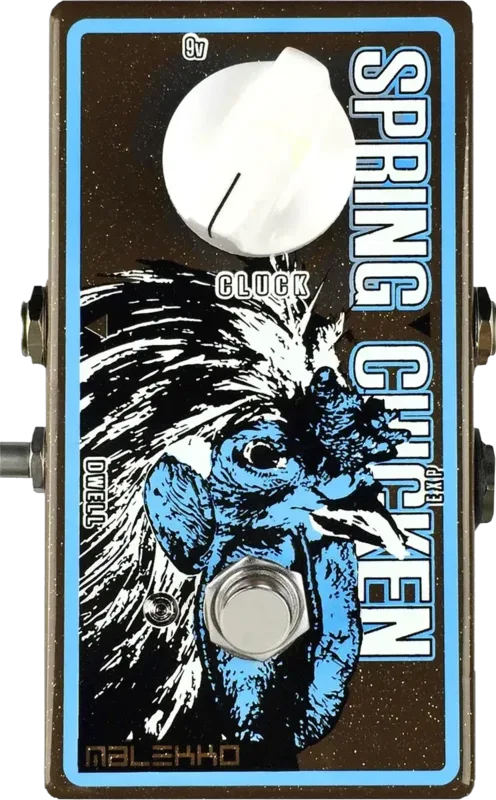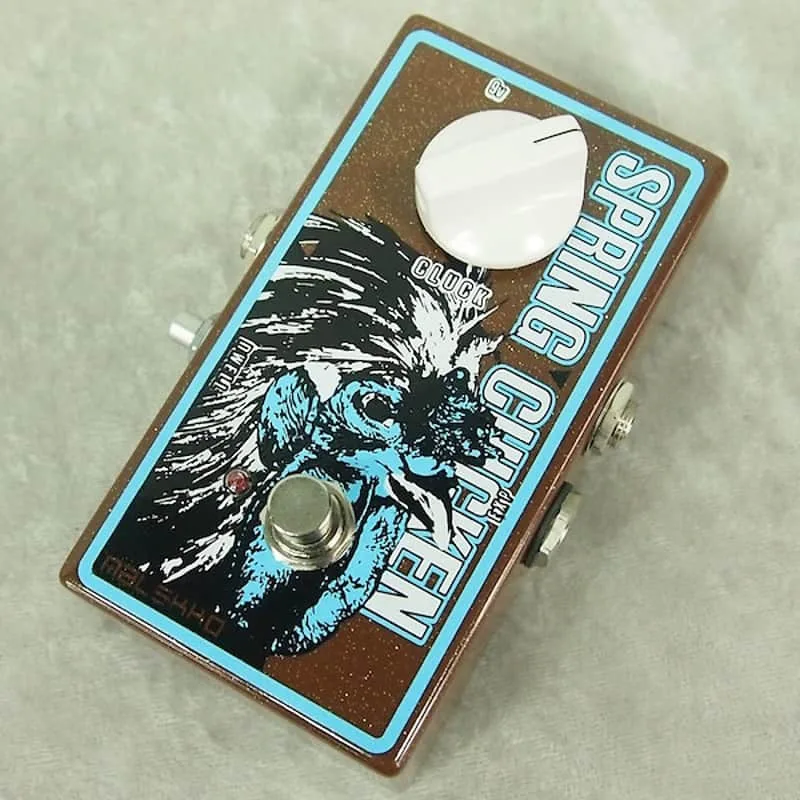


The Malekko Spring Chicken is an analog spring reverb pedal from Malekko, built to put a full-size spring reverb sound into what Delicious Audio's Paolo De Gregorio called "a little tiny enclosure"1. It carries just two knobs, Cluck and Dwell, runs on a standard 9V DC supply, and switches with true bypass21. RockBoard's PedalPedia describes its range as running "From classic beach vibes to extreme cavernous depths"2.
Controls
The Spring Chicken keeps things to two knobs, but reviewers found more under the surface than the layout suggests23.
| Control | What it does |
|---|---|
| Cluck | Wet/dry reverb mix amount, adjusting the level of reverb21 |
| Dwell | Reverb feedback amount; also shapes the bounce and length of the reverberated signal13 |
Dwell is the more interactive of the two. Pedal of the Day's Mike B, reviewing the pedal in May 2015, wrote that "In addition to controlling the wetness of the reverberated signal, it also controls the bounce and length of the signal"3. Pushed far enough, the pedal can self-oscillate, which Mike B called "not generally found in a reverb pedal of this type, and is a welcome addition"3.
"This deceiving little gem packs a reverberated wallop"
On sound, Mike B found the Cluck knob alone covers a wide span, calling the pedal "capable of going from an awesome surf rock or country pickin' sound to an enormous springy soundscape, with just the turn" of that knob3.
Expression pedal input
The newer version of the Spring Chicken adds an optional expression pedal input. Mike B's review notes that Malekko "has upgraded this newer version with an optional Expression Pedal input, which controls the reverb swells, and allows hands-free adjustment of the effect"3. RockBoard's listing puts it more plainly: plug in an expression pedal for hands-free control and create giant swells and wild oscillations2. If you already own an expression pedal, it slots straight in.
The expression pedal input is on the newer version of the pedal. Earlier units do not have it.
Power and bypass
The Spring Chicken runs on 9V DC, center negative, and draws 90mA of current2. That draw is higher than many compact reverb pedals, so it is worth matching against your power supply before sharing an output. Switching is true bypass, so the pedal stays out of your signal path when off1.
Where it came from
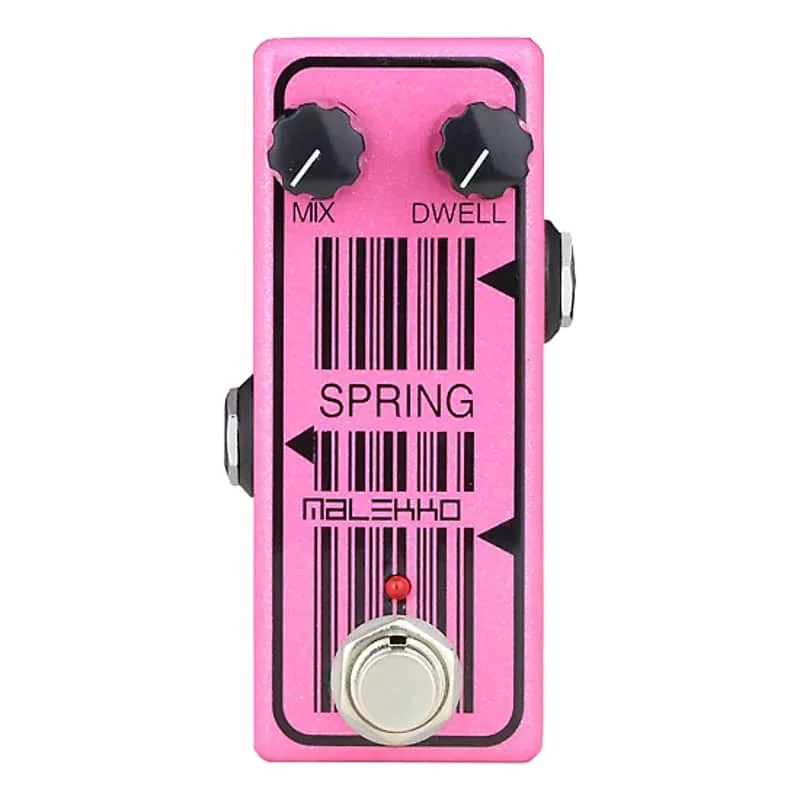
Delicious Audio covered the Spring Chicken in October 2014, when it was being shown at the Brooklyn Stompbox Exhibit1. Paolo De Gregorio tied the pedal's design to Malekko's earlier work: "The experience of working on that pedal's miniature circuit, and on the rest of the Omicron series, surely came handy," referring to the miniature Malekko Omicron Spring1. The Spring Chicken takes that small-format spring reverb idea and expands it with the Dwell control and oscillation.
RockBoard's PedalPedia page links to Malekko's own listing for a Spring Chicken LTD version, a limited edition of the pedal2.
What reviewers said
Coverage of the Spring Chicken has been positive on both sides of the Atlantic. Delicious Audio framed it as an effort to "cram a giant spring reverb in a little tiny enclosure"1, and Pedal of the Day concluded that it is "a welcome reverb in a sea of halls, springs and plates," praising how much it does despite looking like a simple one-knob pedal3. For a player after a compact spring reverb with surf tones at one end and self-oscillation at the other, it sits in a small crowd. If you are comparing it more widely, the site's reverb pedals page gathers the alternatives.
Videos
ProGuitarShopDemos
ProGuitarShopDemos
ProGuitarShopDemos
Questions
Is the Malekko Spring Chicken analog?
Yes. RockBoard's PedalPedia listing for the Spring Chicken gives its circuit type as analog. It is a spring reverb pedal built to put a full-size spring reverb sound into a small enclosure, and it runs on a standard 9V DC, center negative supply.
What does the Dwell knob do on the Spring Chicken?
Dwell sets the reverb feedback amount. Delicious Audio describes it as the reverb feedback amount, and Pedal of the Day's review adds that beyond controlling the wetness of the reverberated signal, it also shapes the bounce and length of the reverb, making it an interactive control rather than a simple set-and-forget knob.
Can you use an expression pedal with the Spring Chicken?
On the newer version, yes. Malekko added an optional expression pedal input, which controls the reverb swells and allows hands-free adjustment of the effect. RockBoard's listing says plugging in an expression pedal lets you create giant swells and wild oscillations without touching the pedal.
How much power does the Spring Chicken need?
The Spring Chicken runs on 9V DC, center negative, and draws 90mA of current, according to RockBoard's PedalPedia listing. That current draw is worth checking against your power supply's per-output rating before adding it to a daisy chain.
Is the Spring Chicken true bypass?
Yes. Delicious Audio's 2014 write-up of the Spring Chicken notes that it features true bypass, so your dry signal passes through untouched when the pedal is off.
Sources (3)
- Malekko Spring Chicken, Delicious Audio, 2014-10-07
- Spring Chicken by Malekko, RockBoard PedalPedia, 2026
- Malekko Heavy Industry Spring Chicken Reverb, Pedal of the Day, 2015-05-16