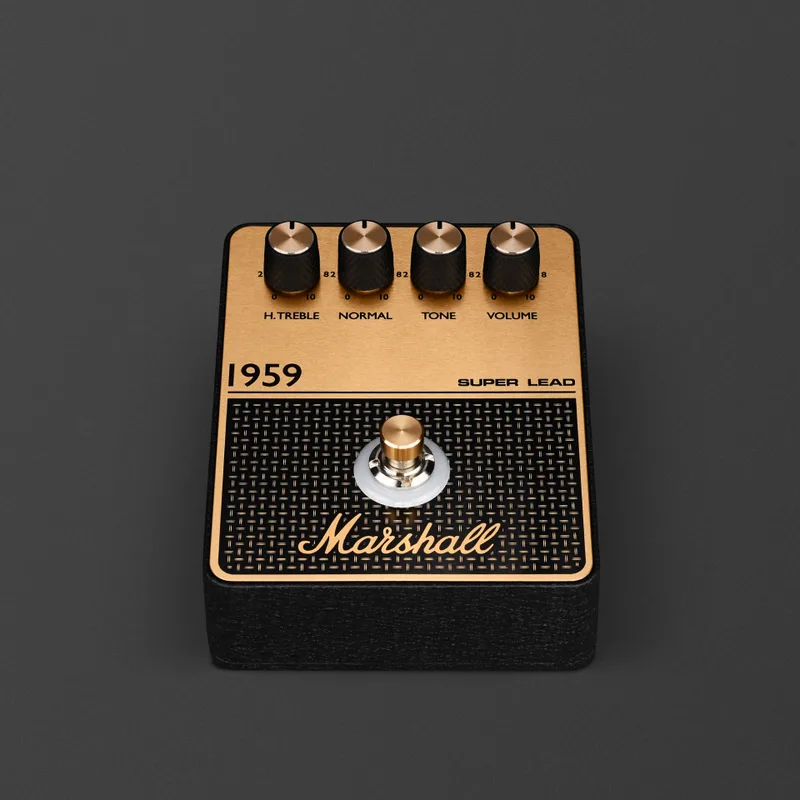


The Marshall 1959 Overdrive is an overdrive pedal from Marshall that puts the sound of the company's 1959 Super Lead amp, the amp players call the Plexi, into a stompbox. Marshall says the pedal "delivers an authentic Marshall experience with classic Plexi tones synonymous with crunchy overdrive," capturing the dynamic range, clarity and tonal character of the original 19591. The pedal sits in a black and gold enclosure, with one 1/4" jack input and one 1/4" jack output, and weighs 0.74 kg1.
What it does: Plexi crunch from the 1959 Super Lead
The 1959 Super Lead is the Marshall head that players know as the Plexi, the amp behind a long tradition of cranked British rock tone. Marshall describes the pedal's sound as "classic Plexi tones synonymous with crunchy overdrive," capturing "the dynamic range, clarity, and rich tonal character that defined the vintage roar" of the original 195921. Each rotary control knob mirrors the intuitive functionality of its amp counterpart, putting the amp's tone within easy reach on a pedalboard31.
The idea is the familiar amp-in-a-box one: instead of running a Plexi head flat out to get it into overdrive, the pedal generates that crunchy, dynamic drive at any volume in front of a cleaner amp. Marshall's own framing is that the pedal is "inspired by the iconic 1959 amp" and built by "the makers of the original"1.
The controls: high treble, normal, tone and volume
The control layout is the part that most directly copies the amp. Guitar World's review lists the controls as "Volume, Tone, H. Treble, Normal"4, and Gearnews explains what they do: "The compact overdrive pedal comes with four controls: high treble, normal (input level), tone and volume (output level)"2.
| Control | What it does |
|---|---|
| H. Treble | High treble channel voicing, as on the amp's front panel4 |
| Normal | Input level, mirroring the amp's normal channel2 |
| Tone | Overall tone shaping2 |
| Volume | Output level2 |
Guitar World noted at launch that "its controls are a little different from the rest" of the series, offering the tweaking of High Treble, Normal, Tone and Volume, where the other four pedals in the range take a more conventional layout5. Marshall says each rotary knob "mirrors the intuitive functionality of its amp counterpart," and the pedal has tactile knobs and an illuminated footswitch1.
Power, size and connections
The pedal runs on 9V DC, center negative, the standard pedalboard arrangement, and Marshall does not include an external supply in the box. On a battery alone, Marshall rates it at 30 hours of play time1.
No external power supply is included with the pedal. A battery gives about 30 hours, and any standard 9V DC center negative adapter or isolated pedalboard output will power it1.
Connections are minimal: one 1/4" jack input and one 1/4" jack output1. The enclosure is black and gold, 101mm (3.97") wide, 131mm (5.15") deep and 52mm (2") high, weighing 0.74 kg1.
Where it came from and what it costs
Marshall builds the 1959 Overdrive as a compact stompbox, measuring 101mm (3.97") wide, 52mm (2") high and 131mm (5.15") deep, and weighing 0.74 kg1. The enclosure is finished in black and gold, and the pedal carries one 1/4" jack input and one 1/4" jack output1.
Controls are tactile rotary knobs that mirror the intuitive functionality of their amp counterparts, plus an illuminated foot pedal for switching the effect in and out3. The pedal's front panel layout follows the amp it is modeled on, so a player familiar with the 1959's controls will find the same functions in knob form3.
The pedal is designed and engineered in the UK and made in Vietnam1.
Videos
Marshall
Moons Guitars
Middle Aged Gear Junkie
Questions
Does the Marshall 1959 Overdrive pedal run on a battery?
Yes. Marshall says the pedal gives 30 hours of play time on a battery if you are not using an external power supply, and no external supply is included with the pedal. It also runs on a 9V DC center negative adapter, which is the way most players power it on a pedalboard.
Where is the Marshall 1959 Overdrive pedal made?
The pedal is made in Vietnam. Marshall states that it is designed and engineered in the UK, where the company designs its amplifiers, and then manufactured in Vietnam. It is part of the five-pedal Overdrive Series Marshall introduced at NAMM in January 2025.
How much does the Marshall 1959 Overdrive pedal cost?
Marshall's US store lists the pedal at $129.99, shown against a crossed-out original price of $159.99. At launch in January 2025 the series was priced at $149 per pedal, and Thomann has listed it at 209 euros, later discounted to 139 euros.
What power supply does the Marshall 1959 pedal need?
The pedal takes 9V DC, center negative, the standard pedalboard supply. Marshall does not include an external power supply with the pedal, but says a battery gives about 30 hours of play time. Any standard 9V center negative adapter or isolated pedalboard output will work.
Sources (5)
- 1959 Overdrive Pedal, www.marshall.com
- Marshall Signature Pedals: Save up to 35 Percent on the new Amp Pedals!, gearnews.com, 2025-01-27
- 1959 Overdrive Pedal, Marshall (marshall.com)
- Marshall 1959, JCM800, JCM900, DSL, and JVM overdrive pedal review, Guitar World, 2025-01-30
- Marshall launches pedal versions of Plexi, DSL, JCM and JMV, Guitar World, 2025-01-23