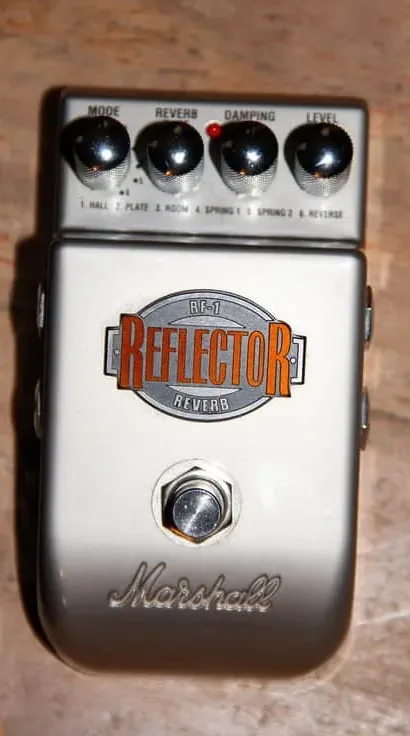


The Marshall RF-1 Reflector is a digital reverb pedal from Marshall. Its time and level controls are standard fare, while the damping control governs the amount of reflected high frequencies, and an expression pedal input provides control over the decay time. Reviewers described it as built like a miniature tank, with top-quality polished jacks and tough switches that deliver a solid click1.
The six reverb modes
The pedal's six modes cover the standard reverb territory a player is likely to need, from room and hall spaces to plate-style reflections, plus two takes on spring reverb for players after that amp-reverb feel1.
| Mode | What it gives you |
|---|---|
| Hall | Large concert-hall style space |
| Plate | Plate-style reflections |
| Room | Smaller room ambience |
| Spring (two simulations) | Amp-style spring reverb feel |
| Reverse | Backwards-style reverb swell |
The sixth mode, Reverse, Guitar World described as "a wildly unique Reverse mode"1.
The shared feature set across the trio includes:
- Dual output jacks, with mono and stereo operation1
- Passive bypass circuitry1
- A spillover circuit that prevents the effect tail from cutting off abruptly when the pedal is switched off1
For a reverb pedal, spillover matters: it lets a reverb tail decay naturally after you disengage the effect rather than stopping dead1.
Controls and connections
The RF-1 keeps its control layout simple.
| Control | What it does |
|---|---|
| Time | Sets the length of the reverb |
| Level | Sets the amount of effect in the mix |
| Damping | Governs the amount of reflected high frequencies, darkening or brightening the tail |
An expression pedal input provides control over the decay time, so the reverb length can be swept by foot while playing1.
Build and power
Guitar World's reviewer was struck by the construction:
"Each of these hefty beauties is built like a miniature tank and features top-quality polished jacks and tough switches that deliver a solid"
The pedal runs on a nine-volt battery, but the reviewer noted a practical annoyance1:
"it's unfortunate that a screwdriver or coin is still required to open the boxes' battery doors"
The RF-1 uses passive bypass circuitry rather than true bypass, which is worth knowing when planning a large pedalboard with many pedals1.
What reviewers said
Guitar World reviewed the RF-1 when the trio launched in 2007 and came away impressed with the reverb quality1:
"THE REFLECTOR'S REVERB effects are on par with some of the better rack units"
That is a meaningful comparison for a compact pedal, since rack-mounted reverb units were the reference point for studio-quality reverb at the time.
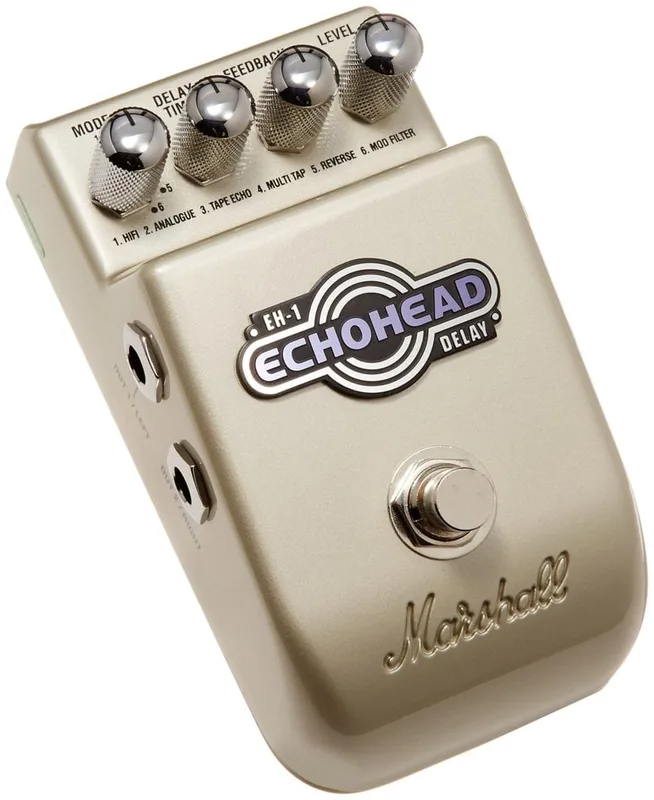
MusicRadar, reviewing the EH-1 Echohead from the same range, referred to "its sibling pedals the RF-1 reverb and RG-1 modulator," placing the RF-1 within that three-pedal family21.
Videos
Marshall
Ryan Lutton
Michael Brooks
Questions
Is the Marshall RF-1 Reflector analog or digital?
It is digital. Guitar World's 2007 review of Marshall's pedal range described the RF-1 and its siblings as digital stompboxes. The reverb algorithms are produced digitally, while the pedal's bypass circuitry is passive.
Is the Marshall RF-1 true bypass?
No. Guitar World described the RF-1 as using passive bypass circuitry rather than true bypass. Whether that matters on a pedalboard depends on the rest of the chain, but it is worth knowing when planning a large board with many pedals.
Can the RF-1 Reflector run on a battery?
Yes. The pedal has a nine-volt battery compartment, though Guitar World noted that a screwdriver or coin is required to open the battery door, which the reviewer found inconvenient.
Does the Marshall RF-1 work in stereo?
Yes. The RF-1 has dual output jacks and supports both mono and stereo operation, so it can feed a single amp or a stereo rig.
What reverb types does the RF-1 Reflector have?
Six: Hall, Plate, Room, two Spring simulations and a Reverse mode. Guitar World called the Reverse mode wildly unique in its review.
Sources (2)
- Marshall RG-1 Regenerator modulator, RF-1 Reflector reverb, EH-1 Echohead delay pedals, Guitar World, 2007-07-24
- Marshall EH-1 Echohead review, MusicRadar, 2007-12-12