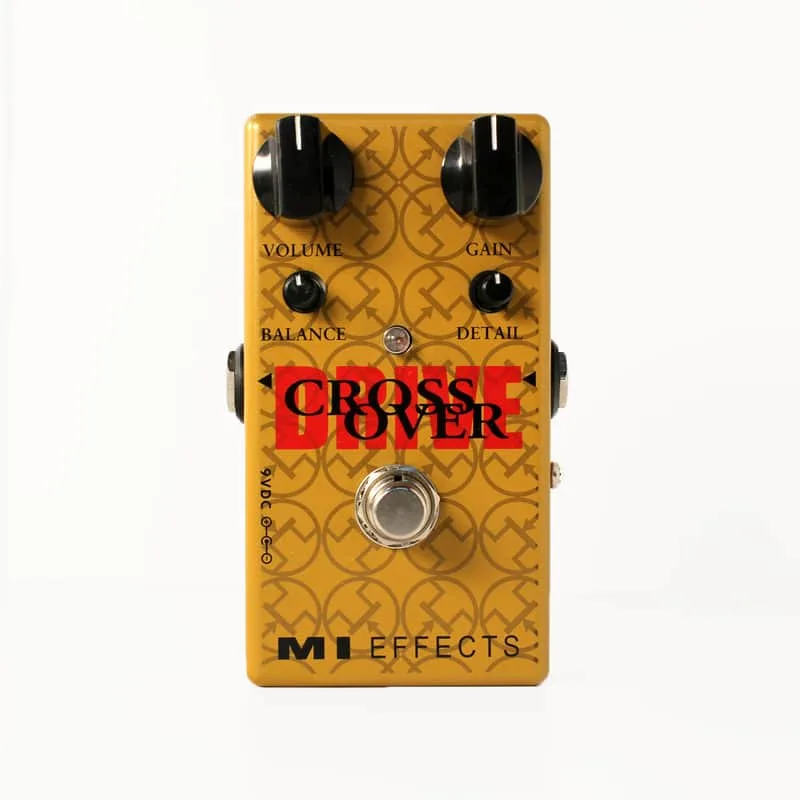



The MI Audio Cross Over Drive is an analog overdrive pedal built around four FET transistors, designed to capture the response and touch-sensitivity of an amp's organic overdrive1. Its name comes from what the Gain knob does: a single sweep moves the pedal from a clean boost, through overdrive and distortion, all the way into fuzz2. It was announced in June 2013 and released that August as a limited edition run of 250 pedals, because the transistors at its heart were in limited supply3. The pedal is currently listed as sold out on MI Audio's product page1.
The backbone of the circuit is four discontinued FET transistors4. MI Audio says its experience designing valve amplifiers informed the FET stage design, covering operating points, dynamic range, the scaling of clipping thresholds, output impedances, and intrinsic capacitances due to the Miller Effect5.
What it does to your sound
At its lowest gain setting, the Cross Over Drive works as a boost and enhancer, adding some extra sparkle to the guitar's natural tone2. Turning the Gain up a bit produces what MI Audio's Michael Ibrahim describes as "some nice, complex, tube-like overdrive" that still cleans up via the guitar's volume knob2. Higher still, and the pedal delivers "a smooth, harmonic-rich, sustaining lead sound from 70's rock to jazz-fusion"2. At the far end of the sweep, the drive reaches loose fuzz territory1.
The amount of drive is tied to picking attack, whether finger-picking or using a plectrum, which is what gives the pedal its touch-sensitive character3. Guitar Interactive's Jonathan Graham noted that the volume-knob clean-up "A/B's well against a standard clean"3.
The controls
The pedal keeps its panel simple: three knobs and a mode switch.
| Control | What it does |
|---|---|
| GAIN | Sweeps from boost to overdrive to distortion to fuzz; at the lowest settings it acts as a boost/enhancer12 |
| DETAIL | Provides the body of the overdrive tone; lower settings suit bright amplifiers, letting you find the right EQ spot12 |
| BALANCE | Blends in the amount of top-end harmonics, from a smooth, round lead sound to a tone that cuts through a mix13 |
| MODE | Selects Low, Standard or Tight mode1 |
MI Audio describes the two-knob EQ of Detail and Balance as helping maintain the full drive sound while allowing refinement of the top and bottom end1.
Low, Standard and Tight modes
The original pedal shipped with a single Standard (STD) mode. The current version adds two more modes, which MI Audio calls "triple the flexibility"1.
- LOW mode: focuses on the bluesier side of the pedal, with what the maker calls incredible touch dynamics and better volume sensitivity1.
- Standard mode: the original voice of the pedal1.
- TIGHT mode: a higher gain mode with a more pronounced upper-mid focus, aimed at more aggressive modern tones1.
Power and hardware
The Cross Over Drive runs on a 9V battery or a 9VDC power supply, but only through a 2.1mm jack with negative center polarity1. At 5mA of current draw it is light on a power supply1. The enclosure measures 2.2 by 4.3 inches (55.9mm x 109.2mm) with a durable powder coat and screen print finish, hand made in Sydney, Australia with a 5 year warranty1.
The pedal is sold out on MI Audio's product page1. It was built as a limited edition run of 250 units because the four FET transistors it uses are discontinued and were only available in limited supply34.
MI Effects or MI Audio?
When the pedal was first announced in June 2013, Delicious Audio and Guitar Interactive Magazine both credited it to MI Effects36. MI Audio's own product pages and video demo, and Premier Guitar's later press release, name MI Audio as the maker254. The coverage describes the same pedal either way: the same FET circuit, the same limited run of 250, and the same August 2013 availability23.
Where it came from
Videos
MI Audio
MI Audio
Rob Chapman
Questions
Is the MI Audio Cross Over Drive true bypass?
Yes. MI Audio specifies a heavy duty 3PDT footswitch with true bypass, so the pedal's FET circuit is completely out of the signal path when it is switched off. The pedal is currently listed as sold out on the maker's product page.
Can the Cross Over Drive run on a battery?
Yes. It runs on a 9V battery or a 9VDC power supply, but only through a 2.1mm jack with negative center polarity. Current draw is just 5mA, so a battery lasts a long time and the pedal is easy on a shared power supply.
Is the MI Effects Cross Over Drive the same pedal as the MI Audio one?
Yes. When the pedal was announced in June 2013, press coverage credited it to MI Effects, while MI Audio's own pages and later coverage name MI Audio. Both describe the same FET overdrive, its limited run of 250 units, and its August 2013 release.
Where is the Cross Over Drive made?
MI Audio states that each pedal is hand made in Sydney, Australia, and carries a 5 year warranty. The enclosure is a durable powder coat and screen print finish, sized 2.2 by 4.3 inches.
Sources (6)
- Store | MI Audio, MI Audio, 2020-04-11
- MI Audio Cross Over Drive Video Demo, MI Audio, 2013-06-25
- MI Effects Release Cross Over Drive Pedal Preview, Guitar Interactive Magazine, 2013-06-24
- MI Audio Releases Cross Over Drive, Premier Guitar, 2013-10-22
- MI Audio Releases Cross Over Drive and DIY Dual Drive OD Kit, Guitar Interactive Magazine, 2013-08-21
- Guitar Pedal News: MI Effects Cross Over Drive, Delicious Audio, 2013-06-20