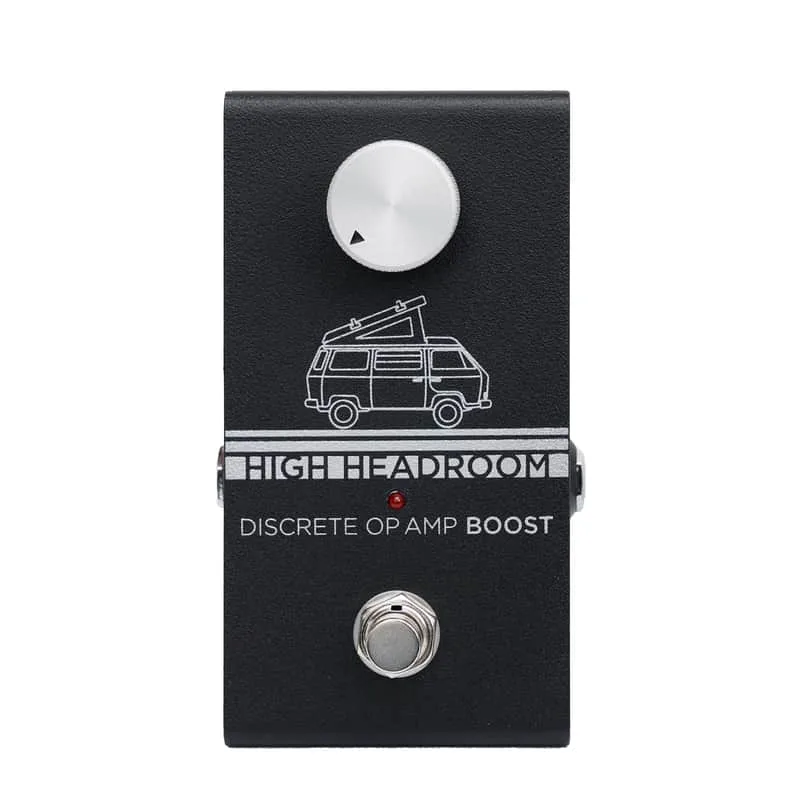


The Pop Top Boost is a one-knob clean boost pedal from Milkman Sound, built around a discrete op amp the maker designed to fit the standard 2520 footprint, the module format used in classic American recording consoles of the 1970s. Milkman says the pedal delivers 30dB of high headroom gain boost and can also serve as a unity gain buffer or line driver. RockBoard's PedalPedia lists the circuit type as analog1.
As of 26 October 2026, the pedal is listed as a pre order item on the Milkman Sound site: "Select a purchase option to pre order this product"2.
The boost level control
The Pop Top Boost has a single control, and it is designed around unity gain. Milkman states: "We designed the Pop Top to run at 'unity gain' with the control set at zero"2. In practice that means the pedal leaves your level untouched with the knob at zero, and turning it up adds up to 30dB of clean gain on top.
| Control | What it does |
|---|---|
| Boost level | Sets the amount of boost; at zero the pedal runs at unity gain, turning it up adds up to 30dB of gain2 |
Paolo De Gregorio, writing at Delicious Audio in January 2023, described the pedal as "a high-headroom discrete OpAmp device based on the circuit of the classic American recording consoles of the 1970s"3.
Headroom and power
The pedal's defining specification is its internal voltage. Milkman says the Pop Top "takes power from a common 9V center negative pedal power supply and converts it to 36V of internal headroom," drawing 110mA2. That converted headroom is what the maker points to when explaining why the boost stays clean: the pedal "can enhance the subtle details of the source in the same way that a microphone preamp in a classic American recording console" does, according to the maker's product page2.
Because it draws 110mA at 9V, the Pop Top Boost needs more current than many simple boost circuits, so it is worth checking what your power supply delivers on each output before adding it to a board2.
Specifications
| Specification | Value |
|---|---|
| Circuit type | Analog1 |
| Gain | 30dB high headroom boost2 |
| Circuit core | Discrete op amp, standard 2520 footprint2 |
| Power | 9V DC center negative, 110mA2 |
| Internal headroom | 36V, converted from the 9V input2 |
| Connections | 1/4" phone connectors, for guitar or any other instrument2 |
| Enclosure | 4-3/4" x 2-1/2" x 1-1/2"2 |
| Weight | .75lb2 |
What it does for a player
Milkman Sound positions the pedal as more than a straight boost. According to the maker's product page, it can fill three roles on a board2:
- A clean boost of up to 30dB of high headroom gain
- A unity gain buffer
- A line driver
The maker ties all three to the same design choice: the discrete op amp built to the 2520 footprint and the 36V of internal headroom converted from a standard 9V supply2.
Price and availability
Delicious Audio's January 2023 write-up noted that the pedal costs "well over $200 USD," with the writer observing that "One-knob pedals that costs well over $200 might seem like a hard sell"3. The pedal is currently offered as a pre order on Milkman Sound's site2.
Videos
AndyDemos
R.J. Ronquillo
JayLeonardJ
Questions
How much gain does the Milkman Pop Top Boost add?
Milkman Sound specifies 30dB of high headroom gain boost. The pedal is designed to run at unity gain with its single boost level control set at zero, so turning the control up adds clean gain on top of your signal without changing the level when the knob is down.
Can the Pop Top Boost be used as a buffer?
Yes. Milkman Sound describes the pedal as usable as a unity gain buffer or line driver, thanks to what the maker calls an unusually large amount of headroom. Set the control at zero and it passes your signal at the same level while driving longer cable runs.
What power supply does the Milkman Pop Top Boost need?
It takes power from a common 9V DC center negative pedal power supply and draws 110mA. Internally, the pedal converts that 9V input to 36V of headroom, which is why Milkman says it stays clean at high boost levels.
Is the Milkman Pop Top Boost analog?
Yes. RockBoard's PedalPedia lists the circuit type as analog, and Milkman Sound describes it as a discrete op amp design that fits the standard 2520 footprint, based on the circuit of classic American recording consoles of the 1970s.
How big is the Milkman Pop Top Boost?
Milkman Sound lists the enclosure at 4-3/4" x 2-1/2" x 1-1/2" and a weight of .75lb. It is larger than a typical compact pedal, which the maker ties to its modern pedal enclosure design around the discrete op amp.
Sources (3)
- Pop Top Boost by Milkman Sound, RockBoard PedalPedia, 2026
- Pop Top Boost, Milkman Sound
- Milkman Sound Pop Top Boost, Delicious Audio, 2023-01-03