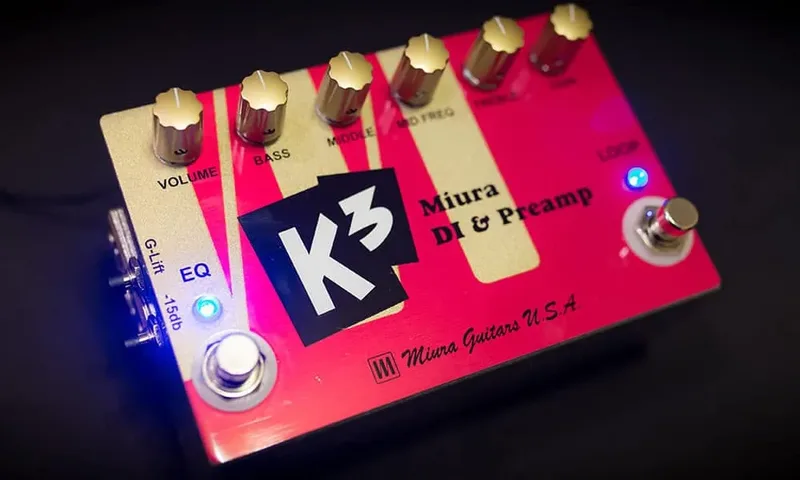


The Miura Guitars USA, Inc. K3 DI & Preamp is a preamp and DI pedal for bassists, launched in August 2018 as the company's second pedal offering dedicated to bass players. It puts the circuit of the company's onboard K3 bass preamp into an external pedal, adding a transformer-coupled DI output and an effects loop, so a bass can feed an amplifier and a mixing desk from one box.1
Where it came from
Hiro Miura, founder of Miura Guitars USA, Inc., explained the idea behind the pedal: "Many players love the sound of our onboard K3 bass preamp so we designed and built the K3 DI & Preamp as an external ped[al]."1 In other words, it is the same preamp that ships built into instruments, repackaged so a player can carry it to any gig or session.
The DI stage is a point of difference the maker stresses. "Since our DI uses a full-scale EDCOR transformer, it can not be compared to a simplified DI," the company said.1 A full-scale transformer DI is a larger, more complete implementation than the simplified output stages found on some pedals, which matters to players who record straight into a desk.
Controls and connections
The pedal keeps its control set small and direct:
| Control or jack | What it does |
|---|---|
| VOLUME | Controls the volume of OUT and DI OUT1 |
| LOOP (effect loop switch) | The signal connected to the loop IN/OUT can be switched ON/OFF1 |
| LINE IN | ¼" input1 |
| LINE OUT | ¼" output1 |
| DI OUT | XLR output1 |
The effects loop sits between the input and the outputs, so a player can place another pedal, such as a compressor or an overdrive, after the preamp stage and switch it in and out with the LOOP switch.1
Power
The K3 DI & Preamp runs on DC 9V, drawing over 150mA, with center minus polarity.1
With a draw of over 150mA, the pedal needs a 9V supply output rated above that figure. A low-current daisy-chain output may not run it reliably.
What reviewers said
Bass Musician Magazine's review, by John Kuhlman with Hiro Miura, found the pedal transparent in use: it "shares a common trait with its predecessor: it adds little, to no, color to your natural tone." The reviewer summed up the experience this way: "In short, you plug and play while enjoying a crisp, bright, and sligh[tly more musical sound]."1
The same review described the build and look: "The K3 is a ruggedly-built pedal featuring bright pink and gold graphics."1
Availability
At the time of the August 2018 review, the pedal was in limited production, with a suggested retail price of $379.99.1
Videos
BassgosuShop
Frets No Frets
Questions
What power supply does the Miura K3 DI & Preamp need?
The K3 DI & Preamp runs on a DC 9V supply drawing over 150mA, with center minus polarity. Because of the current draw, a supply rated to deliver more than 150mA on that output is the safe choice, and a daisy chain shared with several other pedals may not be enough.
Is the Miura K3 DI & Preamp polarity center negative?
Yes. The pedal's power requirement is given as DC 9V, over 150mA, center minus, which is the same center-negative convention used by most modern pedal supplies.
Does the Miura K3 DI & Preamp have an XLR output?
Yes. The pedal has two outputs: a LINE OUT on a quarter-inch jack and a DI OUT on XLR, so it can feed an amplifier and a mixing desk or audio interface at the same time.
Does the Miura K3 DI & Preamp have an effects loop?
Yes. The K3 DI & Preamp has an effect loop IN/OUT, and the signal connected to that loop can be switched on or off with the LOOP effect loop switch.
Is the Miura K3 DI & Preamp the same as the onboard K3 preamp?
It is an external pedal version of the same circuit. Hiro Miura said the company designed and built the K3 DI & Preamp as an external pedal because many players love the sound of the onboard K3 bass preamp.
Is the Miura K3 DI & Preamp still in production?
At the time of its 2018 review, the pedal was in limited production. Check with the maker or dealers for current availability.
Sources (1)
- Review - Miura K3 DI & Preamp - Bass Musician Magazine, The Face of Bass, Bass Musician Magazine, 2018-08-20