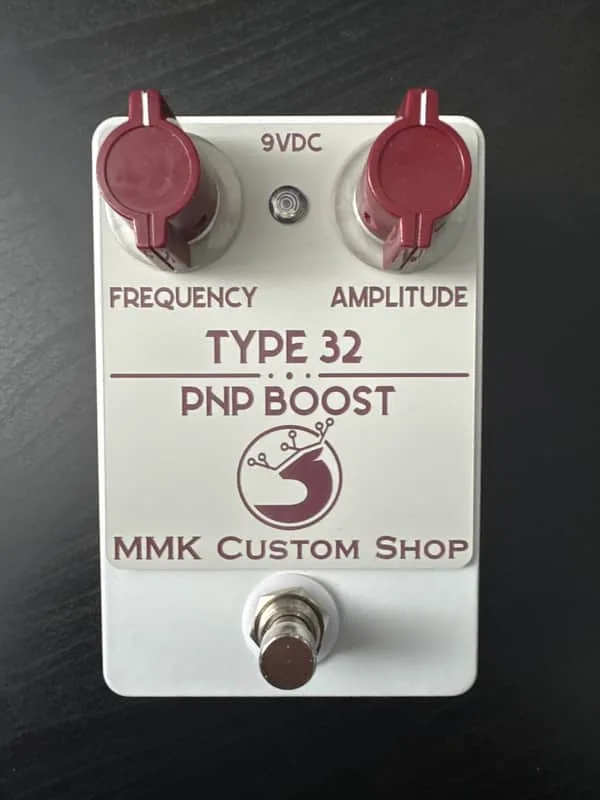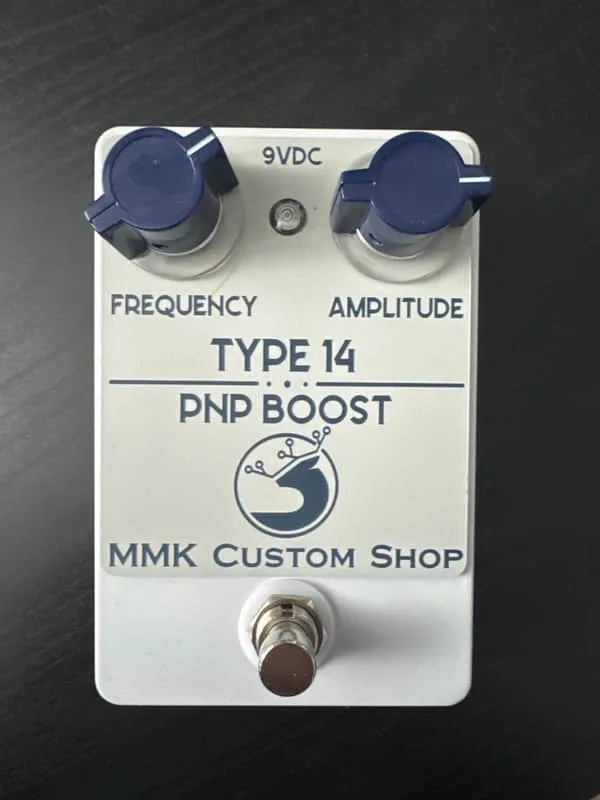


The MMK Electrics Custom Shop PNP Boost Type 14 is a boost pedal inspired by the Rangemaster Treble Booster, the classic one-knob treble booster that players have imitated for decades1. It sits in MMK Electrics' Custom Shop PNP Boost line alongside the Type 32, and the two share the same circuit idea: a single-stage boost that pushes the front end of an amp harder, with an emphasis on the upper frequencies that help a dark amp cut through.
What separates the Type 14 from its sibling is the transistor. The Type 14 is built with NOS Element #14 silicon transistors, where the Type 32 uses Element #32 germanium transistors1. For a player weighing the two, that is the whole decision in one line: same Rangemaster-style circuit, different semiconductor.
Where the circuit comes from
The Rangemaster family is also where the "PNP" in this pedal's name comes from. Jack Orman's AMZ technical write-up notes that the positive-supply technique he describes "may even be adapted for other designs that use pnp transistors (like the Rangemaster)"2. PNP transistors, germanium ones especially, were the standard parts in these old circuits, and a builder working in that tradition has to handle their reversed supply polarity. MMK Electrics' Custom Shop line keeps the PNP topology and the Rangemaster inspiration while offering a silicon option in the Type 14.
Standard and Low-Gain versions
Each Type 14 is available in two configurations: Standard or Low-Gain1. The difference comes down to which transistors MMK Electrics selects and how much gain they produce.
| Configuration | Transistors | Beta (gain) |
|---|---|---|
| Standard Gain | Low leakage transistors | 70 to 100 hFE1 |
| Low Gain | Metal can low leakage transistors | 30 to 60 hFE1 |
Pedal of the Day's reviewer found the two options serve different jobs:
"The lower gain option is really great for a first gain stage in your signal chain, but don't be misled, there is plenty of boost to breakup the front end if need be"
In other words, the Low Gain version is not a weak pedal. It is built to sit early in a chain and add a moderate push, but it still has enough output to drive an amp into breakup when you want it. The Standard Gain version, with its higher-beta transistors, is the hotter of the two1.
Both configurations are biased from two points in the circuit, which MMK Electrics does for reliability and what Pedal of the Day calls "best possible function"1. For a player, that means the transistor is held at a stable operating point rather than a single, more fragile one, a practical concern in a hand-built boost where individual NOS transistors vary.
Silicon versus germanium in this line
The Type 14's silicon transistors set it apart from both the original Rangemaster and the Type 32. Germanium parts, like the OC44s in the JMI Rangemaster3, are prized for their character but are temperature-sensitive and increasingly scarce. Silicon is more stable and more consistent from unit to unit. Within MMK Electrics' own line, the choice is straightforward: the Type 14 is the silicon take on the circuit and the Type 32 is the germanium take1.
Where to get one
As of Pedal of the Day's June 2024 coverage, the Type 14 was available from the MMK Electrics website custom shop, along with the Type 321. Pricing was not published in that coverage, so the maker's site is the place to look for current cost and availability.
Videos
Pedal of the Day
Pair of Pandas
Questions
What is the MMK Electrics PNP Boost Type 14 based on?
It is a boost pedal inspired by the Dallas Rangemaster Treble Booster, the classic one-knob treble booster circuit. MMK Electrics builds its Custom Shop PNP Boost line around that design, with the Type 14 using silicon transistors rather than the germanium parts of the original.
What is the difference between the Standard and Low-Gain versions?
The Standard Gain option uses low leakage transistors with a beta of 70 to 100 hFE, while the Low Gain option uses metal can low leakage transistors with a beta of 30 to 60 hFE. The Low Gain version suits a first gain stage in a signal chain, though it still has enough boost to push an amp's front end into breakup.
What transistors does the Type 14 use?
The Type 14 is built with NOS Element #14 silicon transistors. In the Standard Gain configuration these are low leakage transistors with a beta of 70 to 100 hFE; the Low Gain configuration uses metal can low leakage transistors with a beta of 30 to 60 hFE.
Is the Type 14 a germanium or silicon boost?
It is a silicon boost. The Type 14 uses NOS Element #14 silicon transistors. Its sibling, the Type 32, is the germanium version of the same circuit, built with Element #32 germanium transistors.
Where can the Type 14 be bought?
As of the June 2024 coverage by Pedal of the Day, the Type 14 was available through the MMK Electrics website custom shop, alongside the Type 32. Check the maker's site for current availability and pricing.
Sources (3)
- MMK Electrics Custom Shop PNP Boost Type 14 & 32, Pedal of the Day, 2024-06-11
- Positive Power for the PNP Fuzzface, AMZ Guitar Effects Blog (muzique.com), 2002-03
- TONEHOME, TONEHOME