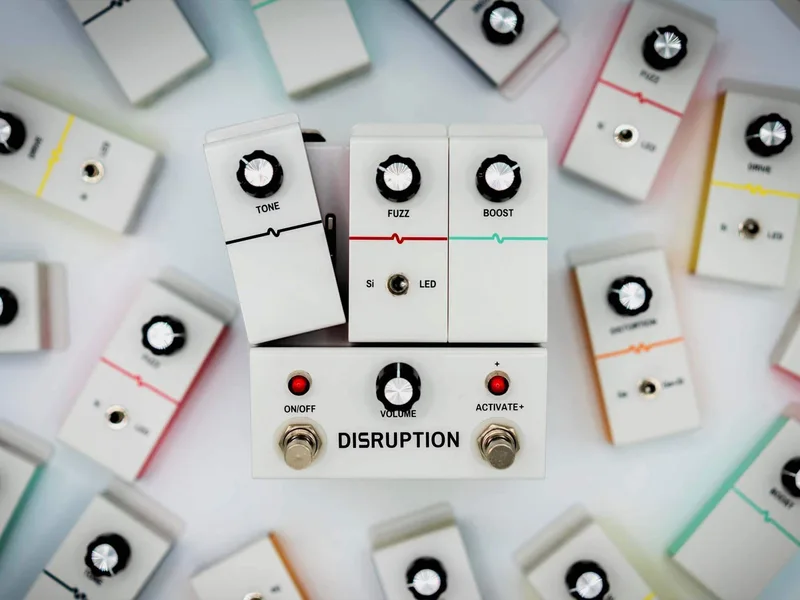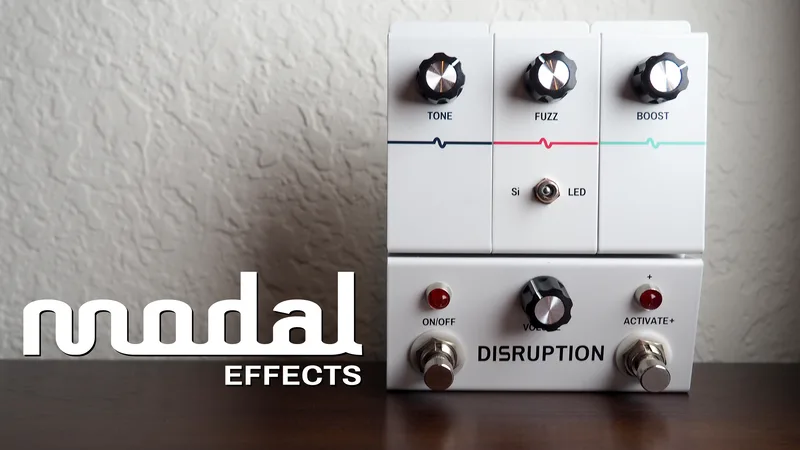


The Modal Effects modular distortion is a distortion pedal built as one base unit with six interchangeable mods that snap on and off. The idea comes from Modal Effects, the company founded by Jeremy Leff and Dallas Condra, who unveiled the format at NAMM in 20181. Instead of buying separate pedals for each kind of dirt, the base unit carries three effects slots, and you place the mods you want in them, connecting through specially designed magnets on the bottom of each module2.
What it does to your signal
The six mods split into four dirt mods and two tone mods. The dirt mods give you fuzz, boost, drive and distortion all in one unit2, and because the base has three slots you can run several of them in whatever order you place them. That order is the point of the design: Leff and Condra were inspired by pedals like the Angry Driver, which came from experimenting with effect order in the chain1.
The mods, as described by the maker:
- Fuzz: a classic fuzz with a balance of crunch and rich, full sustain1
- Boost: a clean boost with warm sustain, for pushing the guitar signal1
- Overdrive: a clean-sounding overdrive with boosted mids, reminiscent of the Tube Screamer1
- Distortion: an iconic '70s metal distortion with a harmonically rich, compressed sound1
- Mid-scoop Tone: low-pass and high-pass filters combined to create a mid boost effect1
- Low-pass Tone: a versatile low-pass filter that works well with all of the mod combinations1
The pedal is fully analog, despite its complexity1. The On/Off switch works as a bypass for the entire unit2.
For a sense of where this sits among single-purpose dirt boxes, see Distortion Pedals, Overdrive Pedals, Fuzz Pedals and Boost Pedals.
Where it came from
The concept grew out of Jeremy and Dallas experimenting with the order of effects in their chain, and they were inspired by pedals like the Angry Driver1. The idea behind the Modal Effects Disruption is that the character of the distortion can be changed by swapping modules: a Fuzz mod described as a classic fuzz with a great balance of crunch and rich, full sustain, an Overdrive mod with boosted mids reminiscent of the Tube Screamer, and a Boost mod, a clean boost with warm sustain for pushing the guitar signal1.
Who uses it
JHS Pedals names slide guitar player Robert Randolph, of Robert Randolph and the Family Band, who says the Modal Effects distortion is a staple on his board1.
Videos
R.J. Ronquillo
shnobel
Pedal of the Day
Questions
Is the Modal Effects modular distortion fully analog?
Yes. JHS Pedals' news post on the format states that the pedal is fully analog despite its complexity. The mods snap onto the base unit magnetically and the whole signal path runs analog, so there is no digital conversion anywhere in the chain.
How many mods come with the Modal Effects modular distortion?
Six. The format is one base unit with six interchangeable mods: a Fuzz mod, a Boost mod, an Overdrive mod, a Distortion mod, a Mid-scoop Tone mod and a Low-pass Tone mod. The dirt mods cover fuzz, boost, drive and distortion in one unit.
How do the mods attach to the base unit?
The mods attach to the base magnetically. The base has three effects slots, and each module connects through specially designed magnets on the bottom of the module, so swapping a mod is a matter of pulling one off and snapping another into place.
What is the difference between the two Tone mods?
The Mid-scoop Tone mod combines low-pass and high-pass filters to create a mid boost effect. The Low-pass Tone mod is a versatile low-pass filter that, according to the maker, works well with all of the mod combinations. One shapes the mids upward, the other rolls off highs.
When was the Modal Effects modular distortion unveiled?
Jeremy Leff and Dallas Condra unveiled the Modal Effects modular distortion at NAMM in 2018. That same year, their PedalCreator design took second place in the Georgia Tech InVenture Prize.
Who uses the Modal Effects modular distortion?
Slide guitarist Robert Randolph, of Robert Randolph and the Family Band, is named by JHS Pedals as a player who says the Modal Effects distortion is a staple on his board.
Sources (2)
- MODAL EFFECTS: A NEW PEDAL FORMAT, JHS Pedals, 2018
- Modal Effects Disruption Modular Gain, Pedal of the Day, 2021-11-07