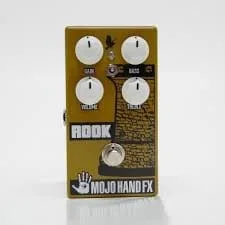



The Mojo Hand FX Rook is a boutique overdrive pedal first released in 20111. Mojo Hand FX describes it as "a classic overdrive paired with a powerful EQ section"2, and the part that sets it apart from most small overdrives is that EQ: a two-band Baxandall circuit rather than the single tone knob found on many drives2. The current version sold as the Kensrue Rook is the signature overdrive of Dustin Kensrue2, and it lists at $159.992.
The original Rook Overdrive made a name for itself quickly. Mojo Hand FX says it has been "hailed as the 'New Standard of Boutique Overdrives'"1, and it was named "Pedal of the Year" by What's That Dude Play3. It has shown up on the boards and on record with players including Brad Whitford of Aerosmith, Ty Tabor of King's X, Andy Timmons, Mark Tremonti and Myles Kennedy of Alter Bridge, Audley Freed, Mato Nanji, Marlon Young, Mike Zito and Lance Lopez13.
The controls
The Kensrue Rook keeps things to four knobs and a toggle. Volume and Treble sit alongside Bass, and the two EQ knobs are where the pedal earns its reputation. Because the Baxandall circuit lets each band be cut or boosted independently, the Rook works less like a tone knob that rolls off highs and more like a small EQ built into the drive2.
| Control | What it does |
|---|---|
| Volume | Sets the output level2 |
| Treble | Cuts or boosts the high band of the Baxandall EQ2 |
| Bass | Cuts or boosts the low band of the Baxandall EQ2 |
| 3-way toggle | Selects the clipping mode: silicon, none, or LED2 |
The interaction between the two EQ knobs is the practical payoff. Mojo Hand FX says that with both Bass and Treble rolled down you get a midrange hump, and with both up you get a mid scoop2. That means one pedal can be voiced toward a mid-forward push for cutting through a band, or toward a scooped shape for a bigger, rounder feel, without touching the gain knob.
On the gain side, the maker's own comparison point is a familiar one:
"Even with the gain dimed, the Rook maintains astonishing note articulation and chord clarity, (think a highly tweakable Tube Scre@mer)."
Mojo Hand FX also calls the Rook "one of the most stack friendly drives on the market," saying it pairs well stacked with other overdrives, fuzzes or muffs and can make the pedals around it sound better2. Players who run multiple drives into each other, the way many overdrive users do with a Tube Screamer-style pedal, will recognize what that claim is aiming at.
Three clipping modes: silicon, LED and none
The three-way toggle is the Rook's other big trick, because it changes the character of the drive rather than just its amount. Overdrive pedals clip the signal with diodes to create their grit, and the choice of diode, or no diode at all, changes how hard and how compressed that grit feels.
- Toggle up, silicon diode clipping. Mojo Hand FX describes this as "classic overdrive" tones, "filled with rich 'harmonicy' goodness"2. Silicon diodes are the same type used in many classic overdrive circuits, and this is the Rook's most conventional setting.
- Toggle down, LED clipping. The maker describes this as "a raw and edgy, almost distortion type drive"2. LEDs have a higher forward voltage than silicon diodes, which lets more signal through before clipping kicks in, and here that translates to a harder-edged voice that leans toward distortion.
- Toggle middle, no clipping diodes. This removes the diodes from the circuit entirely, for "a louder, cleaner, less compressed sound"2. In this position the EQ controls become more pronounced, and Mojo Hand FX says the pedal can be used as "an excellent tone shaping boost"2.
That middle position is worth dwelling on for a moment. A diode-free overdrive with a Baxandall EQ is effectively a two-band boost with gain available, which is a different tool from a fixed-voice clean boost. It is the setting that makes the Rook double as an EQ pedal in front of an amp or another drive.
Versions and editions
The Rook has appeared in several forms since 2011.
| Version | What it is | Price as listed |
|---|---|---|
| Rook Overdrive | The original classic overdrive, released 20111 | $159.004 |
| Kensrue Rook | Dustin Kensrue's signature edition of the Rook2 | $159.992 |
| Seafoam Pearl Kensrue Rook | Numbered run of 50 finished in Seafoam Pearl2 | Limited edition |
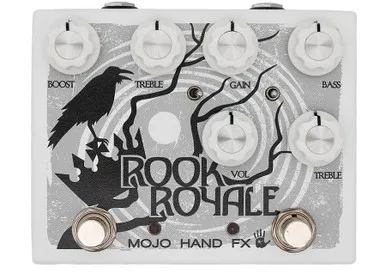
| Rook Royale | Enhanced version pairing the Rook with a boost side35 | $215.005 |
The Seafoam Pearl run is the collectible of the family: a numbered edition of 50 pedals in that finish2. The Rook Royale, announced in March 2013, is the feature expansion. Premier Guitar reported it as "an enhanced version of their Rook overdrive entitled the Rook Royale"3, and it carries the Rook circuit on the right side with Mojo Hand FX's Speakeasy boost on the left1. At launch its street price was $229.953, against the current list of $215.005.
The Royale is also hungrier for power: it draws about 30mA1, five times the Kensrue Rook's ~6mA2. Both are true bypass21. Neither figure is demanding by modern standards, but the difference matters if you are budgeting a compact power supply across a full board.
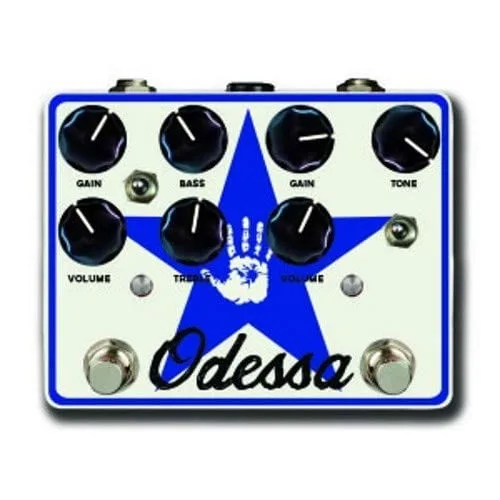
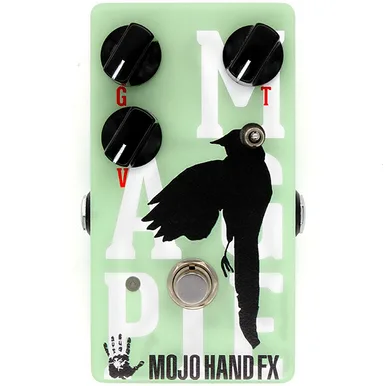
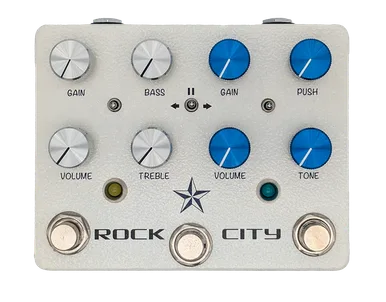
Mojo Hand FX has continued to build the Rook circuit into other pedals. The company's Odessa dual overdrive pairs "our award winning Rook on the left side, as well as our lower gain Magpie on the right side"4, and the Rock City dual overdrive developed from the discontinued Odessa carries the idea further4. Players comparing the family can look at the Rook Royale, the Magpie and the Rock City as the Rook's closest relatives in the lineup.
The Kensrue Rook runs on a standard center negative 9V DC supply or a 9V battery, but neither is included with the pedal2. If you plan to power it from a supply, check that your daisy chain or isolated outputs can spare its ~6mA draw2.
Videos
Lindsay Ell
Mike Hermans
Prymaxe
Questions
Is the Mojo Hand Kensrue Rook true bypass?
Yes. Mojo Hand FX lists the Kensrue Rook as a true bypass pedal, so with the effect switched off your signal passes through without the circuit coloring it. The related Rook Royale is also listed as true bypass.
Can the Kensrue Rook be used as a clean boost?
Yes. Setting the clipping toggle to the middle position removes the clipping diodes entirely, which gives a louder, cleaner, less compressed sound. Mojo Hand FX says the EQ controls also become more pronounced in this mode, making the pedal usable as a tone shaping boost.
How much current does the Kensrue Rook draw?
Mojo Hand FX lists the current draw at approximately 6mA. It runs on a standard center negative 9V DC supply or a 9V battery, neither of which is included with the pedal. The Rook Royale draws more, at approximately 30mA.
What was the Seafoam Pearl Kensrue Rook?
It was a limited edition of the Kensrue Rook, Dustin Kensrue's signature overdrive. Mojo Hand FX completed a numbered run of 50 pedals finished in a Seafoam Pearl color, making it a collectible version of the standard pedal.
What does the voicing switch on the Rook do?
The three-way toggle on the Kensrue Rook selects the clipping character. Up gives silicon diode clipping for classic overdrive tones, down gives LED clipping for a rawer, edgier almost-distortion drive, and the middle position removes the clipping diodes for a cleaner, louder, less compressed sound.
What is the difference between the Rook and the Rook Royale?
The Rook is a single overdrive pedal. The Rook Royale, announced in 2013, is an enhanced version that adds a boost side, pairing the Rook overdrive with Mojo Hand FX's Speakeasy boost in one enclosure. The Royale draws about 30mA versus the Rook's 6mA and lists at $215.00.
Sources (5)
- Rook Royale, MojoHandFX
- Kensrue Rook, Mojo Hand FX
- Mojo Hand FX Launches Rook Royale Overdrive/Preamp, Premier Guitar, 2013-03-13
- Odessa - MojoHandFX, MojoHandFX
- Speakeasy, Mojo Hand FX
 Brad Whitford