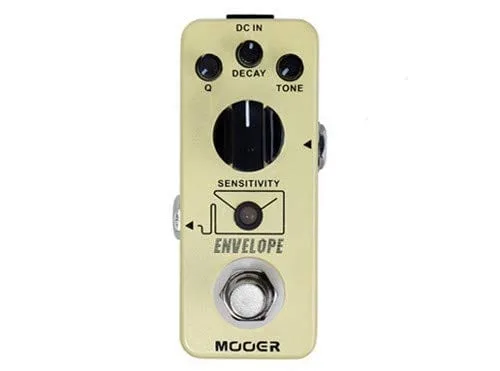


The Mooer Envelope is a pocket sized envelope filter, or dynamic auto wah, made by Mooer Audio. Instead of sweeping a filter with your foot the way a traditional wah pedal does, it uses an envelope follower that reads the level of your signal: play harder and the filter opens up, play softer and it closes down. The result is an automatic wah that responds to your picking dynamics in real time1.
Mooer says the 100% analog circuit provides a lush warm sound, and that the wide range of the controls makes the pedal ideal for use with both guitar and bass1. Gearnews' buying guide describes it as a compact auto wah that "packs plenty of character, from subtle quack to funky, vocal-like sweeps"2.
What an envelope filter does
An envelope filter is a sweepable filter, usually band pass or low pass, whose cutoff frequency is driven by the volume envelope of your own playing rather than by a foot pedal or an LFO. A hard pick attack produces a big envelope, so the filter sweeps high; a soft attack keeps it low. That is why the effect is often called a dynamic auto wah: it is the funk "quack" sound associated with players who dig in hard, without any footwork.
Mooer's product page says the pedal covers a wide range of territory, from exaggerated slap back funk and subtle sultry ambience to static frequency filter effects1. That last one is worth noting: with the Sensitivity control at 0 the pedal stops responding to your attack and works as a fixed filter whose frequency you set with the Tone knob1.
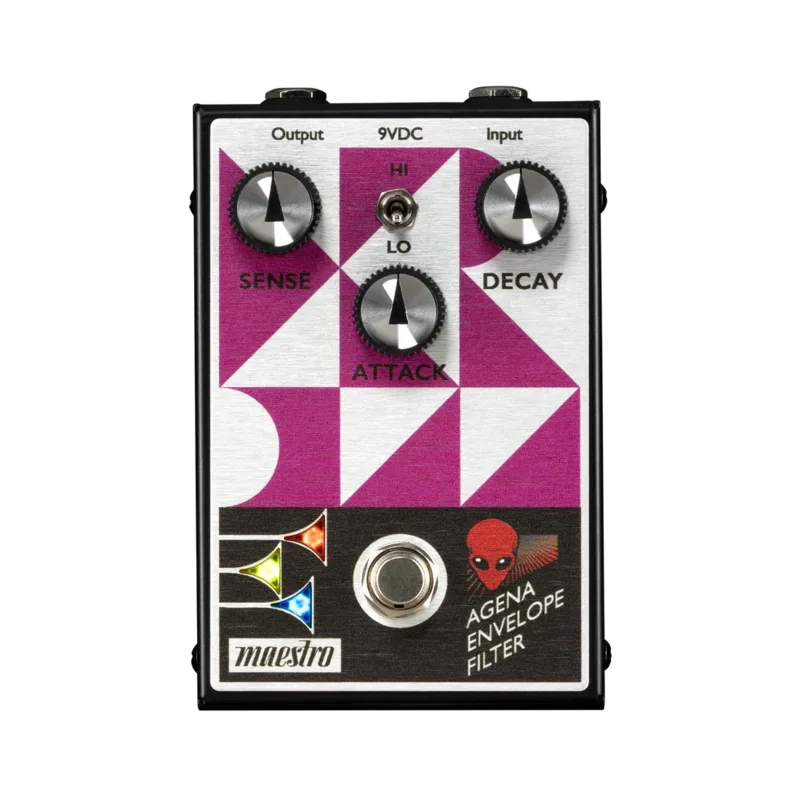
The envelope filter as a category goes back to classic units like the Mu-Tron, whose Beigel Sound Lab reissue still carries the same control vocabulary, including a DECAY knob that adjusts the decay time of the envelope follower4. The Mooer Envelope follows that same basic layout in a much smaller box.
The controls: Sensitivity, Q, Decay and Tone
The pedal has four knobs. Gearnews sums them up as controls for Sensitivity, Q, Decay and Tone that let you fine tune its dynamic response and sweep2.
| Control | What it does |
|---|---|
| Sensitivity | Sets how the filter reacts to your pick attack and the output level of your instrument3 |
| Q | Changes the Q of the wah effect. Clockwise gives a higher Q, a narrower frequency band and a higher peak; counterclockwise gives a wider band and lower peak1 |
| Decay | Adjusts the release and closing of the filter. Clockwise gives a longer decay, counterclockwise a shorter decay1 |
| Tone | Adjusts the overall tone and frequency range. Clockwise is brighter with a higher frequency range; counterclockwise is rounder and lower, which Mooer calls perfect for bass guitar1 |
Sensitivity is the main control to understand first. It determines how much signal it takes to trigger the sweep, so it needs to be matched to your instrument's output level and how hard you play3. Q then shapes the character of the sweep: a high, narrow Q gives that vocal, honking funk peak, while a low Q sounds more like a gentle tonal shift1. Decay sets how quickly the filter falls back after each note1.
Using it with bass
Mooer states that the Envelope is ideal for use with both guitar and bass1, and Gearnews describes it as a compact auto wah designed for both instruments2. For bass players, the relevant control is Tone: turned counterclockwise it shifts the effect into a rounder, lower frequency range that the maker says is perfect for bass guitar1.
This is worth comparing with pedals built specifically for bass. The MXR Bass Envelope Filter is an analog envelope filter designed specifically for bass, with separate Dry and Effect level controls so you can blend in your direct signal and, in Dunlop's words, "bring the funk without losing the low end"5. The DOD FX25B takes a similar approach with a blend control that its listing says makes it equally responsive to guitar and bass6. The Mooer Envelope has no dry blend, so bass players who need their fundamental untouched may prefer a pedal with that feature, while players who want the whole signal filtered will find the Mooer's low Tone setting does the job in a much smaller enclosure.
Power and size
The Mooer Envelope runs on a 9V DC center negative AC adapter only. There is no battery option, and Mooer recommends its own Micro Power supply1.
Current draw is 20mA1, light enough for any isolated power supply or even a daisy chain with other center negative pedals. At 93.5mm deep, 42mm wide and 52mm high1, the pedal takes up roughly the footprint of two effects in Mooer's micro series, which is the whole point of the design: a full envelope filter that fits in the gaps on a crowded pedalboard.
How it compares
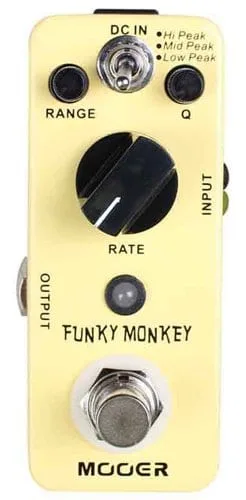
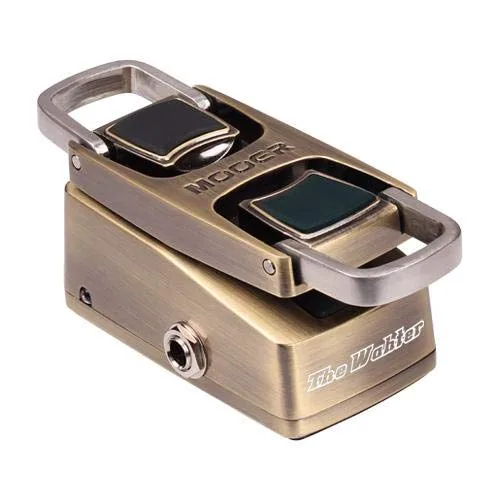
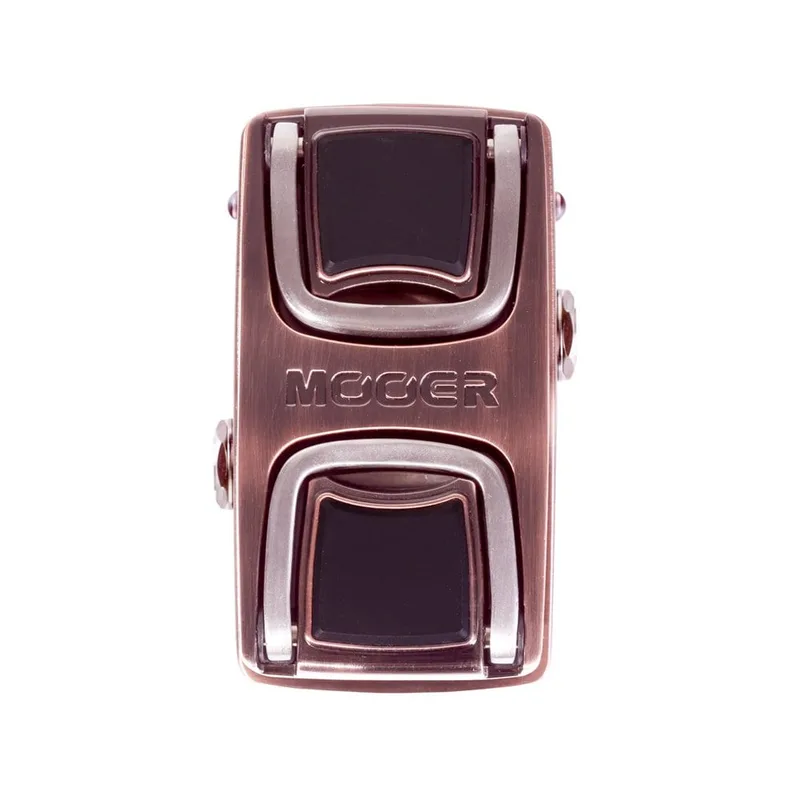
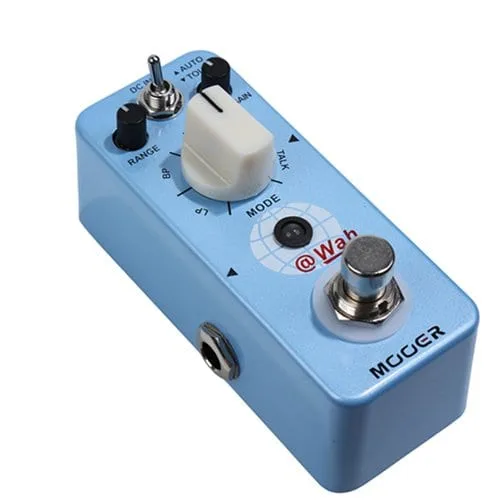
Against other envelope filters, the Mooer's pitch is size and simplicity. Four knobs and true bypass3 against the Mu-Tron-style control sets that include mode switches and sweep characteristics27, or bass specific units with dry blends27. Gearnews noted it selling for $58 USD as of August 20252, which positions it well below most full size analog envelope filters. Players comparing it within Mooer's own wah line, which includes units like the Mooer Funky Monkey and the MOOER The Wahter, should note that those are conventional wahs controlled with your foot, while the Envelope is triggered entirely by your playing dynamics1.
Videos
MOOER Audio
Pertybass
Frankie South
Questions
Is the Mooer Envelope analog or digital?
Analog. Mooer describes the Envelope as a 100% analog circuit, which the company says gives it a lush, warm sound. The pedal is a dynamic auto wah, meaning an envelope follower tracks the level of your playing and opens and closes a filter in response, all in the analog domain.
Does the Mooer Envelope work with bass?
Yes. Mooer says the wide range of the controls makes the Envelope ideal for use with both guitar and bass, and the Tone control turned counterclockwise gives a rounder tone and lower frequency range that the maker calls perfect for bass guitar. Gearnews likewise describes it as a compact auto wah designed for both instruments.
Can the Mooer Envelope run on a battery?
No. The maker lists its power requirement as a 9V DC center negative AC adapter only, with no battery option, and recommends the Mooer Micro Power supply. Current draw is 20mA, so it is easy on a pedalboard power supply.
How big is the Mooer Envelope?
It measures 93.5mm deep by 42mm wide by 52mm high, one of Mooer's pocket-sized micro-series enclosures. That is small enough to fit several of them in the space a single standard-size wah pedal would occupy.
Sources (7)
- Envelope_MOOER Audio, MOOER Audio
- The Best Wah Wah Pedals for Iconic Guitar Tones: Cry Baby and Beyond, gearnews.com, 2025-08-18
- Mooer_Micro_Series_Envelope__Wah__Liquid_und_Micro_Drummer-_Test_by_gitarrebass_(DE).pdf, gitarrebass (via cdn.rockboard.de)
- Beigel Sound Lab, Musitronics Mu-Tron (mu-tron.com)
- MXR® BASS ENVELOPE FILTER, Jim Dunlop (jimdunlop.com)
- FX25B Envelope Filter by DOD, RockBoard PedalPedia, 2026
- Mooer_Micro_Series_Envelope__Wah__Liquid_und_Micro_Drummer-_Test_by_gitarrebass_(DE).pdf.pdf), gitarrebass (via cdn.rockboard.de), 2017-09-11