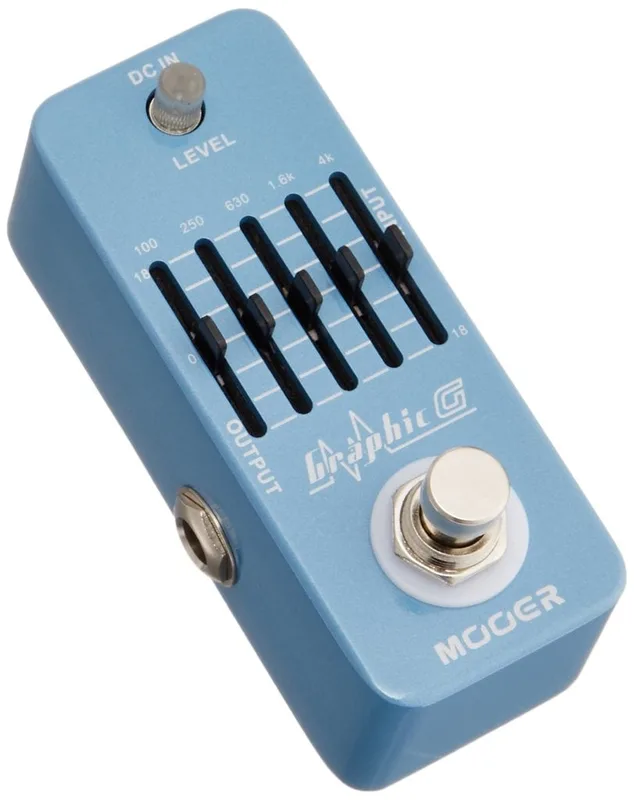


The Mooer Graphic G is a five-band graphic EQ pedal from Mooer Audio, built into the company's micro-pedal enclosure. Mooer describes it as a "5-Band Graphic EQ with master level control" and claims it is the "smallest guitar graphic equalizer pedal in the world"1. Five sliders shape the frequency response of your signal, and a master level control sets the overall output, so you can use it to correct a room, sculpt an amp's voicing, or push the front of an overdrive or distortion pedal.
What it does: a five-band guitar EQ
A graphic equalizer gives you a row of fixed-frequency sliders, each cutting or boosting its band. On the Graphic G those bands are centered at 100Hz, 250Hz, 630Hz, 1.6kHz and 4kHz1:
| Slider | Frequency center | What that region covers |
|---|---|---|
| 1 | 100Hz | Low end and low fundamentals |
| 2 | 250Hz | Body and warmth |
| 3 | 630Hz | Lower mids, where mud lives |
| 4 | 1.6kHz | Upper mids and attack |
| 5 | 4kHz | Presence and bite |
The 100Hz through 4kHz spread covers the regions a guitar player most often wants to adjust: cutting 630Hz to clear out mud, boosting 1.6kHz for definition, or trimming 100Hz to tighten the low end. The master level control then sets the overall volume, so heavy boosts on individual bands can be compensated for. Mooer also lists an adjustable gain range per band of up to ±18dB12.
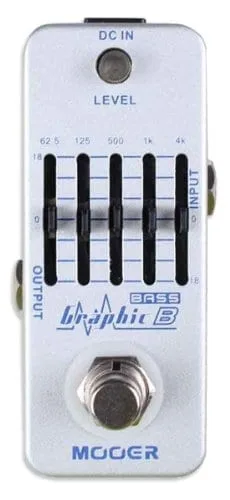
The pedal sits in the same family as the Mooer Graphic B, and the wider category is covered on the equalization pedals page.
Controls, connections and power
The front panel is the five sliders plus the level control, with a footswitch to engage the EQ. Connections are simple: one 1/4" monaural input at 470k Ohms impedance and one 1/4" monaural output at 1k Ohms impedance1.
The Graphic G runs on a 9V DC AC adapter with a center minus (center negative) plug1. That matches most standard pedalboard power supplies, but check polarity before plugging in a non-standard supply.
The enclosure is a full metal shell1, and the whole thing measures 93.5mm deep by 42mm wide by 52mm high, weighing 160g1. That footprint is the pedal's main selling point: it takes up about as much board space as a large effects pedal's side, which is what lets Mooer claim it as the smallest guitar graphic EQ pedal in the world1.
What reviewers said
Gearnews included the Graphic G in a 2025 buying guide of EQ pedals, at a listed price of $55.002. Reviewer Julian Schmauch found the small size a genuine advantage for crowded boards, but flagged the trade-offs that come with it:
"the small size means the controls are close together; fine adjustments can be a bit fiddly, and the extreme boosts or cuts near ±18 dB can introduce noise or affect headroom"
That matches the practical picture: the sliders are usable for the moderate cuts and boosts most players want from an EQ, but wide swings at the ±18dB extremes are where the circuit's limits show2.
Videos
MOOER Audio
Prymaxe
mequellyall
Questions
Is the Mooer Graphic G true bypass?
Yes. Mooer lists the Graphic G as true bypass, so with the pedal disengaged the signal passes through without active circuitry in the path. That suits players who want the EQ out of the chain entirely between songs or on clean settings.
What frequencies does the Mooer Graphic G cover?
The five sliders are centered at 100Hz, 250Hz, 630Hz, 1.6kHz and 4kHz. That spans the low fundamentals of a guitar through the upper-midrange presence region, letting you cut mud, tighten the low end, or add bite and clarity.
What power supply does the Mooer Graphic G need?
It runs on a 9V DC AC adapter with a center minus (center negative) plug, the standard arrangement for most pedalboard power supplies. Mooer does not list battery operation, so plan on a 9V DC supply with the correct polarity.
How big is the Mooer Graphic G?
It measures 93.5mm deep by 42mm wide by 52mm high and weighs 160g. That is micro-pedal sized, roughly the footprint of a standard stompbox's end, which is the whole point: five EQ bands on a cramped board.
Sources (2)
- Graphic G_MOOER Audio, MOOER Audio
- The 7 Best EQ Pedals for Every Budget: Shape Your Tone in Seconds!, gearnews.com, 2025-09-15