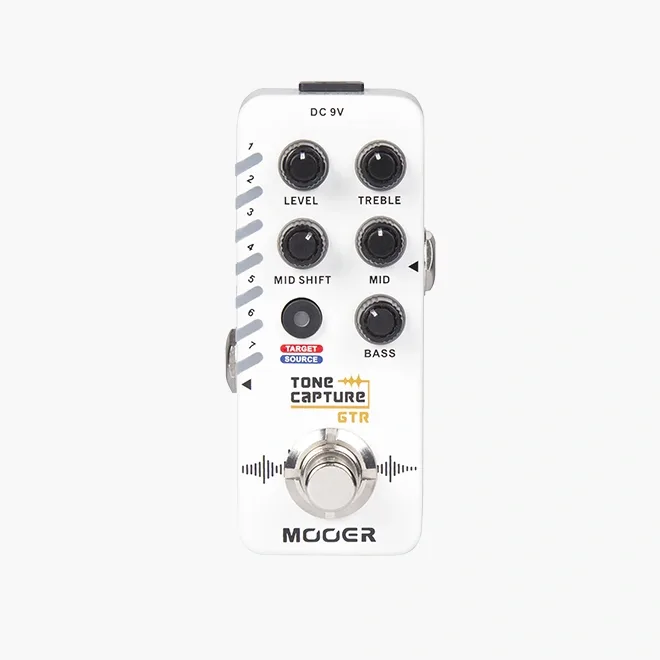


The MOOER TONE CAPTURE GTR is an intelligent EQ match pedal in Mooer's micro pedal format. It is built on what Mooer calls its TONE CAPTURE technology, an EQ matching system that samples the unique tonal characteristics of a target guitar and then applies that captured character to a different guitar1. In practice, it lets a player make one instrument sound closer to another, for example capturing the voice of a hollow-body and playing it through a solidbody.
The Tone Capture GTR is a guitar modeling pedal made in China2. It carries a list price of £992. In use, it samples the sound of a reference guitar and applies that tonal character to whatever guitar is plugged into it, and it can also function as a straightforward EQ pedal.
How the tone matching works
The technology is based on Mooer's EQ-matching algorithm3. Capturing a tone is a physical process rather than a menu dive: you press the target/source button and strum in a consistent and realistic way while the lights on the pedal cycle; when all the lights flash together, the tone has been captured and saved to a slot3.
Guitar.com's reviewer, Michael Watts, tested the pedal by capturing the neck Filter'Tron pickup of a Gretsch White Falcon and playing it through a Telecaster. His verdict on the results2:
"The results aren't bad. Not spot on, but there's a recognisable voice which, when sitting in a mix or coaxed into shape"2
In other words, the capture is not an exact recreation of the target guitar, but it produces a recognisable character that works in a mix, and the EQ accuracy of the captured tones can be further shaped2.
The Tone Capture GTR is part of a line of Mooer products built around tone capture, in which the pedal samples a reference sound and reproduces its tonal character. Reviewers have tested it by capturing the voice of one guitar and applying it to another: capturing a Gretsch White Falcon's neck Filter'Tron pickup through a Telecaster gave results that were, in the reviewer's words, "not bad. Not spot on, but there's a recognisable voice which, when sitting in a mix or coaxed into shape" gets the point across2.
The controls
The control set is straightforward for an EQ pedal:
| Control | What it does |
|---|---|
| Level | Sets the overall output level |
| Bass | Cuts or boosts the low end |
| Mid | Cuts or boosts the midrange |
| Treble | Cuts or boosts the high end |
| Mid shift | Moves the frequency that the mid control acts on |
| Target/source button | Starts the sampling process for tone capture |
| Footswitch | Engages and bypasses the effect |
The control list comes from Guitar World's review, which lists Level, bass, mid, treble, mid-shift and target/source3, and Guitar.com's review, which describes the same set of knobs plus the target/source button and footswitch2.
Bypass, presets and firmware
The pedal can be switched between true bypass and buffer bypass1. True bypass takes it entirely out of the signal path when off; buffer bypass keeps it in line as a buffer, which can help preserve high end on larger pedalboards. Guitar World's spec box lists the bypass simply as switchable3.
The seven preset slots store either Tone Capture samples or EQ settings1, so the pedal can serve double duty as a straightforward EQ with saved curves.
Firmware is upgradeable via USB1, a point also noted in Guitar Interactive's launch coverage4. A user manual is included as an accessory1.
Power and connections
The pedal runs on a 9V DC transformer with internal negative external polarity, and Mooer recommends its own Micro Power supply1. Current draw is 150mA1, which is worth noting for anyone planning to power it from a shared supply: it draws more than many analog micro pedals, so a daisy chain with limited headroom per output may not suit it. Guitar World's review lists the power requirement as DC 9V3.
Input and output are both 1/4" mono jacks, with an input impedance of 2.2M Ohms and an output impedance of 100 Ohms1.
Size, price and origin
The pedal measures 93.5mm deep, 42mm wide and 52mm high, and weighs 155g1, the compact footprint typical of Mooer's micro pedal line. It is made in China2. At the time of Guitar.com's review in December 2019 it sold for £992. Guitar World's review described the price as affordable3.
Videos
MOOER Audio
intheblues
Riffs, Beards & Gear
Questions
How does the Mooer Tone Capture GTR match a guitar's tone?
You press the target/source button and strum in a consistent, realistic way while the lights on the pedal cycle. When all the lights flash together, the tone has been captured and is saved to a preset slot. The pedal then applies that sampled EQ curve to whatever guitar is plugged into it.
Is the Tone Capture GTR true bypass?
It is switchable. The pedal can be set to either true bypass or buffer bypass, so you can choose whether it is fully out of the signal path when off or acting as a buffer, which is useful on longer pedalboard runs.
How many presets does the Tone Capture GTR hold?
It has seven preset slots, which can store either sampled guitar tones from the Tone Capture process or standalone EQ settings. That is enough to keep a capture for each of the main guitars you play.
Is the Tone Capture GTR analog or digital?
It is a digital stompbox. The tone matching is done with Mooer's EQ-matching algorithm, which analyses the sampled tonal characteristics and recreates them as an EQ curve.
Can the Tone Capture GTR firmware be updated?
Yes. The firmware is upgradeable via USB, so Mooer can issue updates for the pedal's matching algorithm or behavior over time. A user manual is included in the box.
How big is the Mooer Tone Capture GTR?
It measures 93.5mm deep by 42mm wide by 52mm high and weighs 155g, which is typical of Mooer's micro pedal format and small enough to fit into a spare corner of a pedalboard.
Sources (4)
- TONE CAPTURE GTR_MOOER Audio, MOOER Audio
- Review: Mooer Tone Capture GTR, Guitar.com, 2019-12-05
- Mooer Tone Capture review, Guitar World, 2020-04-24
- New Tone Capture Micro Pedal From MOOER, Guitar Interactive Magazine, 2019-08-21