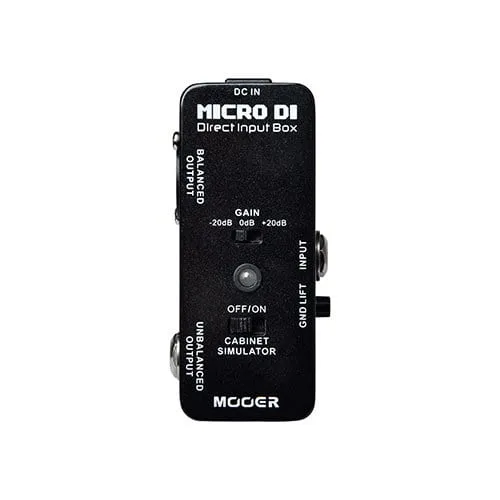


The Mooer Micro DI is a very small and compact direct input (DI) box from Mooer Audio, a maker better known for its mini effects pedals. A DI box takes your instrument signal and converts it into a form an audio system can take cleanly: Mooer describes the Micro DI as a "smart direct input box with ultra low distortion" that "quietly transfers the sound of guitar or bass directly to the audio system"1. Vintage Guitar called it "a smart direct input box with ultra-low distortion" when it introduced the pedal2.
For a player, that means you can plug straight into a PA or recording setup without an amp, and the included cabinet simulator gives the signal a speaker-like character rather than the raw, thin sound of a direct pickup feed21.
What it does
The Micro DI includes four main features, per Mooer's product page1:
- Balanced/unbalanced output, so it can feed a balanced line to a mixing desk
- Gain switch, to match the level of your instrument
- Cabinet simulator, which Vintage Guitar described as a "virtual 4x12" cabinet emulation"2
- Ground lift function, for breaking a ground loop when a hum appears between your rig and the PA
The cabinet simulator is the feature that matters most for direct recording or ampless playing: it shapes the direct signal so it resembles a speaker cabinet rather than a raw pickup output. The ground lift is the classic DI fix for hum caused by two pieces of gear sharing a ground through different paths21.
Power and connections
The Micro DI runs on a 9V DC adapter with a center negative plug, drawing 12 mA1. That current draw is low enough that it shares easily with other small pedals on a powered board.
There is no battery option. The Micro DI is adapter-powered only, so it needs a 9V supply or a pedalboard power output to run1.
On the connections side, the input is a 1/4" monaural jack with 1M ohm impedance, which suits passive guitar and bass pickups, and the output is a 1/4" monaural jack at 1k ohm impedance1. The 1M ohm input is the same ballpark as a typical amp input, so your instrument sees a familiar load.
Using it with bass
Mooer's own description covers both instruments: the box "quietly transfers the sound of guitar or bass directly to the audio system"1. Vintage Guitar likewise presented it as a box for guitar and bass players when Mooer offered it2. The 1M ohm input impedance1 is friendly to passive bass pickups, which prefer a high input load to keep their top end intact. For bassists building a small board, it can sit alongside compact bass pedals like a compressor or overdrive and handle the final link to the desk.
Videos
Prymaxe
Anıl Yazar
All About Worship Guitar
Questions
Does the Mooer Micro DI take a battery?
No. The Micro DI runs on a 9V DC adapter only, with a center negative plug, drawing 12 mA. There is no battery compartment, so it needs a power supply or an isolated pedalboard output to run.
Does the Mooer Micro DI have phantom power?
The maker's specifications do not list phantom power. The Micro DI is powered by a 9V DC adapter with a center negative plug, and Mooer gives no indication that it accepts the 48V phantom power that mixing desks send down XLR cables.
Can the Mooer Micro DI be used with bass?
Yes. Mooer describes it as transferring the sound of guitar or bass directly to the audio system, and its 1M ohm input impedance suits passive bass pickups. Vintage Guitar also introduced it as a box for guitar and bass players.
Does the Mooer Micro DI have an XLR output?
Mooer's specifications list a 1/4 inch monaural jack output at 1k ohm impedance, plus a balanced/unbalanced output feature, but no XLR jack. You would need a 1/4 inch to XLR cable or adapter to reach a mixing desk's XLR input.
Sources (2)
- MICRO DI_MOOER Audio, MOOER Audio
- Mooer Audio Offers Micro DI, Vintage Guitar magazine, 2013-09-12