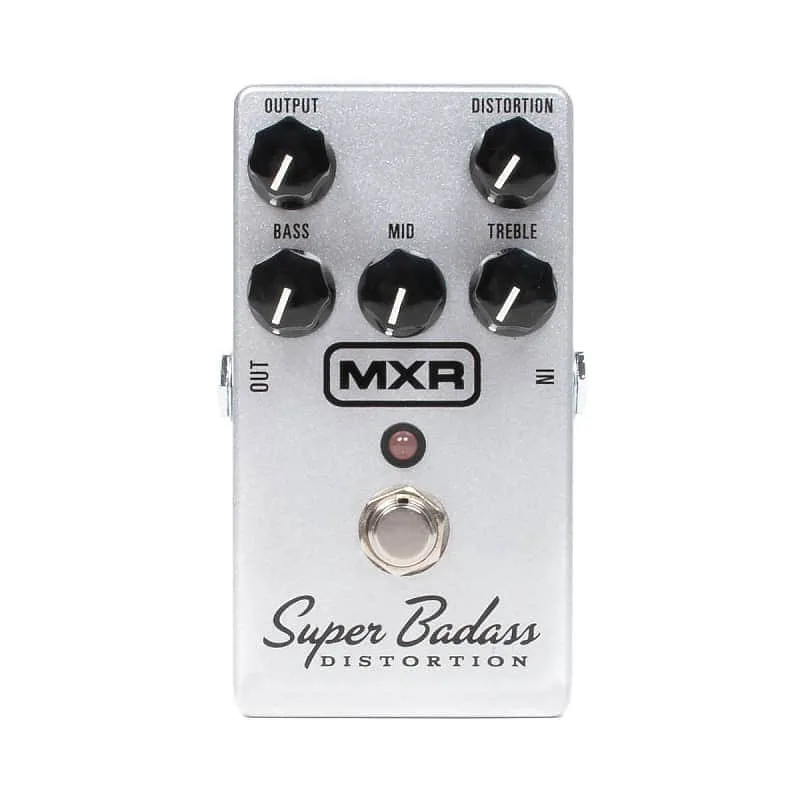


The MXR M75 Super Badass Distortion is an analog distortion pedal from MXR, the Dunlop brand that also builds the Custom Badass '78 Distortion. Released in 2013, it puts what MXR calls "decades of distortion tones in one pedal" at the player's feet, with a five-knob layout whose centerpiece is a three-band EQ1234.
Its default voice sits in British territory. MusicRadar's reviewer found that with every control at 12 o'clock the pedal sounds "tight and crunchy - firmly in the British distortion" camp4, and Guitar World's buying guide describes the default voice as speaking "in British EL34 tube crunch"2. From there the EQ and gain controls can take it toward vintage bite, metal, or a low-gain overdrive character.
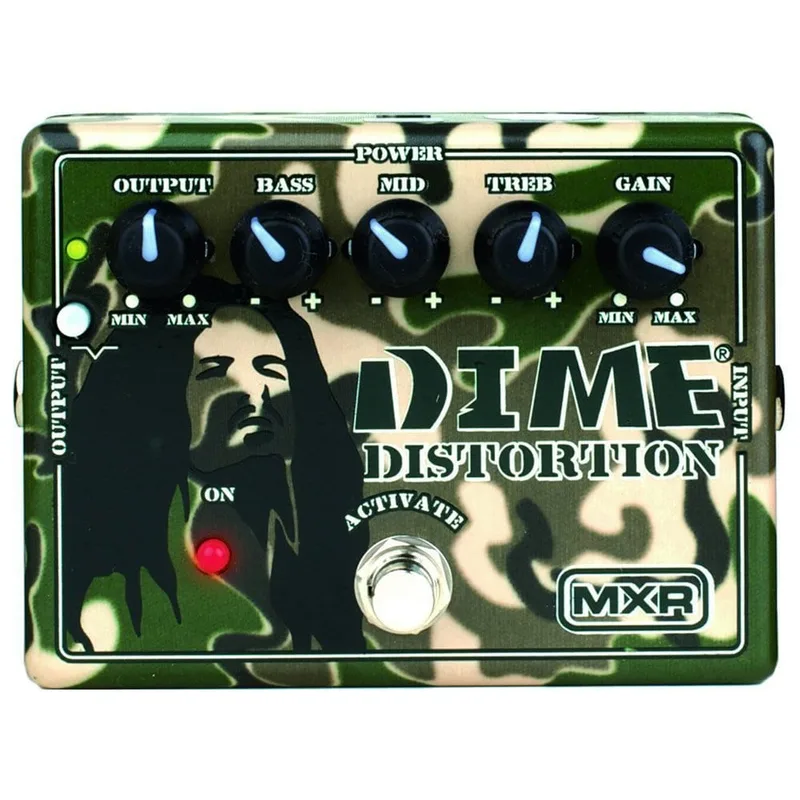
The controls: Output, Distortion, Bass, Mid, Treble
The M75 has five knobs. According to the Dunlop manual, the OUTPUT knob controls overall effect volume and the DISTORTION knob controls the amount of distortion1. The remaining three are a full EQ:
| Control | What it does | Range and frequency |
|---|---|---|
| OUTPUT | Controls overall effect volume | Huge range; unity volume sits around 10 o'clock4 |
| DISTORTION | Controls amount of distortion | Gain of 15 dB to 76 dB at 1 kHz1 |
| BASS | Cuts or boosts low frequencies | +/-11 dB at 150 Hz1 |
| MID | Cuts or boosts midrange | +/-12 dB at 500 Hz1 |
| TREBLE | Cuts or boosts high frequencies | +/-10 dB at 10 kHz1 |
That EQ is what separates the M75 from simpler distortions. Premier Guitar's reviewer called the separate bass, mid and treble knobs "powerful" and said they "enable control over a very wide frequency spectrum"6. MusicRadar's reviewer noted you can "employ the three-band EQ to up the mids for vintage bite or cut 'em for metal thrills"4, and Delicious Audio's buying guide describes it as a versatile distortion with plenty of sculpting options thanks to that three-way EQ section3.
A single footswitch toggles the effect on and bypass, with a red LED indicating when it is on1.
Sample settings
The manual includes four sample settings, which give a picture of the pedal's range1:
- CHUNKY: a fat, heavy rhythm tone
- METAL: high-gain, scooped aggression
- CLASSIC OD: lower-gain overdrive character
- DIRTY BOOST: gain pulled back, output raised
How it sounds at the extremes
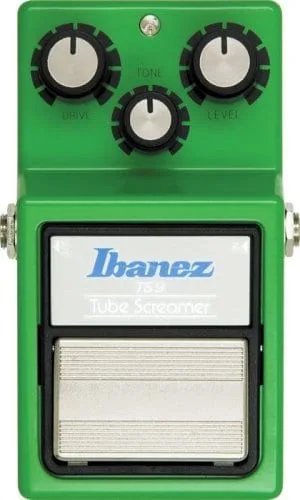
At lower gain settings, Premier Guitar's reviewer got "a brawny overdrive similar to the output from a TS9," though with a more flexible EQ than the Ibanez6. At the other end, the same review found that at maximum distortion "you'll hear a fair amount of white noise from the pedal - especially with single-coils in the mix," and that rolling off the highs reduces the sizzle and helps control unwanted feedback6. Guitar World's buying guide, by contrast, lists low noise and large output among the pedal's pluses, while noting it can be unconvincing at the low and high gain extremes2.
The pedal also works as a boost. Premier Guitar found it "excels" as a boost with the output turned up and the gain killed, "especially with a clean, high-headroom amp," thanks to the flexible EQ6. One caveat from that review: most available tones carry "a trace of modern distortion color"6.
Power and specifications
The M75 runs on 9 volts DC and draws 10 mA1. It can be powered three ways: a 9 volt battery (installed by removing the bottom plate), a 9 volt AC adapter such as the Dunlop ECB003 or ECB003EU, or a power supply such as the DC Brick1.
| Specification | Value |
|---|---|
| Power supply | 9 Volts DC1 |
| Current draw | 10 mA1 |
| Input impedance | 390 kΩ, 500 Hz1 |
| Output impedance | 3.4 kΩ1 |
| Nominal output level | -8 dBV1 |
| Signal to noise | 93 dBV A-weighted, all controls at mid position1 |
| Gain range | 15 dB to 76 dB, 1 kHz1 |
The pedal comes in MXR's reduced-thickness enclosure, which Premier Guitar notes is lighter than older MXR boxes but still sturdy6.
Where it came from: the M75 and the '78
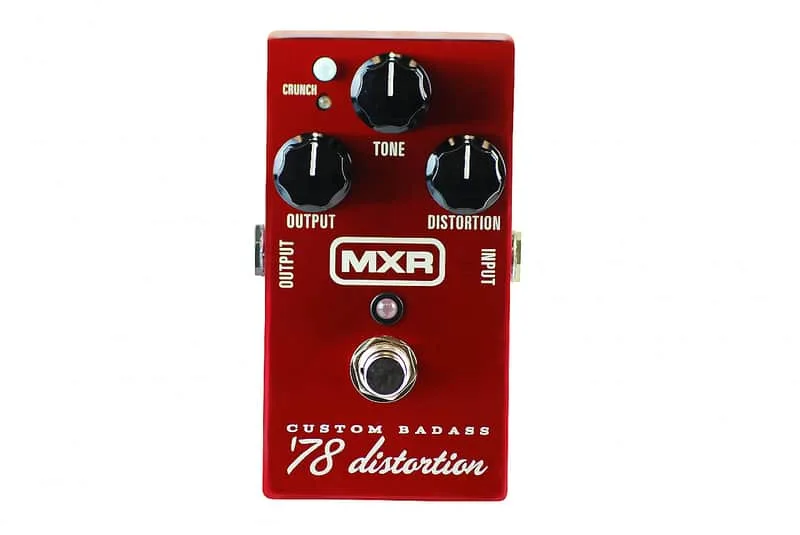
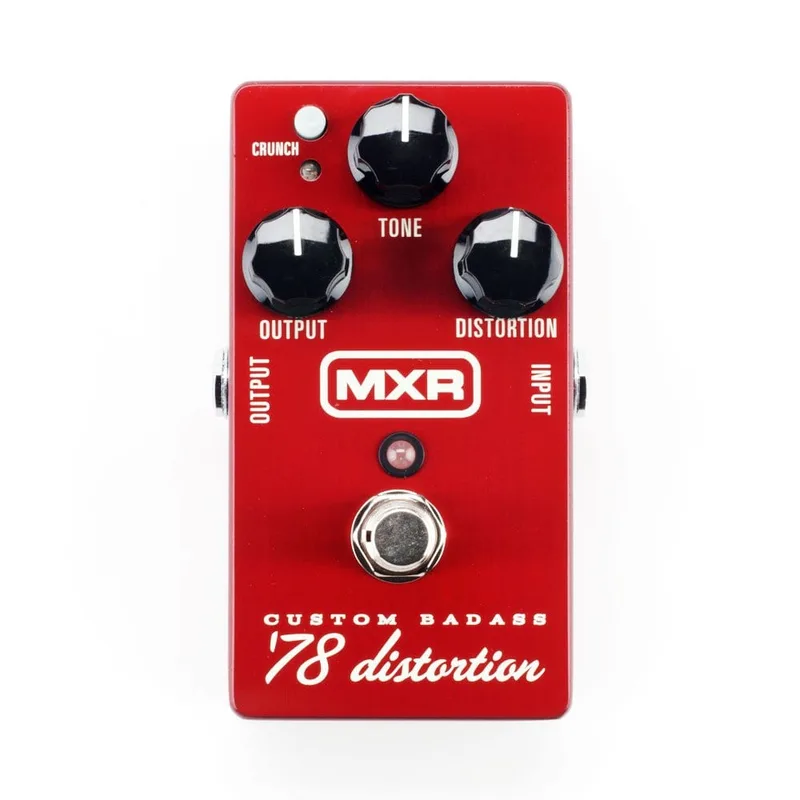
The Super Badass is the second pedal in MXR's Badass line. MusicRadar notes that MXR, "not content with one Badass (the M78 Custom Badass '78 Distortion), they've one-upped it with the M75"4. The M78 '78 Distortion, reviewed by MusicRadar's Trevor Curwen, is a classic hard clipping distortion with two voices and a useful EQ7, and Pedal of the Day's review confirms it is true bypass and all analog8.
The practical difference for a player is the EQ. The M78's tone shaping is simpler, while the M75's independent bass, mid and treble knobs give it much wider sculpting range, from cutting mids for metal to boosting them for vintage bite14. Guitar Interactive's launch coverage described the M75 as putting "decades of 100% analog distortion at your feet," with the Bass, Mid and Treble controls letting you "finely sculpt your sound"5.
Videos
Sweetwater
Bax-shop | Bax Music Goes
Chicago Music Exchange
Questions
What is the difference between the MXR Super Badass and the '78 Distortion?
The M75 Super Badass Distortion followed the M78 Custom Badass '78 Distortion in MXR's Badass line. The M78 is a classic hard clipping distortion with two voices and a simpler EQ, while the M75 adds a full three-band EQ with bass, mid and treble knobs, giving it wider tone sculpting and a broader range from low-gain overdrive to high-gain distortion.
Is the MXR M75 true bypass?
Yes. The Dunlop manual lists the M75 Super Badass Distortion as true hardwire bypass, so the signal passes through largely unaffected when the pedal is off. A single footswitch toggles the effect on and off, with a red LED showing when it is engaged.
Can the Super Badass Distortion work as an overdrive?
Yes. Premier Guitar's reviewer found that at lower gain settings it produces a brawny overdrive similar to an Ibanez TS9, but with a more flexible EQ. It also works as a boost with the output turned up and the gain pulled back, especially into a clean, high-headroom amp.
Is the MXR Super Badass Distortion noisy at high gain?
At maximum distortion there is a fair amount of white noise, especially with single-coil pickups, according to Premier Guitar's review. Rolling off the treble reduces the sizzle and helps control unwanted feedback. Guitar World's buying guide otherwise lists low noise among the pedal's pluses.
What are the sample settings for the M75?
The Dunlop manual gives four sample settings: CHUNKY, METAL, CLASSIC OD and DIRTY BOOST. These cover a fat rhythm tone, high-gain metal, a lower-gain overdrive character, and a boost setting with the gain pulled back and the output raised.
Can the M75 run on a battery?
Yes. The manual says the pedal is powered by one 9 volt battery, installed by removing the bottom plate. It can also run from a 9 volt AC adapter such as the Dunlop ECB003 or ECB003EU, or a power supply such as the DC Brick.
Sources (8)
- M75.pdf, Dunlop Manufacturing, Inc., 2019
- Best distortion pedals: Our top high-gain stompboxes, Guitar World, 2022-06-09
- 2024 UPDATE! The Best Distortion Pedals, Delicious Audio, 2024-05-03
- MXR M75 Super Badass Distortion review, MusicRadar, 2013-09-23
- MXR Introduces the M75 Super Badass Distortion, Guitar Interactive Magazine, 2013-06-19
- MXR Super Badass Distortion Pedal Review, Premier Guitar, 2013-07-26
- MXR M78 Custom Badass '78 Distortion review, MusicRadar, 2011-11-11
- Dunlop MXR M78 Custom Badass '78 Distortion, Pedal of the Day, 2014-07-17