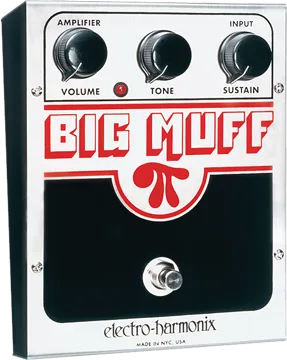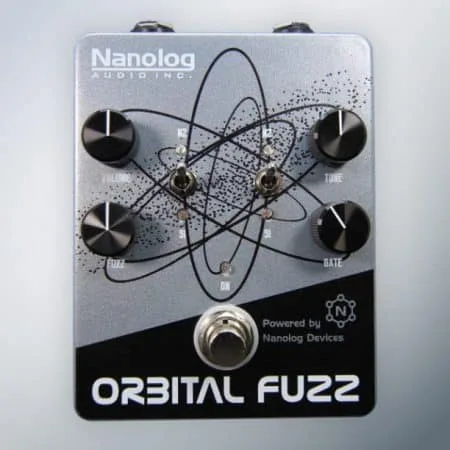


The Nanolog Audio Orbital Fuzz is a fuzz pedal built around two gain stages, inspired by the circuit of the Electro-Harmonix Big Muff Pi but using a clipping technology the original never had: carbon N2 molecular junctions alongside traditional silicon diodes. Delicious Audio described it as "a two gain stages fuzz inspired by the Big Muff Pi but… kind of completely different," designed to deliver "a crushing amount of fuzz for an out-of-this-world tone"1.
Nanolog says the Big Muff was a primary source of inspiration for the design, per Premier Guitar's review2. The Big Muff Pi circuit itself is based on a common amplifier design with clipping diode/feedback loops, as documented in Kit Rae's technical analysis of the circuit3. What sets the Orbital Fuzz apart is that each of its two gain stages lets you choose between molecular junction clipping and silicon clipping, giving four potential clipping pairings in one box.
The controls and clipping options
The Orbital Fuzz carries volume, fuzz, tone, and gate knobs, plus a carbon/silicon switch for each gain stage4. Delicious Audio summed up the design as "multiple clipping options combined with tone, gate, and fuzz control," which the site said allows for a totally immersive experience1.
| Control | What it does |
|---|---|
| Volume | Sets the output level4 |
| Fuzz | Sets the amount of gain4 |
| Tone | Premier Guitar found it has enough range to recast any of the pedal's sounds in significant ways2 |
| Gate | Premier Guitar found it most drastically reshapes the voices, turning each into a more chaotic, sputtering and trashy version of itself2 |
| Carbon/silicon switches | One per gain stage, selecting the clipping type for that stage2 |
The heart of the pedal is its clipping. The two carbon N2 molecular junctions and two silicon diodes can be used alone or mixed, and the silicon and carbon settings can be paired together in series with the two separate gain stages to create what Delicious Audio called "a vast array of fuzz"1. On the carbon settings, the site reported heavy, thick fuzz with enhanced touch sensitivity that lets the player dive deeper into the fuzz universe1.
What the four pairings sound like
Premier Guitar's review mapped the four clipping combinations to distinct characters2:
- Dual nano-diode (carbon) settings: warm and round with Big Muff-scale mass2
- Dual silicon-diode settings: feral and toppy, with hints of silicon Fuzzrite and silicon Fuzz Face2
- Mixed diode-type settings: ranging from heated and huge to a more focused, relatively low-output fuzz2
The reviewer's overall verdict was enthusiastic:
"I loved these sounds. And when you add in the fatter, singing, and sustaining voices, the Orbital Fuzz adds up to a most versatile and unique buzz machine."
What reviewers said
Premier Guitar's review listed the pedal's strengths as "unique smooth to fractured fuzz tones" and "excellent build quality," while noting one drawback: the esoteric clipping technology "adds up to a little extra cost"2.
The Orbital Fuzz drew positive press. Premier Guitar's review praised its "unique smooth to fractured fuzz tones" and "excellent build quality," while noting that its "esoteric clipping technology adds up to a little extra cost"2. On the YouTube channel EytschPi42, Henning, who is normally not a fan of fuzz, also had good things to say about the pedal1.
Delicious Audio also noted that good things were being said about the pedal by Henning of EytschPi42, who is normally not a fan of fuzz1.
Videos
Eirik Stordrange
EytschPi42
shnobel
Questions
What circuit is the Nanolog Audio Orbital Fuzz based on?
It is a two-gain-stage fuzz inspired by the Big Muff Pi circuit. Nanolog says the Big Muff was a primary source of inspiration for the design, though the clipping is done with carbon N2 molecular junctions and silicon diodes rather than the original's diode pairs.
Can the silicon and carbon clipping settings be combined?
Yes. Each of the two gain stages has its own carbon/silicon switch, so the settings can be paired together in series with two separate gain stages. That gives four potential clipping pairings: dual carbon, dual silicon, and the two mixed combinations.
Where is the Nanolog Orbital Fuzz made?
It is made in Canada, according to Guitar.com's review of the pedal. Nanolog Audio launched the Orbital Fuzz under its own name in January 2019, using molecular clipping technology previously offered in a 2016 collaboration with Dr. Scientist.
Does the Orbital Fuzz sound like a Big Muff?
Partly. Premier Guitar's reviewer found the dual nano-diode settings warm and round with Big Muff-scale mass, but the pedal also covers other ground: dual silicon settings were described as feral and toppy, with hints of silicon Fuzzrite and silicon Fuzz Face.
Sources (4)
- Nanolog Audio Orbital Fuzz, Delicious Audio, 2018-11-16
- Quick Hit: Nanolog Orbital Fuzz Review, Premier Guitar, 2019-10-20
- BIG MUFF TRANSISTORS AND OTHER COMPONENTS, Kit Rae (kitrae.net), 2012-07
- Review: Nanolog Audio Classic Overdrive & Orbital Fuzz, Guitar.com, 2019-01-09