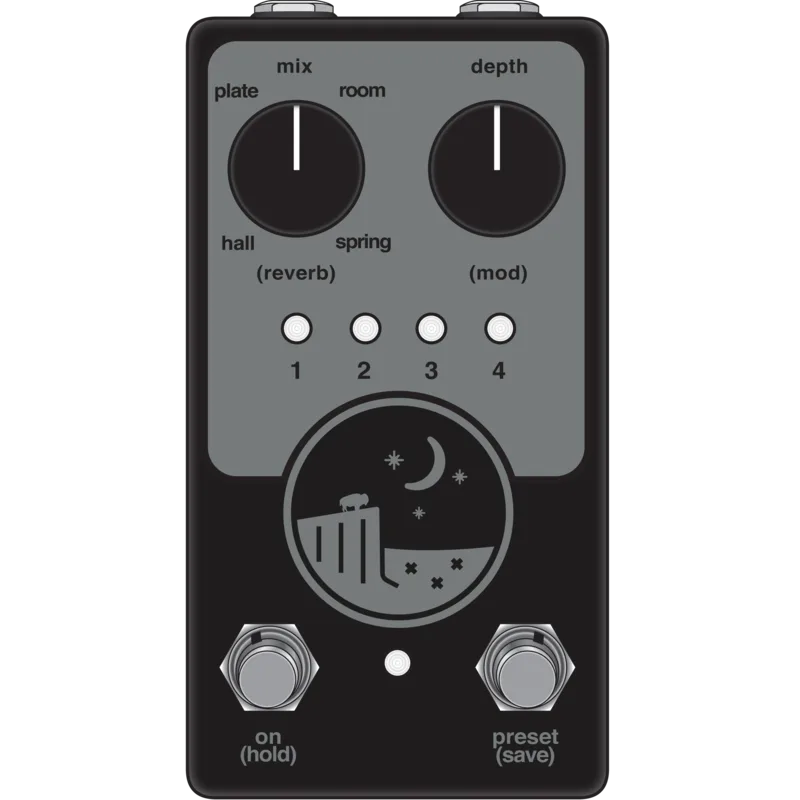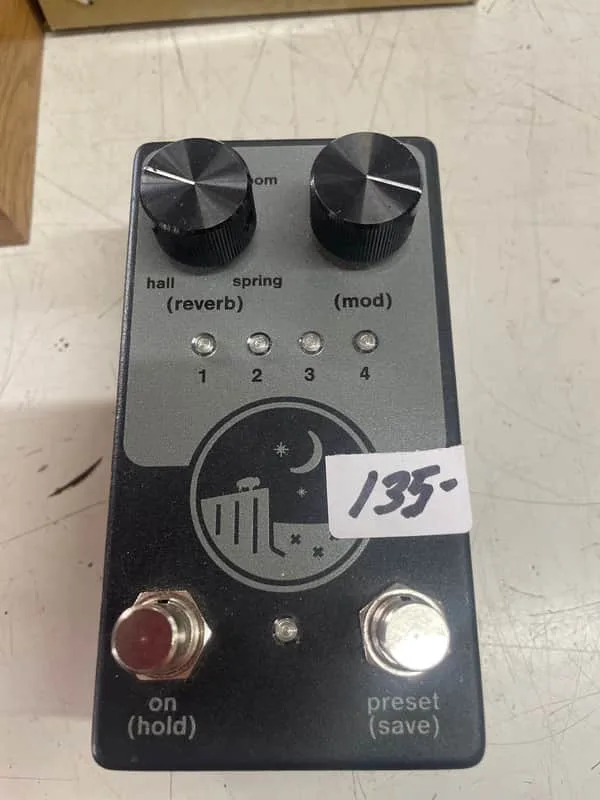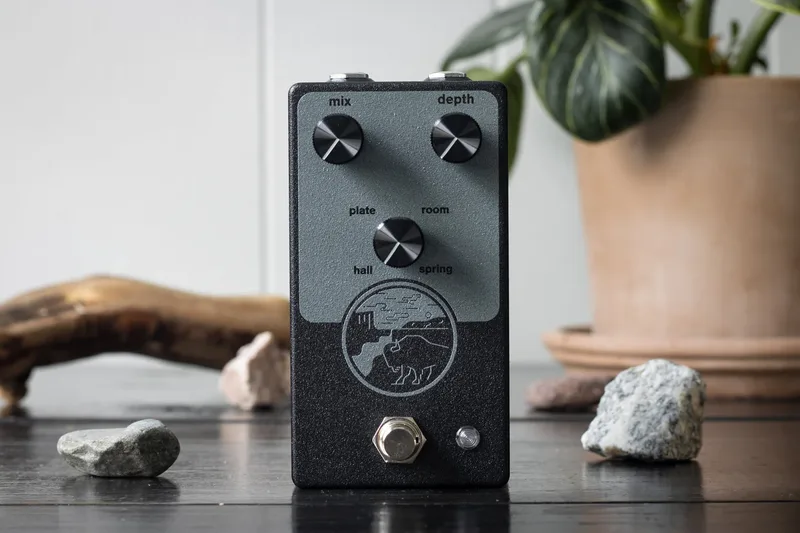


The NativeAudio Buffalo Days is a compact multi-mode reverb pedal with four algorithms: hall, plate, room and spring. NativeAudio describes it as "a gig-friendly, multi-reverb solution" that runs "from subtle room reflections to cavernous echoes." The circuit is digital with an analog dry signal, and the output is mono1.
The four reverb types are inherited from NativeAudio's more sophisticated Ghost Ridge reverb, according to Paolo De Gregorio at Delicious Audio, who reviewed the pedal in July 2023 and called it "a compact, streamlined multi-mode reverb pedal"2.
The four reverb types
A central knob switches between the four reverb types2. NativeAudio describes each mode as a space with its own reflection character1:
| Mode | Space | Character |
|---|---|---|
| Room | Small space | Warmer reflections |
| Spring | Small-to-medium space | Spring-like dynamics |
| Hall | Medium-to-large space | Warmer reflections |
| Plate | Medium-to-large space | Brighter reflections |
Hall and Plate share the same medium-to-large space size; the difference is the tone of the reflections, warmer in Hall and brighter in Plate. Room is the smallest and warmest of the four, while Spring brings spring-reverb-style dynamics to a small-to-medium space1.
Controls
The interface is deliberately streamlined: two knobs on top of the pedal2.
| Control | What it does |
|---|---|
| Reverb selector (central knob) | Switches between the four reverb types2 |
| Mix | Controls the overall mix of the signal1 |
| Depth | Shapes the reverb depth; the Mix knob lets the analog dry signal through2 |
Because the dry signal stays analog while the reverb is generated digitally, the pedal keeps your unaffected guitar tone on an analog path1.
Bypass, trails and the footswitch
The Buffalo Days uses buffered bypass with optional trails. Trails let the reverb decay naturally after you switch the effect off, rather than stopping abruptly1.
The single footswitch does several jobs, and how you press it matters:
- On and off: press and release the switch quickly to toggle the effect on and off1.
- Trails on or off: hold the switch while powering up the pedal to toggle trails1.
- Switching method: the pedal works in either momentary or latching mode, so you can use it for momentary reverb swells or as a standard latching on/off switch1.
Trails are set at power up, not during normal use: hold the footswitch while connecting power to toggle them. If your reverb cuts off dead when you bypass, the trails setting has likely been switched off at the last power up1.
Power and specifications
The pedal runs from 9VDC with a 2.1mm center negative connector and draws 70mA1. The firmware version is 1.01.
At 70mA, the Buffalo Days needs a supply output rated for at least that draw. The maker's specifications list no battery option, so plan for a 9V DC pedalboard supply1.
What reviewers said
Delicious Audio's Paolo De Gregorio covered the Buffalo Days in July 2023, describing it as a compact, streamlined multi-mode reverb from "an emerging, US pedal company owned and run by a Native American engineer," with the four reverb types carried over from the Ghost Ridge and switchable from the central knob2.
Videos
NativeAudio
NativeAudio
NativeAudio
News
Questions
Does the NativeAudio Buffalo Days run on a battery?
The maker's specifications list a 9VDC power supply with a 2.1mm center negative connector and a 70mA current draw. No battery option is given in those specifications, so plan to run the pedal from a 9V DC supply that can deliver at least 70mA on an isolated output.
Is the Buffalo Days stereo or mono?
The Buffalo Days is a mono pedal. NativeAudio lists its audio output as mono, and the circuit design is described as digital with an analog dry signal, so your dry guitar tone passes through an analog path while the reverb is generated digitally.
What power supply does the Buffalo Days need?
NativeAudio specifies 9VDC with a 2.1mm center negative connector and a current draw of 70mA. Use a supply that meets those figures, and note that the pedal also has a power-up function: holding the footswitch while powering the pedal toggles reverb trails on or off.
Does the Buffalo Days have reverb trails?
Yes. The pedal offers optional reverb trails, which NativeAudio describes as allowing a natural decay of the reverb when you switch the effect off, rather than cutting the reverb dead. Trails are toggled by holding the footswitch while powering the pedal up.
What is the difference between Hall and Plate mode on the Buffalo Days?
Both are medium-to-large space algorithms, but NativeAudio describes Hall as having warmer reflections and Plate as having brighter reflections. If you want a bigger-sounding reverb that sits behind the notes, Hall is the warmer of the two; Plate gives the same size of space with a brighter character.
Can the Buffalo Days footswitch be momentary?
Yes. NativeAudio lists the switching methods as momentary or latching. In latching use, a quick press and release turns the effect on and off; holding the switch while powering the pedal up toggles the trails setting instead.
Sources (2)
- NativeAudio: Native-owned effect pedal company, NativeAudio
- NativeAudio Buffalo Days Multi-Reverb, Delicious Audio, 2023-07-11