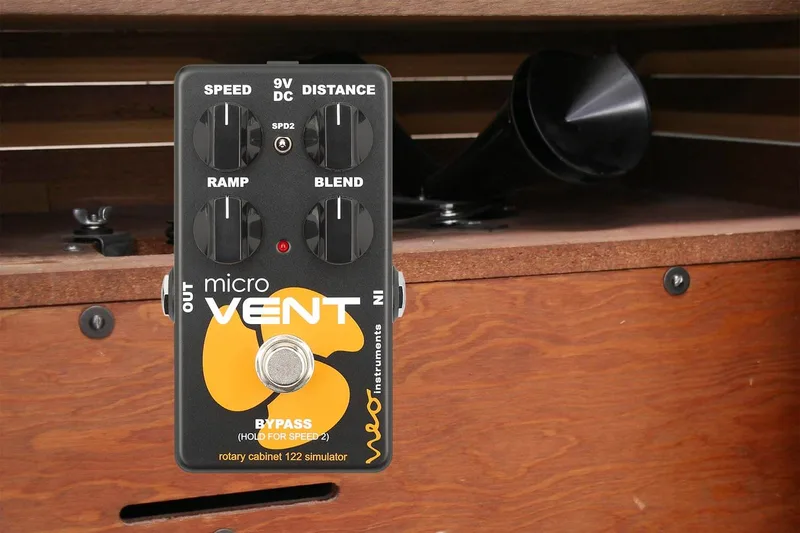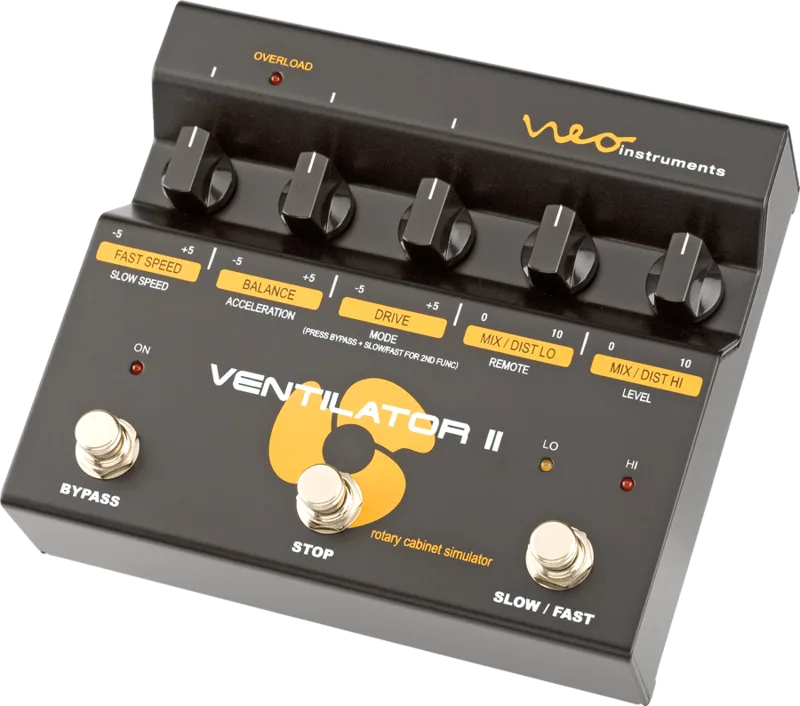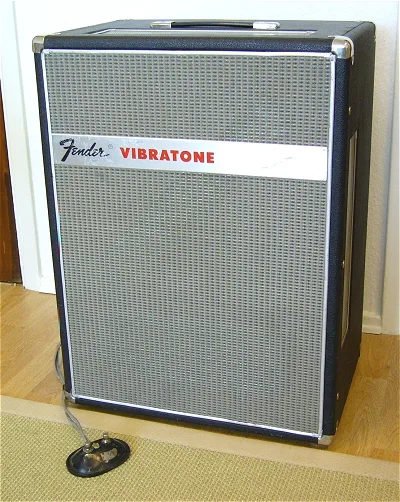


The micro Vent is a rotary speaker pedal from Neo Instruments, built to put the company's Ventilator technology into a standard size stompbox enclosure. It models the sound of a rotating Leslie-style speaker, the horn-and-drum setup long associated with organ and guitar tones, and gives a player speed switching, a simulated microphone position and a dry blend in a pedal that takes one power outlet. It comes in two versions: the black micro Vent 122, modeled after the Leslie 122 rotary speaker, and the white micro Vent 16, modeled on the Fender Vibratone1.
The controls
The micro Vent carries the speed and microphone controls of a rotary speaker onto its top panel. Speed 1 is set with a pot and ranges continuously from Slow to Fast, providing intermediate speeds as well. Speed 2 is selected with a 3-way switch featuring the standard speeds: Slow, Fast and Stop. The DISTANCE pot varies the distance of the two mics in the simulated micing technique, and the RAMP parameter determines acceleration and deceleration between the two speeds1.
| Control | What it does |
|---|---|
| Speed 1 (pot) | Speed set continuously from Slow to Fast, with intermediate speeds available |
| Speed 2 (3-way switch) | Selects the standard speeds: Slow, Fast and Stop |
| DISTANCE (pot) | Varies the distance of the two mics in the simulated micing technique |
| RAMP | Determines acceleration and deceleration between the two speeds |
The BYPASS footswitch switches the effect on and off or selects between the two speeds. Various modes determine whether switching is momentary or latching, and the pedal can be set to select speeds exclusively, leaving the effect always on. Special SWITCH MODES provide flexible switching, for example from Slow to Fast, Fast to Slow, Slow to Stop or Stop to Fast1.
Neo Instruments also built in an analog blend circuit, which the maker describes as "providing latency free mixing-in of the dry signal"1.
The micro Vent draws 180mA at 9V DC with standard negative polarity. Plan for a power supply outlet that can supply that current; the maker notes the standard negative polarity means it integrates easily into larger pedalboards1.
Two versions: micro Vent 122 and 16
The two versions share the enclosure, controls and switching, but they model different rotary speakers1.
| micro Vent 122 | micro Vent 16 | |
|---|---|---|
| Color | Black | White |
| Modeled on | Leslie 122 rotary speaker | Fender Vibratone with a 10 inch speaker into a single drum rotor |
| Algorithm origin | Derived from the Ventilator II | Simulates the classic guitar leslie |
| Micing simulation | One mic on the horn, one on the drum rotor, with variable mic distance via the DISTANCE pot | One mic capturing the Vibratone, with variable distance from the cabinet |
| Character | Complex and dominant | Less complex and dominant than the 122 |
Neo Instruments describes the 122 as modeled after the Leslie 122, "just like its brothers Ventilator II and mini Vent II," with its algorithm derived from the famous Ventilator II1. The 16 takes a different subject: the maker says it simulates the classic guitar leslie with a 10 inch speaker into a single drum rotor, the Fender Vibratone. Compared to the 122, the maker describes the 16 as sounding less complex and dominant, perfect for rhythm work and for giving lead tones the final touch1.
For a player choosing between them, the 122 is the fuller two-mic rotary simulation aimed at the classic organ-style Leslie sound, while the 16 is the single-drum guitar speaker cabinet that players have used as an effect in front of an amp. Both leave the pedal as a mono signal1.
Videos
Mike Hermans
gilmourish
Alberto Barrero
Questions
Is the neo-instruments micro Vent true bypass?
Yes. Neo Instruments specifies the micro Vent as True Bypass or Buffered Bypass, so the pedal can be set to pass the guitar signal untouched when off, or to drive long cable runs with a buffer in the loop. The same BYPASS footswitch also handles speed selection and can be set to leave the effect always on while switching speeds only.
Does the micro Vent run on a battery?
The maker specifies 9V DC power with standard negative polarity, drawing 180mA. That current draw is well beyond what a 9V battery is asked to deliver, so the pedal is meant to run from a pedalboard power supply that can supply 180mA on its outlet.
Is the micro Vent mono or stereo?
The micro Vent is a mono pedal: it has a mono input and a mono output. Its rotary effect is produced inside the algorithm, including the simulated two-microphone recording technique on the 122 version, and leaves the pedal as a single mono signal.
How big is the neo-instruments micro Vent?
The micro Vent measures 113 x 65 x 47mm (W x D x H) and weighs 235g, about 8 oz. Neo Instruments describes it as a standard size stompbox enclosure, so it sits on a pedalboard like any compact single pedal.
Sources (1)
- micro Vent, neo-instruments.com