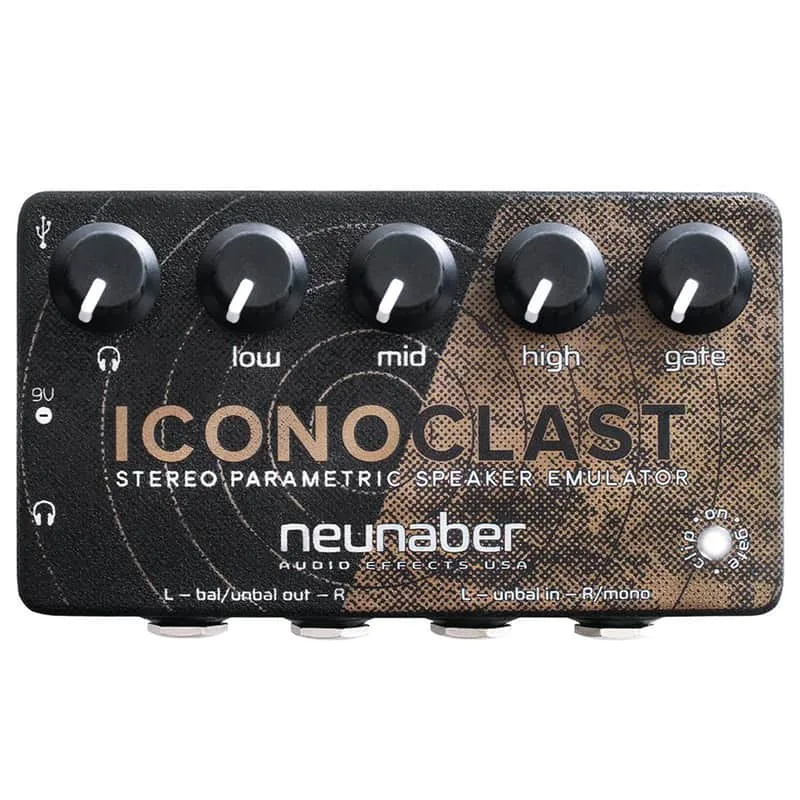


The Neunaber Iconoclast is a stereo speaker emulator pedal, designed and made in Orange, California by Neunaber Technology LLC, that sits at the end of your signal chain and shapes your tone the way a speaker cabinet would12. Placed after your pedals and/or preamp, it completes the chain and gives you a direct output for consistent amp tone at any volume and in nearly any setting, feeding headphones, a mixer, an audio interface or powered speakers134. It was unveiled at NAMM 2017 as a stereo parametric speaker sim, and Guitar World's review carried a direct price of $24945.
The Iconoclast is now listed among Quilter Labs' discontinued products, described there as a "speaker emulator with response visualization, deep editing, EQ, and stereo enhancement"6.
What the Iconoclast does
A guitar speaker does two things to your sound that a raw pedal or preamp signal lacks: it rolls off high frequencies with a sharp drop-off and a bit of fizz, and it interacts dynamically with the power amplifier driving it. The Iconoclast reproduces both, using adjustable filters for the drop-off and fizz, and emulating the interaction between a virtual drive amplifier and the loudspeaker through a damping factor control1. MusicRadar described it at NAMM 2017 as a pedal that would "dynamically shape your tone" in the same way a speaker cabinet would4.
Because it is a speaker emulator rather than a load box, it belongs after your pedals or preamp, taking instrument or line level signals. Its nominal input level is -10 dBV and its maximum is 6 dBV12.
The Iconoclast is not a load box. It must not be connected to an amplifier's speaker output, and not to the amplifier's return either12.
It runs in mono in/mono out, mono in/stereo out, stereo in/stereo out, or TRS stereo in/stereo out configurations, with outputs over TS (unbalanced) or TRS (balanced) cabling2. The 3.5mm stereo headphone output has its own dedicated amplifier, works at the same time as the stereo outputs, and can double as a separate line output via a 3.5mm TRS to 1/4" TS cable, tip as left and ring as right2. Pedal of the Day called the headphone output "the perfect compliment for indoor/late night practicing"3.
The controls
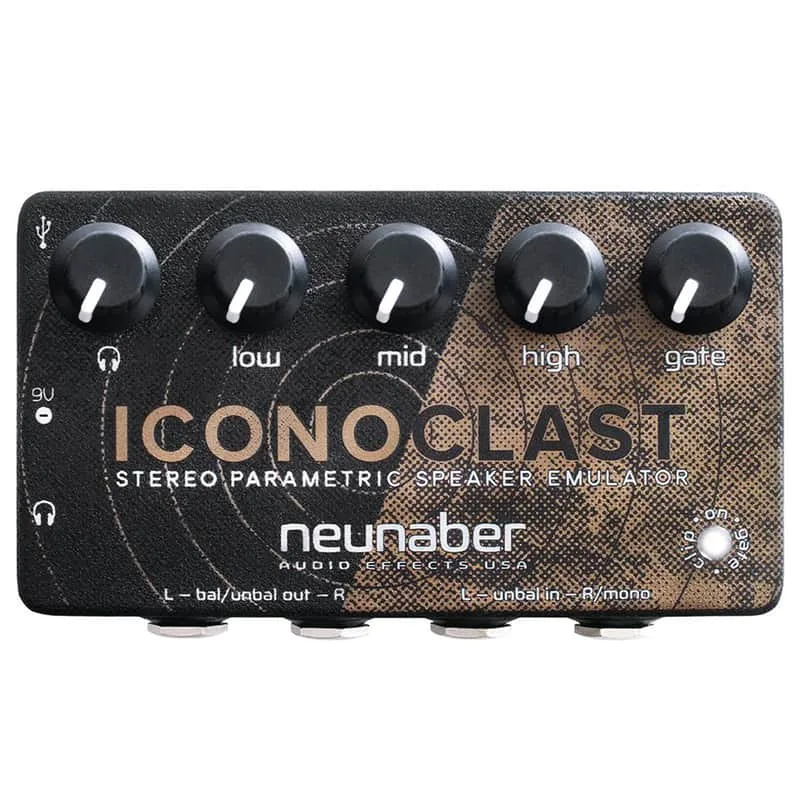
The pedal keeps its front panel simple, with three tone knobs, a gate knob and a headphone volume knob. What each one does is less obvious than its label suggests.
| Control | What it does |
|---|---|
| High | Shapes high frequency character by changing the drop-off frequency of a steep filter; clockwise lets more high frequencies through2 |
| Mid | Essentially the amplifier damping factor control; behaves like a broad midrange cut when turned counterclockwise2 |
| Low | Shapes low frequency character like changing the virtual size and type of the cabinet; full left is a single open 12" cabinet, full right a closed 4x12"2 |
| Gate | Sets the threshold of a studio-quality noise gate; fully counterclockwise turns the gate off, and the LED lights blue when the gate closes1 |
| Headphone volume | Sets the headphone output volume only, with no effect on the L/R outputs; turn it down before connecting or removing cables2 |
The Low knob is the one that surprises players most: rather than a bass EQ, it moves between virtual cabinet types, from a single open 12" at one end to a closed 4x12" at the other2. Pedal of the Day highlighted the same behavior, noting that "Low actually adjusts the virtual cabinet size and type"3. The High control shifts the frequency cutoff, replicating a range of speaker types4.
A single LED reports the pedal's state: white for normal operation, blue when the noise gate has closed, red when the input is clipping2.
Editing with the Iconoclast software
The free Iconoclast software for MacOS and Windows connects to the pedal over its Micro-B USB port and unlocks far more than the knobs offer52. Guitar World's reviewer noted that the software "is available free of charge and is compatible with MacOS or Windows," and that it lets users "connect the box via USB to a MacOS or Windows computer and program a wide variety of custom settings"5.
What the software exposes includes:
- Frequency response visualization, with the ability to view third-party IR responses for comparison2
- Deep editing of the Low knob's behavior, the virtual loudspeaker impedance curve, the high-frequency filter type and the amount of fizz12
- Power compression intensity and dynamic response time12
- Noise gate attack, hold and release times, threshold hysteresis and attenuation12
- Two bands of parametric or shelving EQ2
- Adjustable mono-compatible stereo width2
- Master bypass, gain and polarity, plus save and load of settings2
What reviewers said
Guitar World's review was positive about the pedal's core job:
"The Neunaber Iconoclast impressively delivers the natural sound and organic feel of playing through a speaker cabinet5."
Reviewers praised the Iconoclast's core job. One wrote that it "impressively delivers the natural sound and organic feel of playing through a speaker cabinet"5, and a second found it produces a "crisp and clean" sound and "handles any kind of effects" well3. The built-in studio-quality noise gate was also noted as a feature3.
Pedal of the Day found it "crisp and clean" in its demo and praised how well it handled any kind of effects placed in front of it, also noting the built-in studio-quality noise gate3. The pedal itself is compact: Guitar World described it as "housed in a die-cast box about the same size as a Phase 90"5, and the manual gives its dimensions as 116 x 68 x 47 mm and its weight as 227 g without cables2.
Where it sits among speaker emulators
The Iconoclast is a pedal-format speaker emulator, designed and made in Orange, California, USA432, that sits at the end of the signal chain, after pedals and/or a preamp432. It is not a load box and must not be connected to an amplifier's speaker output1. Its Micro-B USB port connects it to a MacOS or Windows PC running the Iconoclast software2, which gives access to its settings beyond the front-panel controls. For more on the category, see speaker simulation pedals.
Videos
Pete Thorn
Andertons Music Co
Premier Guitar
Questions
Can the Neunaber Iconoclast be connected to an amp's speaker output?
No. The manual states plainly that the Iconoclast must not be connected to a speaker output of an amplifier, and not to the amplifier's return either. It is not a load box. It takes instrument or line level signals, placed at the end of your chain after your pedals or preamp, and its maximum input level is 6 dBV.
Does the Iconoclast take a battery?
No. It runs on an external 9V DC or 12V DC power supply rated at 100 mA or greater, center-negative, with a 5.5mm OD x 2.1mm ID plug. The supply is not included, and Neunaber recommends a Boss-compatible 9VDC pedal power supply of 100 mA or more.
Can I use headphones and the stereo outputs at the same time on the Iconoclast?
Yes. The 3.5mm stereo headphone output is driven by a dedicated amplifier and is usable at the same time as the stereo outputs. It can also serve as a separate line output using a 3.5mm TRS to 1/4" TS cable, with tip as left and ring as right. The headphone volume knob affects only the headphone output.
What do the Iconoclast's LED colors mean?
White means normal operation, blue means the noise gate has closed, and red means the input is clipping. If you see red, your input signal is too hot for the pedal, which has a maximum input level of 6 dBV.
Is the Neunaber Iconoclast analog or digital?
It is digital, running at a 96 kHz sample rate with a minimum latency of 0.315 ms. Editing is done over USB with free Iconoclast software for MacOS and Windows, which offers deep editing of the speaker response, EQ, compression, noise gate and stereo width.
Sources (6)
- Iconoclast User Guide, Quilter Labs
- Iconoclast User Guide (Deutsche), Quilter Labs (Neunaber Technology LLC), 2016
- Neunaber Audio Effects Iconoclast Speaker Emulator, Pedal of the Day, 2017-03-07
- NAMM 2017: Neunaber promises consistent amp tone from your pedalboard with Iconoclast Speaker Emulator pedal, MusicRadar, 2017-01-05
- Review: Neunaber Iconoclast Speaker Emulator, Guitar World, 2017-08-07
- Discontinued Products, Quilter Labs