

The Neunaber Wet Reverb is a digital reverb pedal built around a single, studio-quality reverb algorithm that Neunaber holds a US patent on (US Patent #8204240, plus a Chinese patent)1. The line launched in 2009 and has run through several versions, from the original pedal to the V4 and the current v5, all made in Orange, California USA12. The idea behind the pedal is simplicity: a small box, a handful of knobs, and one reverb done well rather than a menu of modes.
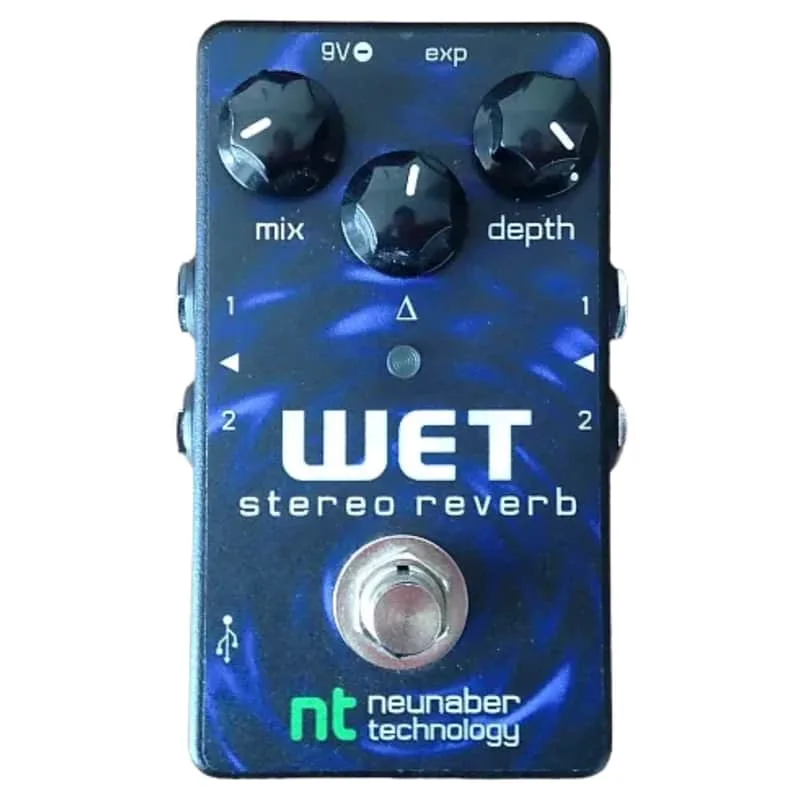
The Wet Reverb family splits into mono and stereo pedals. The mono V4 has a mono input and output3, while the Wet Stereo Reverb adds stereo inputs and outputs plus an expansion port4. Neunaber also built the Wet Mono Reverb, which Premier Guitar described as filling "a logical, largely neglected middle ground" with "a simple, 3-knob layout and no distracting bells or whistles"5.
The controls
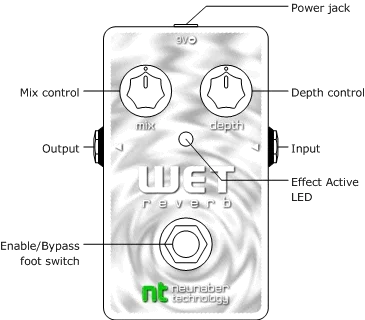
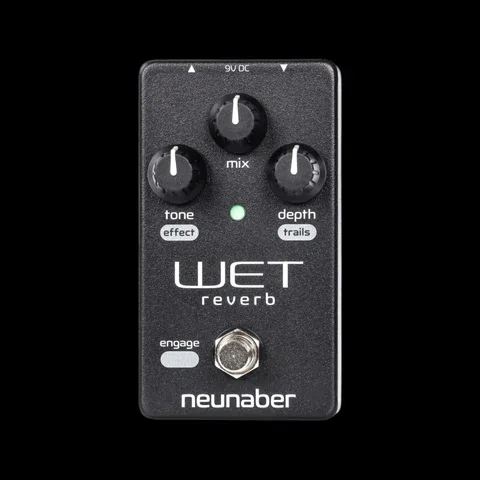
The v5 keeps the control set small: three knobs on top, one Engage footswitch, and two alternate controls you reach by holding down the Engage footswitch while turning a knob1.
| Control | What it does |
|---|---|
| Mix | Blends dry signal and reverb. Full counter-clockwise is 100% dry, full clockwise is 100% reverb, and about 3 o'clock is an even mix1 |
| Depth | Sets the length of the reverb tail, or the size of the acoustic space1 |
| Tone | Sets the tone of the reverb only, darker counter-clockwise and brighter clockwise. The dry signal is not affected1 |
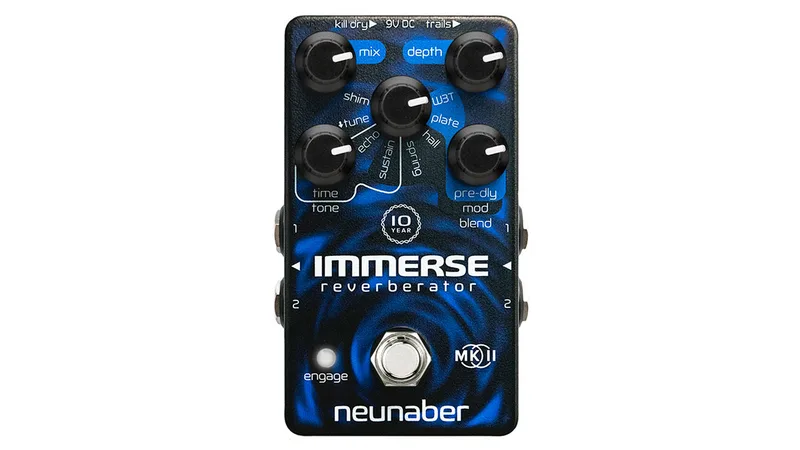
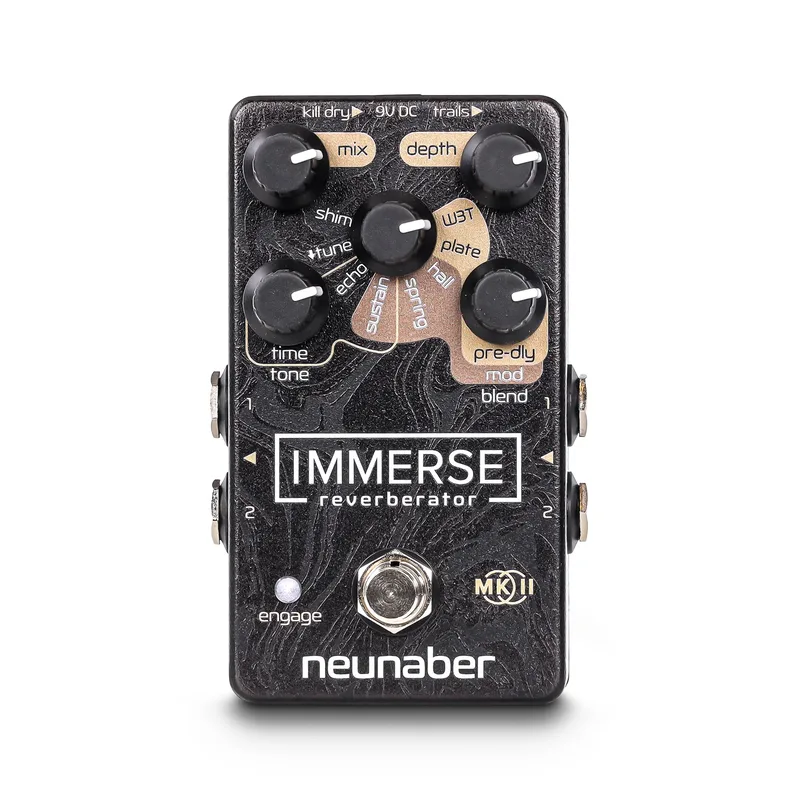
| Effect (alternate) | Switches between the original Wet algorithm (blue LED) and the newer W3T algorithm (green LED), the same algorithm as the Immerse Mk II1 |
| Trails (alternate) | Turns trails on or off. On, the effect trails off naturally after bypass; off, it cuts off immediately1 |
| Engage footswitch | Selects engaged or bypassed; the LED lights when the effect is active1 |
The V4 worked the same way at heart. Its mix control was "fully adjustable from 100 percent dry to 100 percent wet for use in any pedalboard or effect loop setup," and its depth control could dial in "anything from small room reverb to massive hall and 'cathedral' reverbs"3. The V4 revision added the tone control and a soft, non-clicking footswitch over earlier versions3.
On the stereo side, Pedal of the Day's Cameron K described the same three knobs from a player's angle: Mix "controls the amount of reverb you have in your overall mix," Depth "controls the size room you're wanting in your reverb," and the tone control shapes the reverb's brightness. He noted you can "give it a huge 'reverb tail' or keep it short and sweet," and that the controls change depending on which algorithm is loaded onto the pedal, since Neunaber's stereo pedals can be reprogrammed into other Neunaber effects6.
Bypass and trails
Bypass behavior is the main thing that separates the versions, and it is worth knowing which one you are looking at5.
- V4 standard: a buffered bypass circuit that always buffers the signal, on or off, with three user-selectable bypass modes: trails (the reverb fades out naturally), normal (the reverb ends abruptly when you bypass it), and two-stage bypass (the trail continues while the footswitch is held down and cuts off when released)3
- V4 true bypass option: a $20 option that changed the bypass modes to buffered trails, true bypass without trails, and two-stage bypass3
- v4tb mono version: true-bypass switching5
- v5: trails are set by the Trails alternate control rather than a switch on the circuit board1
- Wet Stereo Reverb v1: a buffered bypass, which the maker said "eliminates the tone change that can be caused by some bypassing schemes"7
- Wet Reverb Pedal v2a: true bypass, and bypassing worked even with a dead battery or no power applied8
MusicRadar's Trevor Curwen highlighted the stereo pedal's bypass as a practical feature: it "lets the reverb trail linger when you switch it off"4.
Power and connections
The v5 runs on a standard pedal power supply: 9 to 12 V DC, center-negative, with a 5.5 mm OD x 2.1 mm ID plug, and the adapter must supply 100 mA or more. The adapter is not included, and the manual makes no mention of battery power1.
The power requirement varies a lot across the versions. The v5 needs 100 mA or more1, the Wet Mono Reverb v3 needs at least 65 mA9, and the Wet Reverb Pedal v2b needs only 50 mA at 9V. Check your version before ordering a supply.
For connections, the v5's input accepts your instrument, an amplifier effects loop output, or another effect pedal, and the maker recommends placing the pedal at the end of your chain, after all other effects1. The output is buffered and capable of driving long cables1. The original pedal also had an internal effects loop switch that selected between series (normal) and parallel effects loop operation; in parallel mode only the reverb signal appears at the output and the Mix knob adjusts the reverb level10. The stereo pedal adds a 100 percent wet setting for effects loops and can still be used in mono4.
Specifications from the maker's manual1:
| Specification | Value |
|---|---|
| Input impedance | 1 MΩ |
| Output impedance | 1 kΩ |
| Frequency response, dry/bypassed | 20 Hz to 30 kHz, +/-1 dB |
| Total harmonic distortion, dry/bypassed | 0.01% |
| Signal-to-noise ratio, A-weighted, dry/bypassed | 116 dB enabled with all knobs at 50%; 101 dB bypassed |
| Nominal input level | -10 dBV, instrument level |
| Maximum input level | 8 dBV |
| Dimensions | 115 mm L x 64 mm W x 46 mm H (4.6" x 2.6" x 1.9") |
| Weight | 190 g / 6.7 oz |
Where it came from
The Wet Reverb launched in 2009, and by July 2019 Neunaber was celebrating a decade since the pedal's launch2. The V4 revision that came before the v5 added a tone control and a soft, non-clicking footswitch over earlier versions, carrying a $179 street price for the standard version and $199 for the true bypass option3.
What reviewers said
Guitar World gave the V4 a Gold Award in 2017, calling it "a strong contender, combining simple, straightforward operation, plenty of performance versatility and professional sound quality"3. On the sound itself:
"the essence of simplicity when it comes to digital reverb effect pedals"
Premier Guitar's take on the Wet Mono Reverb was positive but noted the cost and build details: "Pros: Great digital fidelity in an incredibly easy-to-use package. Cons: Pricey. Plastic pot shafts don't inspire confidence"5.
Reviewers took to the stereo pedal quickly. Rick called it "My favorite pedal. Best pedal I ever used. Highly recommended"11, and another reviewer wrote that "The Stereo Wet is a phenomenal reverb pedal"6. MusicRadar found the stereo version "great to use"4. The pedal's reach was visible early on, with one observer noting it was "popping up all over the place, on boards around the world"12.
Videos
Premier Guitar
Guitar World
Neunaber Audio
News
Questions
Does the Neunaber Wet Reverb have trails?
Yes, depending on the version. The V4 offers three user-selectable bypass modes: trails, where the reverb fades out naturally after you bypass it; normal, where it cuts off immediately; and two-stage bypass, where the trail continues while you hold the footswitch and cuts off when you release it. The v5 has a Trails control that turns this behavior on or off.
Is the Neunaber Wet Reverb true bypass?
It depends on the version. The V4 standard version uses a buffered bypass circuit that buffers the signal whether the pedal is on or off, with a true bypass option available for $20 more. The v4tb mono version has true-bypass switching. Earlier pedals like the v2a were true bypass, while the Wet Stereo Reverb v1 used a buffered bypass.
Can the Wet Reverb go in an amp effects loop?
Yes. The v5 input accepts an amplifier effects loop output, and the maker recommends placing the pedal at the end of your chain, after all other effects. The Mix control goes to 100 percent reverb, which suits parallel loops, and the original pedal had an internal switch for series or parallel effects loop operation.
Is there a stereo Neunaber Wet Reverb?
Yes. The Wet Stereo Reverb has stereo inputs and outputs plus an expansion port, a 100 percent wet setting for effects loops, and can still be used in mono. The mono Wet Reverb V4 has a mono input and output. The stereo Wet Stereo Reverb v2 was discontinued at the end of 2020.
Sources (12)
- Wet Reverb v5 User Guide, Quilter Labs
- Neunaber celebrates its 10-year anniversary with limited-edition Immerse Mk II reverb pedal, MusicRadar, 2019-07-01
- Review: Neunaber Wet Reverb V4 Pedal, Guitar World, 2017-02-03
- Neunaber Wet Stereo Reverb review, MusicRadar, 2016-02-18
- Neunaber Wet Mono Reverb Review, Premier Guitar, 2014-09-21
- Neunaber Audio Effects Wet Stereo Reverb, Pedal of the Day (www.pedal-of-the-day.com), 2015-05-27
- Stereo Effect Pedal (v1) User Guide, Quilter Labs
- Wet Reverb Pedal v2a User Guide, Quilter Labs
- Wet Mono Reverb v3 User Guide, Quilter Labs
- Wet Reverb Pedal v1 User Guide, Quilter Labs
- Neunaber Audio Effects Wet Stereo Reverb, Pedal of the Day, 2014-04-08
- Neunaber Audio Effects Seraphim Mono Shimmer, Pedal of the Day, 2015-05-07