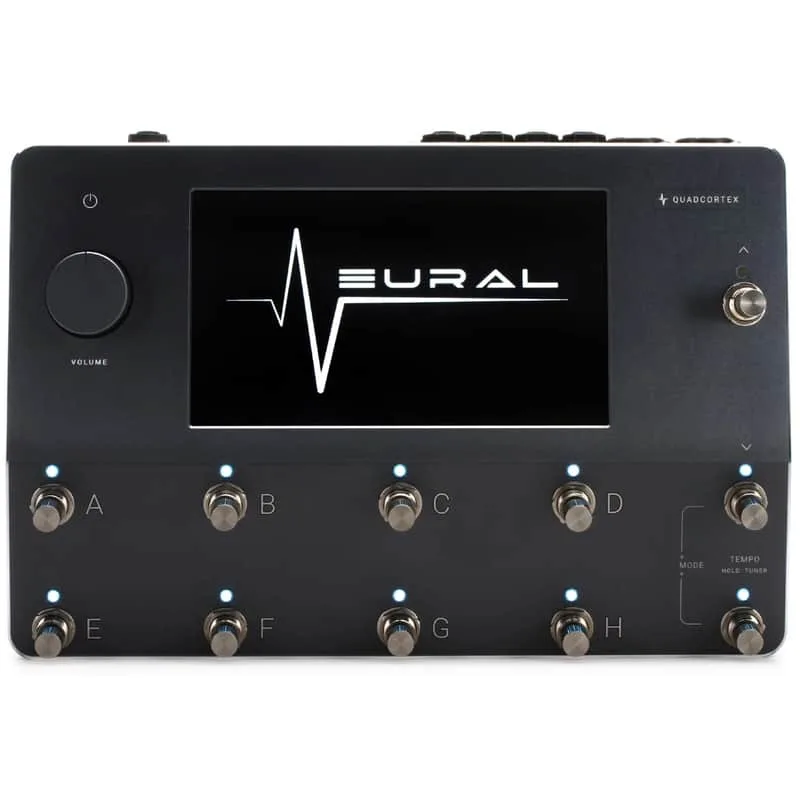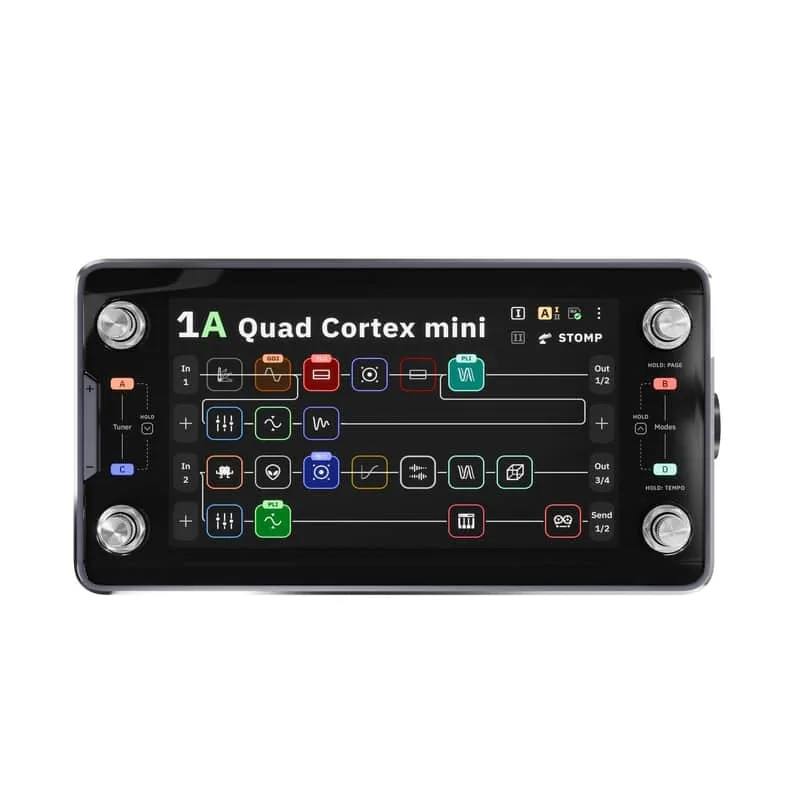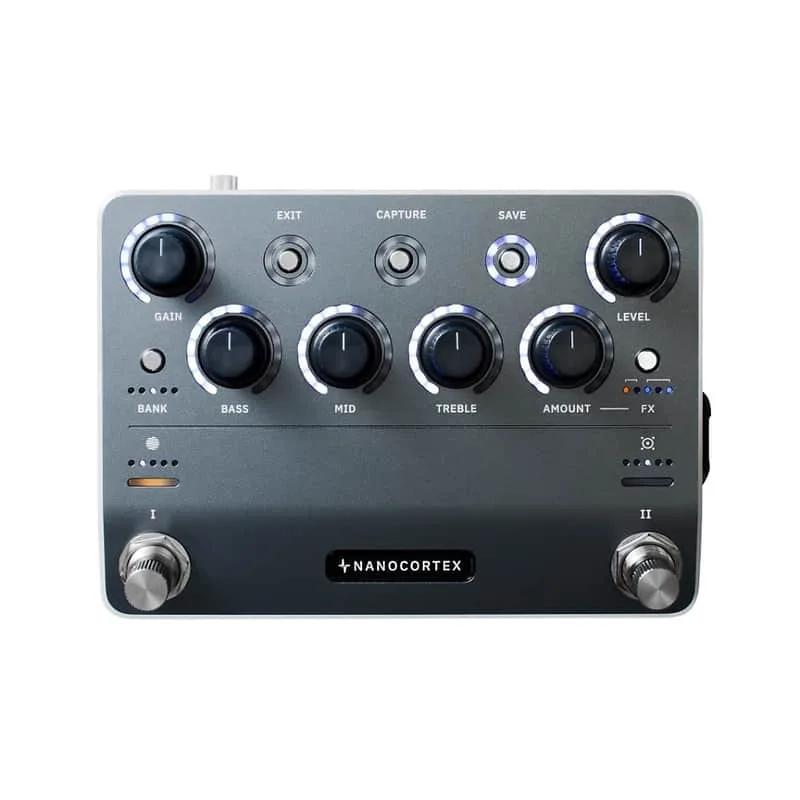


The Neural DSP Nano Cortex is a compact amp, cab and effects unit in a metal housing, built around a single signal path: input compression, an overdrive or amp/cab capture block, then modulation, delay and reverb1. It is Neural DSP's second-ever hardware product, following the Quad Cortex, which reviewers describe as its big brother12. What sets it apart from most multi-effects pedals is capture: you can profile your own amp, speaker, microphone and mic pre together and store that as a model on the unit1.
It launched at $5693 and carries a list price of $549 in the US, £499 including VAT in the UK4. Guitar.com's reviewer called the original Nano Cortex "a fantastic and great value point of entry into the world of Neural's fantastic ecosystem"2.
What the Nano Cortex does
The unit runs everything on one signal path rather than the flexible routing of a full modeler: compression at the input, then a drive or captured amp and cab block, then post-IR effects1. Mason Marangella of Vertex Effects, one of the unit's beta testers, described the capture process as covering the whole chain: "So I'm capturing like, My amp, my speaker, my microphone, my mic pre"1.
Physically it sits between familiar overdrive sizes: slightly bigger than an Analog Man King of Tone, definitely smaller than a Klon1. Guitar.com's reviewer noted the trade-off in its connectivity: "The lack of an effects loop and stereo inputs means that you'll either have to run your stereo pedals after the amp or n"6. There is no stereo input; the outputs are stereo16.
The controls: knobs, LED rings and two footswitches
The top panel carries two momentary buttons, rotary gain and EQ controls, and twin footswitches, all with LED indicators4. Each front-panel knob is surrounded by a segmented LED ring that displays its setting within the recalled preset, so you can see where a preset sits without opening the app4. Sounds are stored as presets, and when one is recalled the two LED rows above footswitch 1 show its bank and slot position4.
| Control | What it does |
|---|---|
| Twin footswitches | Preset selection and bypass, with LED rows above footswitch 1 showing bank and slot4 |
| Rotary gain and EQ controls | Adjust the recalled preset's settings, shown on segmented LED rings4 |
| Two momentary buttons | Exit and capture functions; holding both connects Bluetooth to the app14 |
| Capture footswitch and boost switch | Mounted on the side of the unit1 |
| Headphone knob | Separate level control for the dedicated headphone out1 |
The rear panel also carries a ground-lift switch4. For deeper editing, you hold the exit and capture buttons to connect the unit to the companion app over Bluetooth1.
The effects slots and the models behind them
The signal chain's effects slots are each built on a specific modeled circuit, with the deeper parameters reachable through the app1.
| Slot | What it is | Controls |
|---|---|---|
| Adaptive Noise Gate | Noise gate before the amp block | Adaptive behavior; Sound On Sound's reviewer found it "very effective" and liked that it does not continuously open and close around the cutoff level4 |
| Transpose | Pitch shift | Wet/dry mix, ±12-semitone pitch-shift, separate high-pass and low-pass filters4 |
| Chorus | Neural DSP's model of the Boss DC-2W chorus pedal | App gives wet/dry mix, variable Drive parameter, output level, SDD-320 front-panel switching, Standard/SDD-320 mode switch4 |
| Delay | Emulation of a BBD (bucket-brigade) type analog delay | Wet/dry mix, delay time, feedback, high- and low-pass filters, modulation rate and depth, stereo width, drive, ping-pong off/on4 |
| Reverb | Mind Hall reverb, emulating Lexicon's 224 digital reverb | App-based editing4 |
The chorus slot has two personalities: in Standard mode the DC-2W emulation follows Boss's original 1980s DC-2 Dimension C, while SDD-320 mode emulates Roland's SDD-320 Dimension D4. Guitar.com's reviewer wrote of the reverb: "Neural more than delivers with the Mind Hall Reverb [inspired by the trailblazing Lexicon 224 digital reverb]. It's haun"6.
For cabinet IRs, you get direct access to five of the 10 pre-loaded factory IRs, plus the ability to store and load a further 256 IRs4. Each factory cab IR contains five microphones and six mic positions, a total of 30 IRs per cabinet4. By comparison, the Quad Cortex library can store a maximum of 2048 Neural Captures and 2048 IRs.
Connections and MIDI
The rear panel carries quarter-inch balanced TRS jacks: one for the mono instrument input, two for the mono/stereo output, and one for an expression pedal that doubles as a MIDI I/O port4. The unit is MIDI capable and presets can be changed through MIDI1. The NanOS 2.1 firmware, released in August 2025, brought what Morningstar called "a massive boost in MIDI control," adding incoming MIDI CC for effect block bypass, tempo, tuner and expression control7.
The Capture input does not supply phantom power; it expects a passive dynamic microphone. An adjacent switch applies a 26dB boost to the capture signal4.
What reviewers said
Sound On Sound's Bob Thomas reviewed the original unit in February 2025 and was impressed8. After the NanOS 2.x updates he went further: "I can't think of any other pedal near its price that can equal its sound quality, speedy onboard amp and drive pedal capture, IR loading, effects modelling, computer connectivity and complete portability with a powerbank"8.
Guitar World's Matt McCracken took a different angle in a 2026 roundup: "More of a straight amp capture system rather than a true multi-effects, the Neural DSP Nano Cortex is nonetheless worthy"9. Guitar World's multi-effects buying guide lists its model counts as 256+ amps and 50+ effects5, and Guitar.com's best-effects guide named it best multi-effects10.
Videos
Andertons Music Co
Andertons Music Co
Neural DSP
News
Questions
Can the Nano Cortex be powered over USB?
Yes. Alongside its 9 or 12 volt power input, the Nano Cortex can be bus powered over USB, which makes it easy to run from a powerbank when you are traveling or recording away from a pedalboard power supply.
Does the Nano Cortex capture input supply phantom power?
No. The Capture input does not supply phantom power, so it expects a passive dynamic microphone. There is an adjacent switch that applies a 26dB boost to the capture signal.
Does the Nano Cortex have a stereo input?
No. The instrument input is a single mono quarter-inch balanced TRS jack. The outputs are stereo: two quarter-inch balanced TRS jacks for mono or stereo output, plus a dedicated headphone out with its own level knob.
Can the Nano Cortex change presets over MIDI?
Yes. The unit is MIDI capable and presets can be changed over MIDI. The NanOS 2.1 firmware update, released in August 2025, added incoming MIDI CC control for effect block bypass, tempo, tuner and expression control.
How many IRs can the Nano Cortex store?
It ships with 10 pre-loaded factory cabinet IRs, five of which you can reach directly, and you can store and load a further 256 IRs of your own. Each factory IR contains five microphones and six mic positions, 30 IRs per cabinet.
Sources (10)
- This Pedal Just Changed the Amp Modeling Game, vertexeffects.com, 2024-10-03
- Neural DSP Nano Cortex review: NanOS 2.0 update, Guitar.com, 2025-05-16
- "It's the full power of the Quad Cortex, just in a smaller box": Neural DSP Quad Cortex mini review, MusicRadar, 2026-02-09
- Neural DSP Nano Cortex, Sound On Sound, 2025-02
- Best multi-effects pedals 2026: replace your rig, Guitar World (www.guitarworld.com), 2022-08-25
- Neural DSP Nano Cortex review, Guitar.com, 2024-10-25
- Nano Cortex gets Huge MIDI Control Improvements with NanOS 2.1, Morningstar, 2025-08-04
- Neural DSP NanOS v2.0 & v2.1, Sound On Sound, 2025-02
- HeadRush Flex Prime review, Guitar World, 2024-12-13
- The best effect pedals for all styles and budgets, Guitar.com, 2025-11-05