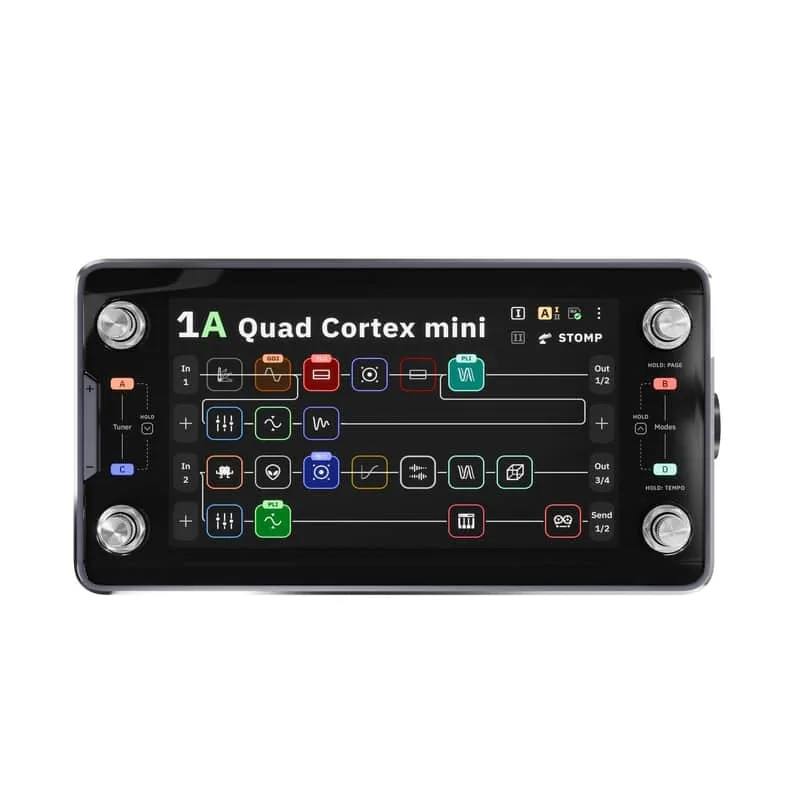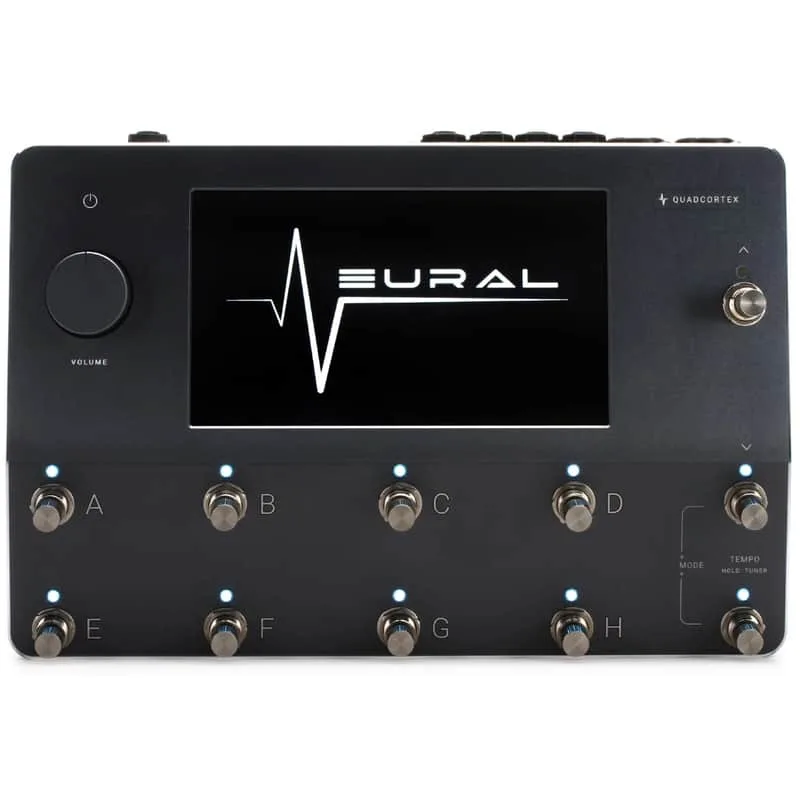


The Neural DSP Quad Cortex is a digital floor modeler from Neural DSP that combines amp modeling, multi-effects and the maker's Neural Capture profiling system in one stage unit. It was first unveiled in 20201 and Neural DSP claims it offers "the most powerful floor modeller on the planet"12. Beyond its stock amp and effects models, Neural Capture lets the unit profile a real amp and store the result as a digitized rig, which Neural DSP describes as "the most comprehensive and detailed detection system, and the most accurate and powerful digitized rigs on the market"3.
The unit is built into an anodised aluminum unibody enclosure with 1.8mm chemically strengthened protective glass manufactured by Corning, and it is made in Finland4. It measures 290 x 190 x 50mm and weighs 1.9kg/4.2lb4.
The controls: 11 footswitches and a 7-inch touchscreen
The Quad Cortex is controlled with 11 footswitches and a 7-inch multi-touch display6. Preset naming takes full advantage of the touchscreen with an on-screen keyboard7. The unit can be configured for Preset, Scene, Stomp and Hybrid playing modes9, and modes can be re-ordered, changing their order when cycling through Modes on The Grid9.
One thing MIDI users should know: when you re-order Modes, MIDI CC values do not adapt to the changes. By default, Preset Mode sits in Mode Slot 1 and is recalled via CC#47 value 0; if Stomp Mode is moved to Mode Slot 1, that same CC#47 value 0 then recalls Stomp Mode9.
Selected MIDI control assignments from the Quad Cortex's MIDI CC list10:
| CC# | Value | Function |
|---|---|---|
| 1 | 0-127 | Expression pedal 1 |
| 2 | 0-127 | Expression pedal 2 |
| 32 | 0-127 | Bank (LSB), Setlist change (Program Change) |
| 35 | 0-127 | Enable/bypass Footswitch A (all modes) |
| 44 | 0-127 | Tempo BPM |
Power and connections
The Quad Cortex runs on a 12 V DC power adaptor, which is included8. Its rear panel carries 2x 1/4" output jacks, 2x XLR output jacks, a headphone output, MIDI in and out/thru, dual expression inputs and a USB audio interface with Cirrus Logic codecs8. Guitar connects to Guitar Input 111.
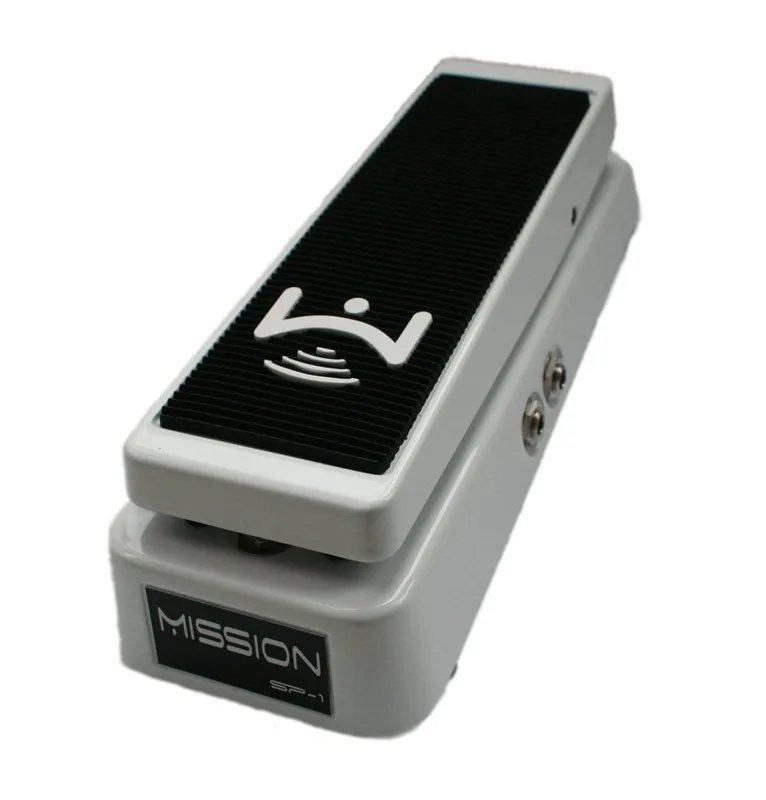
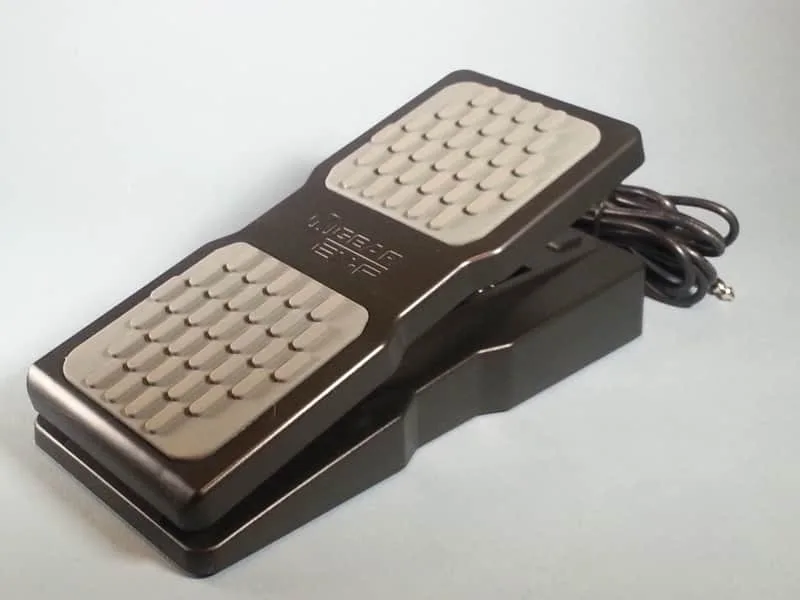
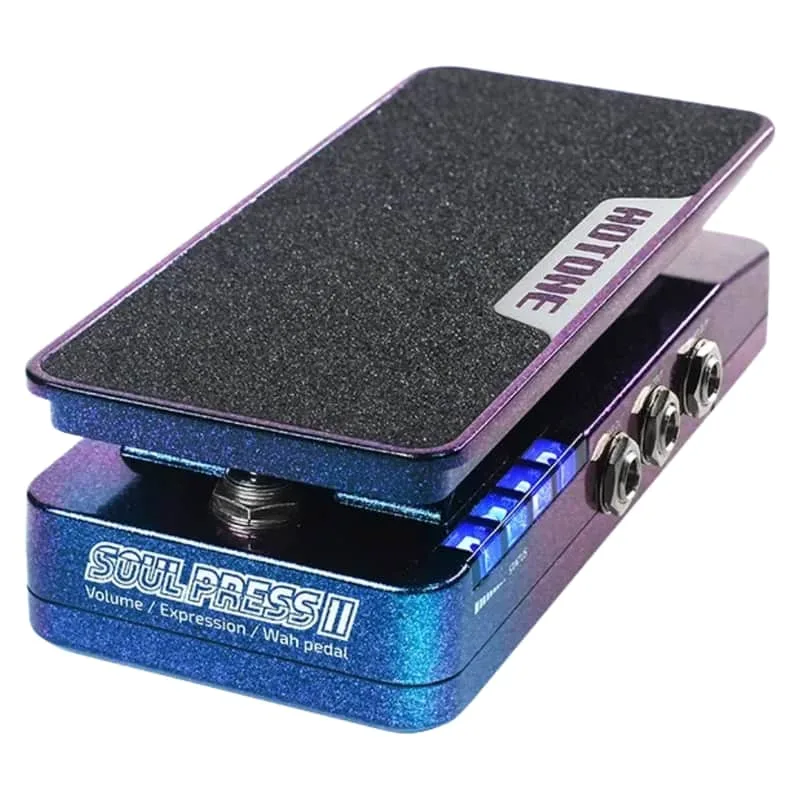
The unit has two expression pedal inputs12. Neural DSP has tested the following pedals with the Quad Cortex with very good results12:
- Mission Engineering SP-1
- M-Audio EX-P
- Roland EV-5
- Hotone Soul Press
- Electro-Harmonix Expression Pedal
- Boss FV-500-L
- Dunlop DVP 3
- Dunlop DVP 4
- DOD FX-17
Using it with a real amp: the four-cable method
The Quad Cortex works with a traditional amp using the four-cable method. In a setup documented by KHE Audio Electronics with their amp switcher, the connections run11:
- Guitar connects to the QC's Guitar Input 1.
- The QC's SEND 1 connects to the KHE GUITAR INPUT jack, sending the guitar signal after the stompbox section to the amp switcher's guitar input.
- The QC's RETURN 1 connects to the KHE FX INPUT jack, connecting the master effects send of the amps to the input of the QC's effect section.
- The QC's OUT 3/L connects to the KHE FX OUTPUT jack, sending the signal after the QC's effect section back to the master effects return and the power amp of the activated amplifier.
In this setup, the Quad Cortex functions as a mono multi-effect unit: only the stompbox and effect blocks are active, and all amp and cab modeling blocks are disabled. A Mono Loop Block is inserted to create the insert point for the amp's effects loops, and the preset must have all amp and cab models deactivated. The QC's own pedals (Boost, Overdrive, Gate and such) are used in front of the amps like normal pedals, and the QC's MIDI can remotely control the KHE presets during patch changes11.
Setlists, presets and modes
Presets on the Quad Cortex are organized into Setlists. A Setlist can contain 32 banks of 8 Presets, and you can create as many Setlists as you like7. Presets save by default in the "My Presets" Setlist, with the option to specify another Setlist when saving7. The Library can store a maximum of 2048 Neural Captures and 2048 IRs13.
Neural Captures offer limited tweaking after the fact: just Gain, Bass, Mid and Treble, with a more limited range than you will find on an amp model14.
Neural DSP recommends that you create a backup before updating your firmware15. Backups go to Cortex Cloud: the Quad Cortex notifies you when a downloaded backup is ready to install and warns that installing it will replace all files currently on the device. If you already have a backup on Cortex Cloud, the unit warns that the existing backup will be replaced with the new one16.
Durability testing
Before release, Neural DSP put the Quad Cortex through a series of environmental and vibration tests, with the unit powered on and a tone running through it to ensure it continued to produce sound17:
- Temperature: placed in a climatic test chamber for 15-minute intervals starting at 0°C (32°F) and 40% humidity, with the temperature increased by 10°C after each interval. It performed flawlessly through to 70°C (158°F), at a level Neural DSP says is expected of military specification components. At 80°C (176°F) the test was cut short after 10 minutes because testers had concerns about the internal battery exploding17.
- Humidity: passed a 15-minute test at 70°C (158°F) and 95% humidity with no issues17.
- Vibration: passed three standardized 30-minute vibration tests at random frequencies, matching a lorry or van, mild aircraft turbulence and severe aircraft turbulence, each with a 100% pass17.
- Resonant frequency: operational for the full 40-minute resonant frequency test and passed, with vibration amplitude increased up to 20 G17.
What reviewers said
Guitar.com gave the Quad Cortex a 10/10 review, calling it a game-changing guitar product of the decade4. In GuitarPlayer's round-up, Dave Hunter's overall verdict was:
"From any angle, the Quad Cortex is a clever, feature-packed, well-built, and great-sounding unit. What's more, it's truly fun and inspiring to play and easy to use," earning an Editors' Pick Award18.
In MusicRadar's 2026 multi-effects guide, Alex Lynham wrote:
"The quality of the sounds is exceptional. That processing power is really brought to bear on the signal path. Even the most complex rigs are rendered with superb fidelity, and with the promise that more is to come, it suddenly begins to look like money well spent."19
Price history
The Quad Cortex launched at $1599/€159920, with 1000 units available for pre-order at the Neural DSP website3. Neural DSP raised the price in June 2021 because supply chain disruptions during and after COVID-19 raised component costs; with those costs since normalized, the maker decreased the global MSRP to $1699/€1699 (inc VAT) effective October 2, 202321. Later published figures differ: Guitar World's 2026 review of the Quad Cortex mini lists the full Quad Cortex at $1,849, £1,449 and €1,58522, while MusicRadar's 2026 guide lists it at $1799/£1449/€16691423.
The Quad Cortex and the smaller Cortex units
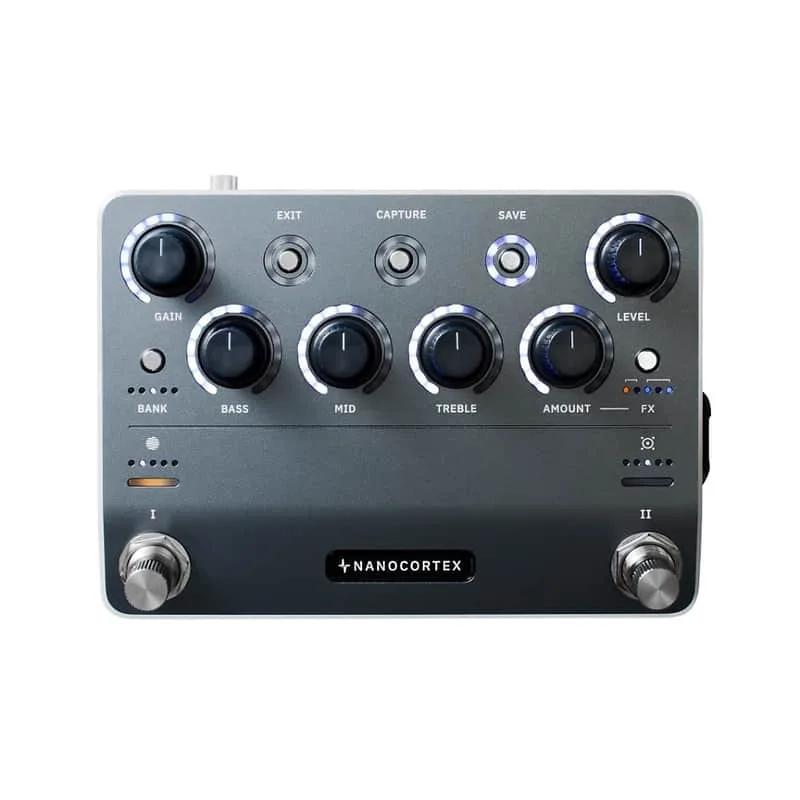
The Quad Cortex now sits at the top of a three-unit Cortex range. The Quad Cortex mini, debuted at NAMM 2026, is roughly a third of the size and keeps the QC's functionality intact, with the same processing power, the same seven-inch screen size and the full Neural Capture technology241. It has four footswitches instead of 11, and one expression pedal output instead of two, with a second requiring a MIDI connection6. MusicRadar's review found the mini's Etch-A-Sketch style editing easier to use than the bigger Quad Cortex's parameter assignment, and rated its sounds five stars, calling it "a little narrow in potential use cases within a live scenario, but a fantastic studio companion"14. The mini sits between the full Quad Cortex and the Nano Cortex in the range24.
Videos
Rhett Shull
Sweetwater
Andertons Music Co
News
Questions
Can the Quad Cortex capture my own amp?
Yes. Neural Capture is the Quad Cortex's profiling system, and Neural DSP describes it as the most comprehensive and detailed detection system, producing what the maker calls the most accurate and powerful digitized rigs on the market. Captures are stored in the Library, which holds up to 2048 Neural Captures. Note that tweaking after a capture is limited to Gain, Bass, Mid and Treble, with a more limited range than an amp model.
How many presets can the Quad Cortex hold?
A Setlist contains 32 banks of 8 presets, and you can create as many Setlists as you like. Presets save by default in the My Presets Setlist, with the option to specify another Setlist when saving. The Library can also store a maximum of 2048 Neural Captures and 2048 IRs.
Does the Quad Cortex work with an amp using the four-cable method?
Yes. Guitar goes into Guitar Input 1, SEND 1 feeds the amp's input, the amp's effects send returns into RETURN 1, and OUT 3/L sends the signal back to the amp's effects return. A Mono Loop Block creates the insert point, and all amp and cab models must be deactivated on the preset so the unit runs as a mono multi-effect with only stompbox and effect blocks active.
Which expression pedals work with the Quad Cortex?
The Quad Cortex has two expression pedal inputs. Neural DSP has tested the Mission Engineering SP-1, M-Audio EX-P, Roland EV-5, Hotone Soul Press, Electro-Harmonix Expression Pedal, Boss FV-500-L, Dunlop DVP 3, Dunlop DVP 4 and DOD FX-17 with very good results. Over MIDI, CC# 1 controls Expression pedal 1 and CC# 2 controls Expression pedal 2.
How do I back up the Quad Cortex before a firmware update?
Neural DSP recommends creating a backup before updating firmware. Backups go to Cortex Cloud: the Quad Cortex notifies you when a downloaded backup is ready to install and warns that installing it will replace all files currently on the device. If you already have a backup on Cortex Cloud, the unit warns that the existing backup will be replaced with the new one.
What is the difference between the Quad Cortex and the Quad Cortex mini?
The mini is roughly a third of the size of the Quad Cortex and keeps its functionality intact, with the same processing power, the same seven-inch screen size and the same Neural Capture technology. It has four footswitches instead of 11, and one expression pedal output instead of two, with a second requiring a MIDI connection. It sits between the full Quad Cortex and the Nano Cortex in the Cortex range.
Sources (24)
- Neural DSP debuts the Quad Cortex mini, Guitar World, 2026-01-21
- HeadRush debuts Prime, “the most powerful, versatile floorboard FX ever”, Guitar World, 2023-03-21
- NAMM 2020 VIDEO: Neural DSP's AI-powered floor modeller is 'Vulgar Display of Power', MusicRadar, 2020-01-18
- Neural DSP Quad Cortex review: is this the game-changing guitar product of the decade so far?, Guitar.com, 2021-07-01
- Watch: Can the Quad Cortex capture vintage Fender Deluxe and Marshall Super Bass tones?, Guitar.com, 2021-09-16
- Best multi-effects pedals 2026: replace your rig, Guitar World (www.guitarworld.com), 2022-08-25
- Setlists!, Neural DSP, 2020-09-04
- Best multi-effects pedals 2026: Intensify your tone, MusicRadar, 2022-10-19
- Quad Cortex Development Update #28, Neural DSP, 2022-09-29
- Voes | MIDI-CC, Voes, 2024
- KHE + Neural Quad Cortex 4CM, KHE Audio Electronics
- Quad Cortex Expression Pedal Compatibility, Neural DSP, 2021-02-02
- CorOS 3.0.0 and Cortex Control 1.1.0 are now available, Neural DSP, 2024-07-30
- "It's the full power of the Quad Cortex, just in a smaller box": Neural DSP Quad Cortex mini review, MusicRadar, 2026-02-09
- CorOS 3.0.1 and Cortex Control 1.1.1 are now available, Neural DSP, 2024-09-11
- Cloud backups!, Neural DSP, 2020-09-25
- Durability tests!, Neural DSP, 2020-09-18
- Best multi-effects pedals 2026: do-it-all multi-FX, GuitarPlayer (www.guitarplayer.com), 2021-11-10
- Best multi-effects pedals 2026: Intensify your tone, MusicRadar, 2022-10-19
- The best new effects pedals of NAMM 2020, MusicRadar, 2020-01-24
- Quad Cortex MSRP Decrease, Neural DSP, 2023-10-02
- Neural DSP Quad Cortex mini review, Guitar World, 2026-02-04
- Hotone Ampero II Stage review, MusicRadar, 2026-09-24
- Neural DSP Quad Cortex Mini review: too good to be true?, Guitar.com, 2026-02-20
 Rabea Massaad