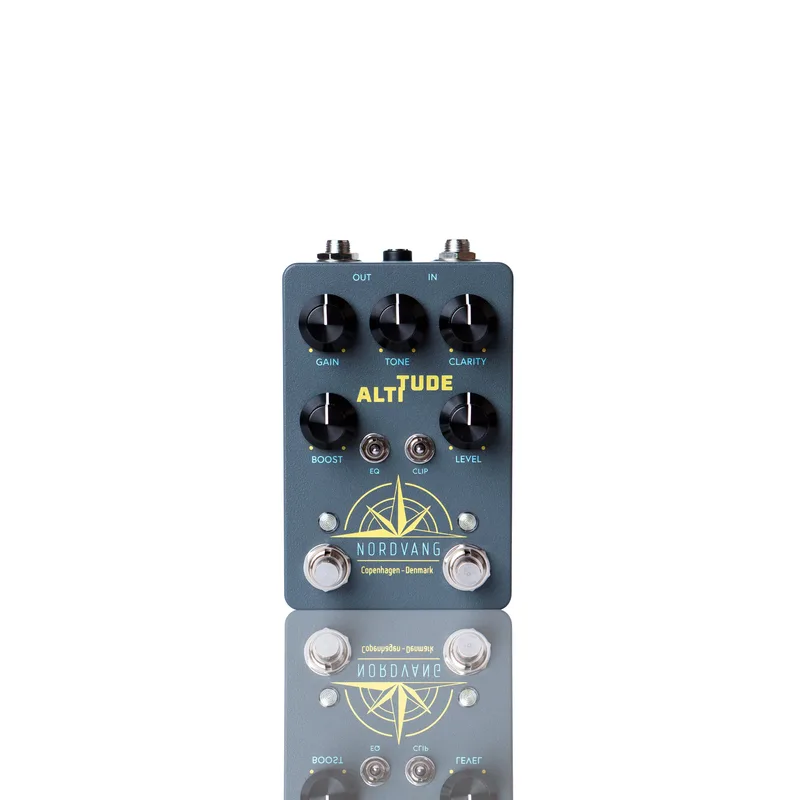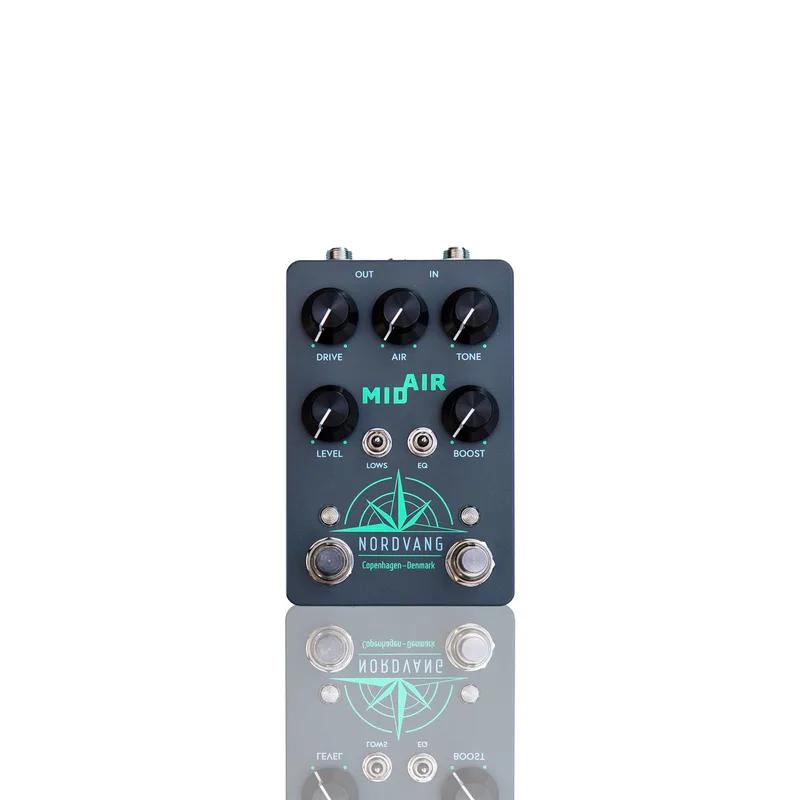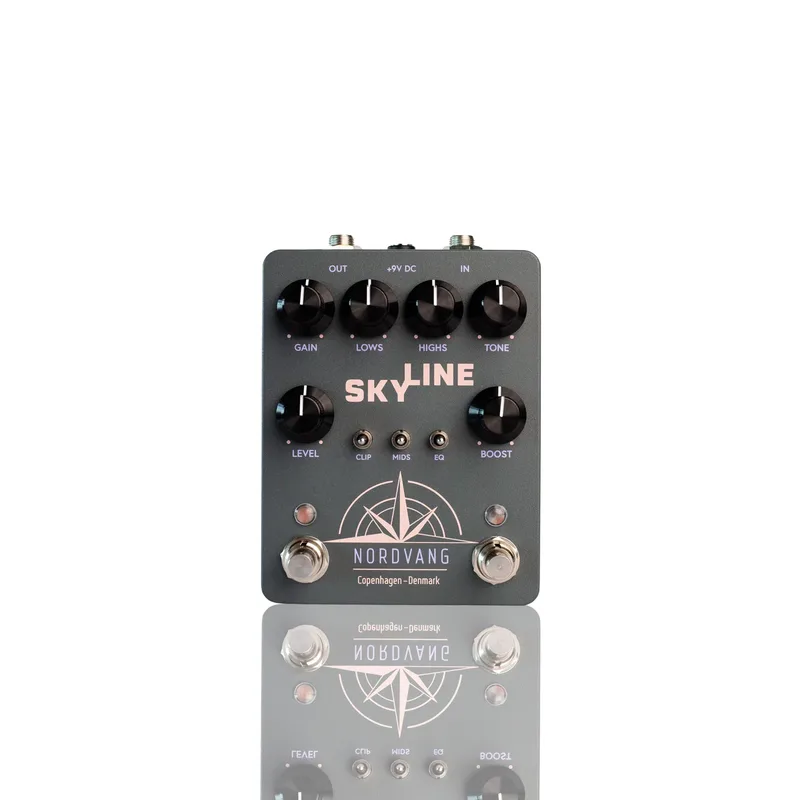


The Nordvang Custom Skyline V2 is an overdrive pedal with an integrated clean boost, built on what the maker describes as the "Timmy" topology1. The drive side covers a range of sounds: Nordvang Custom says that at higher settings it reaches a saturated, mid-forward, TS-inspired drive, and that the pedal works as an always-on platform or a more aggressive drive1. The boost is a separate circuit that sits before the drive and can be used on its own1.
The V2 expands on the original Skyline with two additional toggle switches for clipping and mid-push shaping, and to fit them Nordvang Custom moved the pedal into a slightly larger 1590BB enclosure1. The pedal is listed at £285.63 GBP on the maker's site1.
An overdrive with a separate clean boost
The Skyline V2 is really two circuits in one box. The main overdrive section does the clipping and tone shaping, while the boost circuit is pre-drive, meaning it feeds into the drive section, and it can be used independently of the main drive circuit1. Nordvang Custom calls it a "clean" boost built around an op-amp, not meant to color the tone1. For a player, that means you can push the front of the overdrive harder for more saturation, or run the boost alone into your amp as a volume lift for solos.
The circuit lineage is a selling point the maker states plainly: the drive is based on the Timmy topology1. Guitar Pedal X's Stefan Karlsson, in his overview of Nordvang Custom's overdrive and boost pedals, likewise identifies the Skyline as a Timmy-based design2. At the higher end of the gain range, Nordvang Custom says the character shifts toward a saturated, mid-forward, TS-inspired drive1, so the pedal moves between two well-known overdrive voices rather than sitting at one extreme.
Karlsson found the format versatile, writing that:
"The top dip-switch certainly offers some help with the compression side of the pedal, and there are some robust EQ elements"2
Guitar Pedal X, Stefan Karlsson2
The controls
The front panel splits between the overdrive section and the boost section, with two footswitches, one for drive and one for boost2.
| Control | What it does |
|---|---|
| Gain, Tone, Level | Standard controls for shaping the overdriven sound1 |
| HIGHS knob | Adjusts the high-frequency response of the overdrive section, enhancing clarity and introducing grit and saturation clockwise1 |
| LOWS knob | Regulates the low-frequency response of the gain and clipping stage across the entire sweep1 |
| Boost knob | Controls the gain of the boost circuit, from unity at minimum to an 18 dB boost at max1 |
| EQ toggle (boost) | Three-position toggle giving three voicings: full frequency, low-mids and high-mids1 |
| Drive footswitch | Engages the overdrive section2 |
| Boost footswitch | Engages the boost circuit2 |
The LOWS control is worth a note for anyone who has used overdrives where the bass control only thins the sound at one end of its sweep: here Nordvang Custom says it regulates the low-frequency response of the gain and clipping stage across the entire sweep1.
Inside the pedal there are further shaping options. An internal HIGHS dip-switch works with the tone knob, altering the high-cut parameter for the tone control1. Guitar Pedal X's overview of the original Skyline lists the internal switching in detail: a three-position dipper selecting clipping configurations (clip on, two symmetrical diodes, three asymmetrical diodes, five asymmetrical diodes, or symmetrical diodes) and a two-position dipper for a lows boost or a mids boost2. The V2's two additional toggle switches bring clipping and mid-push shaping to the outside of the pedal, which is what moved it into the larger 1590BB enclosure1.
The boost section's EQ toggle gives three voicings, full frequency, low-mids and high-mids, so the boost can be voiced to sit differently against the drive or your amp rather than being a flat lift only1.
Bypass modes and power
The Skyline V2 lets you choose its bypass behavior. An internal dip switch selects buffered or true bypass1. The buffer circuit is an NPN transistor input buffer with an input impedance of 510K Ohm, which Nordvang Custom notes is like a TS, followed by an op-amp output buffer with a 100 Ohm output impedance1. Players who run long cable runs or many true-bypass pedals can leave the buffer on; players who want the pedal fully out of the chain when off can switch to true bypass.
If the pedal is set to buffered bypass and the power fails, it automatically switches to true bypass and lets signal through, including while the pedal is engaged1. A dead supply will not cut your signal mid-song.
Power comes from an external supply only: there is no battery operation1. The maker lists the supply current as 100 mA1, so it needs a power output that can deliver at least that, and it is worth accounting for if you share one supply across several pedals.
Nordvang Custom also lists the components inside: Vishay metal film resistors, WIMA audiophile capacitors, Taiway switches and Pure-Tone jacks1.
Videos
Ambient Endeavors
THE PEDAL COLLABORATIVE
Questions
Is the Nordvang Skyline V2 true bypass or buffered?
It can be either. An internal dip switch selects buffered or true bypass. The buffered mode uses an NPN transistor input buffer with 510K Ohm input impedance, like a Tube Screamer, followed by an op-amp output buffer with 100 Ohm output impedance.
What happens to the signal if power fails in buffered mode?
If the pedal is set to buffered bypass and the power fails, it automatically switches to true bypass and lets your signal through, including while the pedal is engaged. You keep playing rather than going silent.
Can the Skyline V2 run on a battery?
No. Nordvang Custom states there is no battery operation, so the pedal needs an external power supply. It draws 100 mA, which is worth noting if you run it from a shared or daisy-chain supply.
How much current does the Skyline V2 draw?
The maker lists the supply current as 100 mA. That is modest for a modern pedal but higher than a simple analog overdrive, so check your power supply's capacity per output.
Can the boost on the Skyline V2 be used without the overdrive?
Yes. The boost circuit sits before the drive circuit and can be used independently of it. It is a clean boost built around an op-amp, designed not to color the tone, with up to 18 dB of gain on tap.
Is the Skyline V2 based on the Timmy?
Yes. Nordvang Custom describes the circuit as based on the Timmy topology, and Guitar Pedal X's overview of the Skyline likewise lists it as a Timmy-based design. At higher gain settings the maker says it moves toward a saturated, mid-forward, TS-inspired drive.
Sources (2)
- SKYLINE V2, Nordvang Custom
- Guitar Pedal X, Guitar Pedal X, 2024-06-11