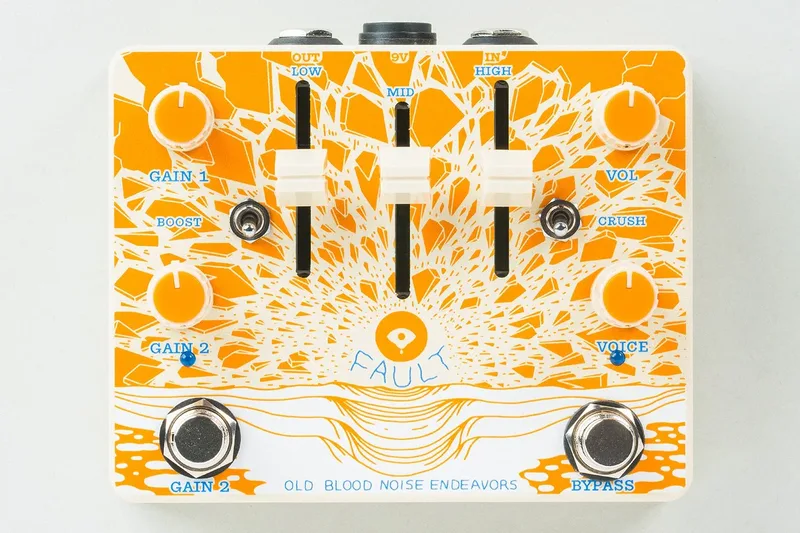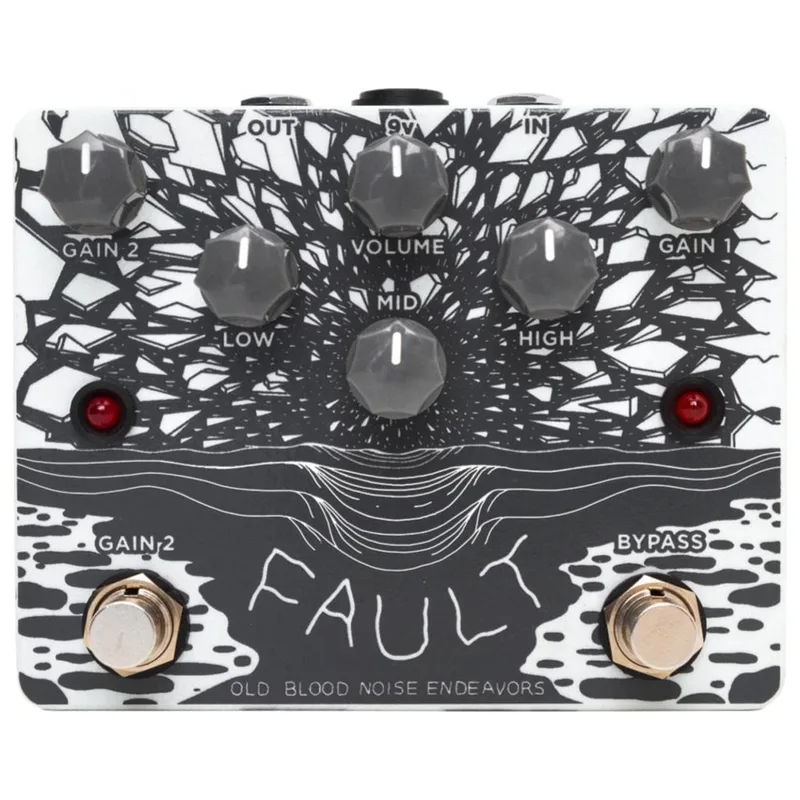

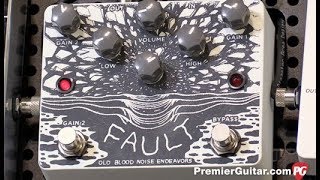

The Fault is an overdrive/distortion pedal from Old Blood Noise Endeavors, an Oklahoma City maker better known for ambient and atmospheric effects. The Fault is a more straightforward entry in the maker's lineup: a two-channel cascading gain circuit with an active three-band EQ, aimed at players who want natural amp breakup rather than a specialty texture12. OBNE describes the current Fault V2 as "an overdrive pedal that ranges from boost to distortion"3.
The core idea is that the pedal stacks two gain stages you can switch independently, then shapes the result with an EQ that cuts or boosts. Premier Guitar's reviewer called it "an exceptional sounding one, readily able to move from mild crunch to full-blown breakup bliss"1.
A two-stage overdrive with an active EQ
The Fault's circuit is built around two cascading gain channels. Gain 1 sets the intensity of the first stage, and the pedal can go from light, almost clean boost to tight and crunchy gain on that stage alone4. Gain 2 is a separate, higher gain range that you bring in with its own footswitch, and it reacts to wherever Gain 1 is set, so the second stage drives an already-driven signal rather than starting from scratch14.
OBNE says the two gain controls are interactive, which is what gives the pedal its spread: a low Gain 1 setting with Gain 2 engaged behaves differently from a hot Gain 1 setting with the same Gain 2, and the gearnews write-up of the V2 noted that this interactivity potentially leaves "a wealth of drive tones at your fingertips"5.
The EQ is the other half of the design. It is an active three-band EQ, and according to Brady Smith of OBNE, quoted in the Delicious Audio review of the original, it was first developed for the OBNE EQ Buffer; the review summed up the pedal as "essentially their active EQ in a mid-range drive"2. The three bands are precise rather than generic tone controls:
| Band | EQ behavior | Control on the V2 |
|---|---|---|
| Low | 100 Hz shelf filter | Low slider14 |
| Mid | 500 Hz bell curve | Mid slider14 |
| High | 3 kHz shelf filter | High slider14 |
The EQ sits after the drive stages and works in a cut/boost configuration shared by both gain channels, so it shapes the driven signal rather than the clean one going in1. MusicRadar described the V2's three sliders as offering "a tactile and precise control experience for players who need to dial in and edit" their tone on the fly4.
A single Volume knob controls the master output1.
Controls and switches
Beyond the two gain knobs and the EQ, the Fault V2 carries two toggles that extend its range354:
| Control | What it does |
|---|---|
| Vol | Sets the master output level31 |
| Gain 1 | Sets the intensity of the first gain stage, light to tight and crunchy4 |
| Voice | Sets the overall tone of the drive heading into the three-band EQ4 |
| Gain 2 | A higher gain range, introduced when the Gain 2 footswitch is pressed31 |
| Boost toggle | Sets the range and voice of Gain 1, from clean to mean35 |
| Crush toggle | Adds additional clipping at the very last stage in the circuit, after the EQ35 |
The Crush toggle is the V2's final-stage trick. Because it clips after the EQ, it hits a signal that has already been driven and tonally shaped. Guitar.com describes this section as engaging hard diode clipping, and MusicRadar frames it as a way "to shape one final clipping stage before the pedal's output"64. The Boost toggle, meanwhile, changes what the Gain 1 knob itself is capable of, effectively giving the first stage two personalities35.
The pedal uses dual footswitches: one for bypass, one to engage the Gain 2 channel1.
Power: 9V, 60mA
The Fault V2 requires a 9V DC center negative power supply with a 2.1mm jack, capable of 60mA, and the supply is not included3. There is no battery option; Premier Guitar's review of the original noted "No dice if you're interested in a 9V battery option," since the pedal only works via its 9V jack1.
No battery compartment means the Fault needs a spot on a power supply from day one. The center negative polarity and 2.1mm jack match the standard used by most isolated pedalboard supplies and daisy chains.
The original Fault and the V2
The original Fault launched as what Delicious Audio called "the latest straightforward entry from Old Blood Noise Endeavors," a pedal that was not technically part of OBNE's Utility Line but was akin to it in spirit and function2. It carried the same core concept: two cascading gain stages, the active EQ, dual footswitches, and true bypass, at a $199 street price at the time of Premier Guitar's review17.
In May 2020, OBNE unveiled the Fault V26. The update kept the concept but expanded it. Per gearnews, the V2 "takes the original design further with a greater gain range, voice control and new clipping options"5, and MusicRadar likewise cited greater gain ranges, the Voice control, and the clipping options as what makes the V2 a more versatile gain pedal4. The V2 also moved the three-band EQ to sliders4.
Pricing has shifted with the update: the V2 launched at $209 in May 20208, and the maker's current product page lists it at $229.003.
What reviewers said
Published reviews of both versions have been positive about the sound. Premier Guitar's reviewer found the original delivered "nice natural amp breakup from a two-channel cascading gain circuit" and described the output as natural feeling, characteristic of an amplifier pushed to its limits1. The same review called the 3-band EQ's cut/boost configuration useful1.
"the OBNE Fault is an exceptional sounding one , readily able to move from mild crunch to full-blown breakup bliss"
On the V2 side, the launch coverage focused on versatility: gearnews framed it as "way more control, way more tones" compared with the original, and MusicRadar pitched it as a pedal for players who want overdrive and distortion in one box rather than choosing between them54. OBNE's own positioning is similar: "A wide control set can make this the only gain pedal on your board, though of course it loves to stack as well"3.
Where it sits in the OBNE lineup
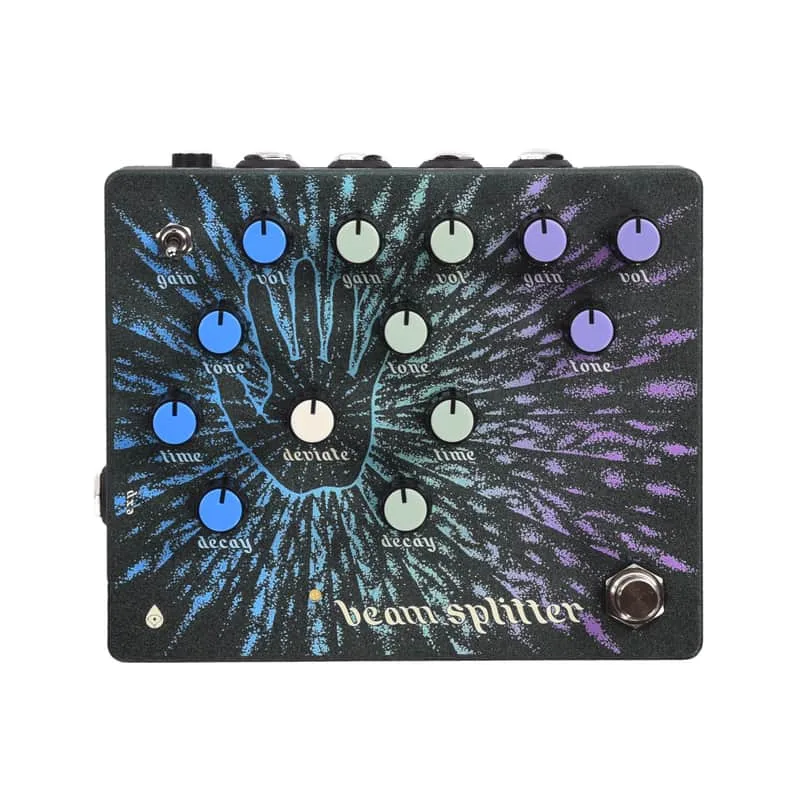
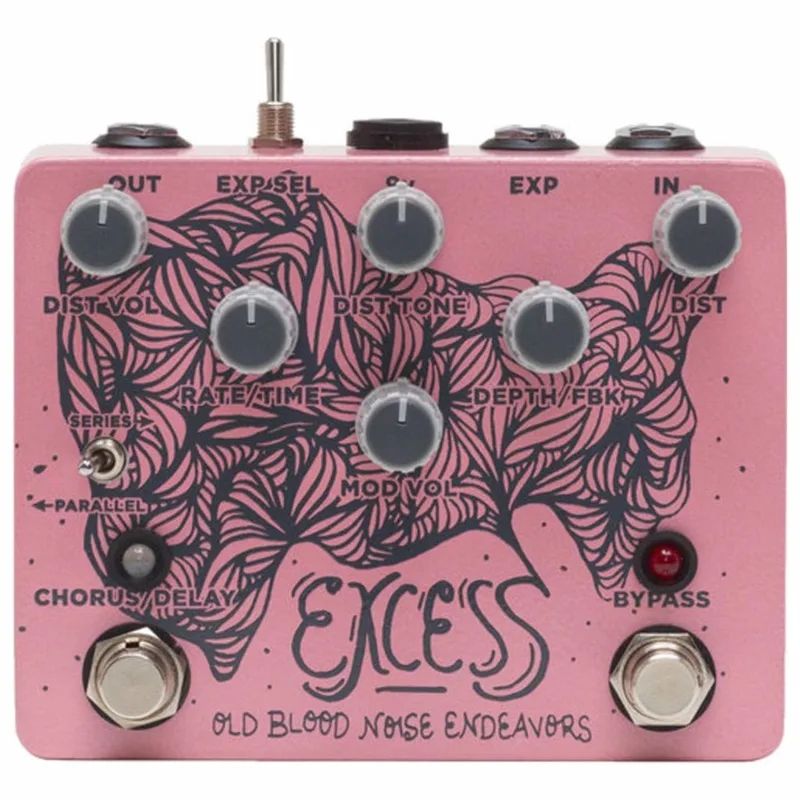
The Fault is OBNE's straightforward gain pedal, but not the maker's only take on drive. The Beam Splitter is a triple-tracker overdrive/distortion that splits the signal across three drive paths, and the Excess is a distortion paired with modulation, offering delay, chorus and fifth modulation modes. Players comparing gain pedals more broadly can also look at the site's pages on overdrive pedals and distortion pedals213.
Videos
Premier Guitar
Premier Guitar
Old Blood Noise Endeavors
News
Questions
Does the OBNE Fault run on a battery?
No. The Fault only works through its 9V DC power jack, and there is no battery compartment. The V2 requires a 9V DC center negative 2.1mm power supply capable of 60mA, which is not included with the pedal, so you need a separate supply or an isolated output on your pedalboard power brick.
Is the Old Blood Noise Endeavors Fault true bypass?
Yes. The Fault V2 uses a soft-touch bypass footswitch for true bypass and minimal switch noise, and reviewers of the original Fault also described the pedal as true bypass. When the pedal is off, your signal passes through without buffering.
What does the Crush switch do on the Fault V2?
Crush is a toggle that adds additional clipping at the very last stage in the circuit, after the EQ. Guitar.com describes this section as engaging hard diode clipping, and MusicRadar says it lets you shape one final clipping stage before the pedal's output. It is a way to push the already-driven signal harder at the end of the chain.
How do Gain 1 and Gain 2 work together on the Fault?
Gain 1 sets the intensity of the first gain stage, ranging from light to tight and crunchy gain. Gain 2 is a second, higher gain range activated by its own footswitch, and it reacts to wherever you have set Gain 1. OBNE says the two gain controls are interactive, so the combination gives you a wide spread of drive tones.
What frequencies does the Fault's EQ cover?
The active three-band EQ uses a 100 Hz shelf filter on the low end, a 500 Hz bell curve in the mids, and a 3 kHz shelf filter for the high end, in a cut/boost configuration shared by both gain stages. On the V2 the three bands are set with sliders for Low, Mid, and High.
Sources (8)
- Old Blood Noise Endeavors Fault Review, Premier Guitar, 2017-12-01
- Review: Old Blood Noise Fault OD/Distortion by Gearphoria, Delicious Audio, 2017-08-10
- Old Blood Noise Endeavors, Old Blood Noise Endeavors
- Why choose between overdrive and distortion when the Old Blood Noise Endeavours Fault V2 pedal gives you both, MusicRadar, 2020-05-19
- Old Blood Noise Endeavors Fault V2 overdrive: Way more control, way more tones, gearnews.com, 2020-05-15
- Old Blood Noise Endeavors launch the Fault V2 overdrive/distortion, Guitar.com, 2020-05-18
- Old Blood Noise Endeavors' Fault is a refreshing take on distortion pedals, gearnews.com, 2017-06-18
- Old Blood Noise Endeavors debuts versatile, slider-equipped Fault V2 overdrive/distortion pedal, Guitar World, 2020-05-15