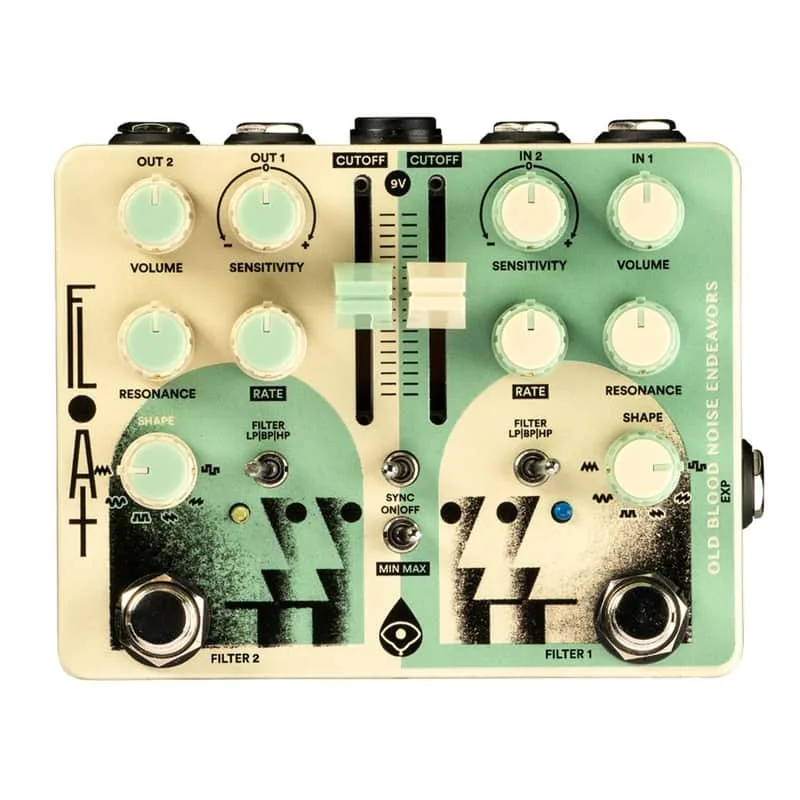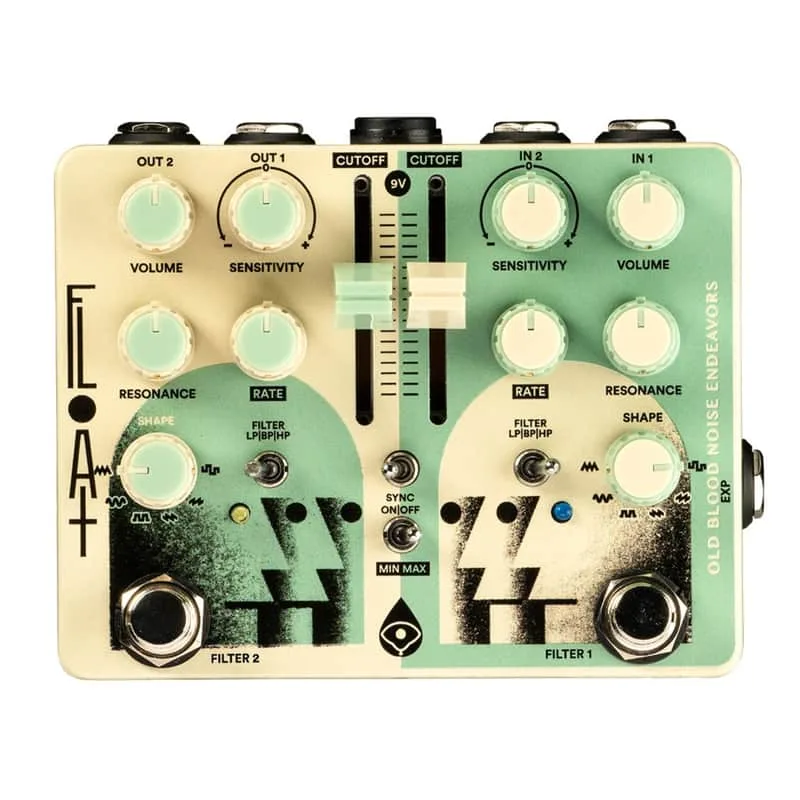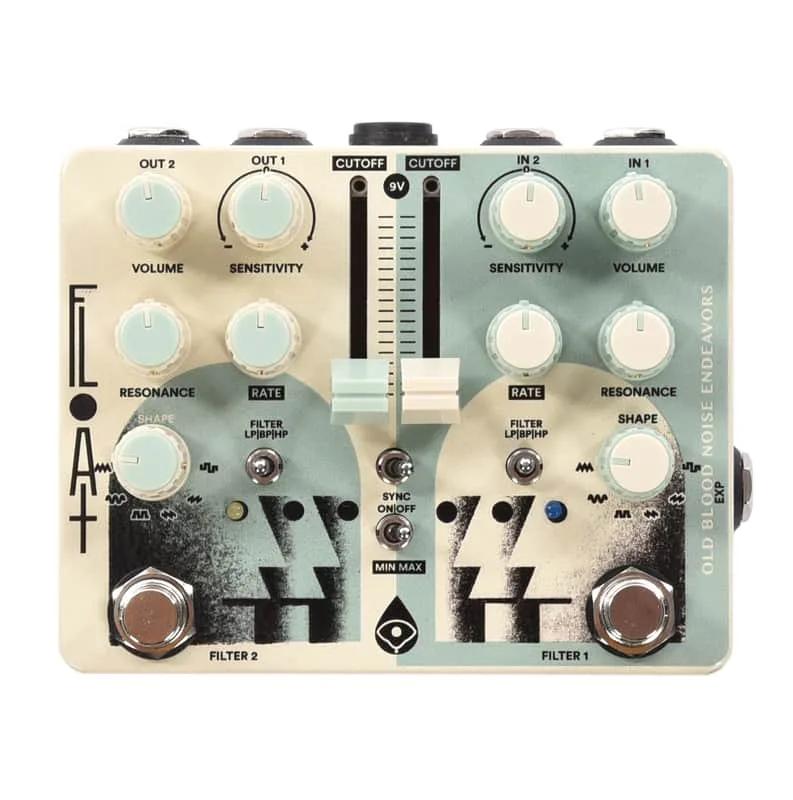


The Old Blood Noise Endeavors Float is a dual analog filter pedal with two independent, independently controllable filters in one box. Each filter can be set to low pass, band pass or high pass, and each has its own controls for cutoff, resonance, LFO rate, envelope sensitivity, LFO shape and volume. The two sides can be routed as true stereo, parallel mono, or series mono, and used together they can produce stereo movement, linked reactive effects, and modulations that press outlets described as approaching harmonic tremolo and phaser as well as classic filter sounds12.
Old Blood Noise Endeavors revealed the Float in late July 202234. Guitar.com's review noted that it is the company's first ever digitally-controlled analog pedal: the control scheme is digital while the filtering itself remains analog5.
Two filters in one pedal
The core of the Float is its pair of independent filters. MusicRadar described the Dual Moving Filter as the result of two years of work, with the two filters independently controllable and many ways to control their motion1. Each filter can be set to low pass, band pass or high pass, so one side can, for example, sweep highs while the other sweeps a band, and the two can be optionally synced together18.
Because the filters move, the pedal covers more ground than a static EQ. Gearnews described the range as matching harmonious tremolo and phaser effects as well as classic filter sounds9. Old Blood Noise's own description of what the pedal can access runs from "quacky auto-wahs, shooting sonic laser beams or organically rising and falling filter landscapes… plus a mind-bending modulation device that can become everything from a phaser, a harmonic tremolo, a choppy or bubbly step-filter or an automated synth-like sweeper"1.
The controls
Each filter section carries the same control set, and the pedal has two of everything5:
| Control | What it does |
|---|---|
| Cutoff | Sets the filter's cutoff frequency; implemented as a slider on each filter section, which Gearnews found easy to tweak live during a performance9 |
| Sensitivity | Sets envelope sensitivity, how strongly your playing drives the filter587 |
| Resonance | Sets the emphasis at the cutoff point587 |
| Rate | Sets LFO speed587 |
| Wave shape | Selects among 6 LFO waveshapes9 |
| Volume | Sets the level of that filter section587 |
| Filter type | Low pass, band pass or high pass, per filter1 |
| Min/Max mini switch | Sculpts the LFO and envelope range of the effect9 |
Footswitches are also doubled up: the pedal carries two low/band/high-pass filter footswitches and two bypass footswitches, so each filter can be engaged or switched independently5.
Routing: stereo, parallel or series
The Float's dual inputs and dual outputs allow three routings5:
- True stereo: each filter feeds its own output for a wide, moving stereo image12
- Parallel mono: the two filters run side by side into a mono output12
- Series mono: one filter feeds into the other for stacked filtering12
Guitar.com's reviewer, Jason Mays, found this flexibility to be the pedal's standout quality, writing that "perhaps the Float's best feature is its musical duality when running a stereo setup," a lush pulsating effect he described as unique to this pedal's stereo operation5.
Expression control
The Float has an expression pedal input, and an external expression pedal can control Cutoff or Rate for each of the filters15. That means you can sweep a filter by foot in real time rather than leaving its motion to the internal LFO or the envelope follower, which suits players who want manual wah-like control over an otherwise automated effect.
Power and connections
The Float runs on 9V DC with a center negative plug and draws 100mA6. Delicious Audio's product page specifies that it requires at least 100mA of 9V DC center negative power2, and Guitar.com's review confirms it is powered by a 9-volt mains supply only, with true bypass switching5.
There is no battery option: the Float is mains supply only, and it needs a power output that can deliver at least 100mA25. On a compact pedalboard power supply, check that the output assigned to it has the headroom.
Price and availability
The Float launched at $299 USD, a figure consistent across MusicRadar, Guitar World, Gearnews and Delicious Audio at the time1109. UK pricing varied by outlet: MusicRadar listed £299, Gearnews listed £271, and Guitar.com's review a month later listed £295159.
What reviewers said
Guitar.com's Jason Mays reviewed the Float in August 2022 and highlighted its stereo operation as its best feature5. MusicRadar's Rob Laing, covering the launch, called it "a filter pedal taken to the max of potential, and if you fall on the side of otherworldly with your pedal tone tastes" it was worth trying1. The pedal also has a longer tail in the press: a 2026 Guitar.com review of another pedal cited the Float as a controllable and alternative set of filters worth knowing about11.
Videos
The Pedal Zone
AndyDemos
Old Blood Noise Endeavors
Questions
How much does the Old Blood Noise Endeavors Float cost?
The Float launched at $299 USD in July 2022, with UK press listings ranging from £271 to £299 depending on the outlet and date. Guitar.com's review listed it at £295. The US price was consistent across MusicRadar, Guitar World and Gearnews at launch.
Can the Float run in stereo?
Yes. The Float has dual inputs and dual outputs and can run in true stereo, parallel mono, or series mono. Guitar.com's reviewer found its stereo operation to be perhaps the pedal's best feature, describing a lush pulsating effect unique to running the two filters as a stereo pair.
Can you use an expression pedal with the Float?
Yes. The Float has an expression pedal input, and an external expression pedal can control Cutoff or Rate for each of the two filters. That gives you a way to sweep the filters by foot rather than relying only on the LFO and envelope motion.
What filter types does the Float have?
Each of the two filters can be set to low pass, band pass, or high pass, selected per filter. Each side also has its own volume, sensitivity, resonance, rate, wave shape and cutoff controls, with six LFO waveshapes available.
How much current does the Float draw?
The Float draws 100mA and runs on 9V DC with a center negative plug. It is powered by a 9-volt mains supply only, so there is no battery option, and it needs a power supply or pedalboard output that can deliver at least 100mA.
Sources (11)
- If you think filter pedals are dull you need to hear the new Old Blood Noise Endeavours Float, MusicRadar, 2022-07-28
- Old Blood Noise Float Dual Filter, Delicious Audio, 2022-08-31
- Hear the ethereal (and "ridiculous") sounds of a harp run through a wah pedal, Guitar World, 2022-08-17
- Old Blood Noise Endeavors unveils its first digitally-controlled analogue pedal: Float, Guitar.com, 2022-07-28
- Old Blood Noise Endeavors Float review: Two filters, total lunacy, Guitar.com, 2022-08-30
- Float by Old Blood Noise Endeavors, RockBoard (PedalPedia), 2026
- Best New Pedal Releases, Delicious Audio, 2022-08-02
- The Best Filter And EQ Pedals For Synths, Delicious Audio, 2023-09-14
- Old Blood Noise Endeavors Float: Dual Moving Analogue Filter, gearnews.com, 2022-07-29
- Old Blood Noise Endeavors debuts the Float Dual Moving Filter, Guitar World, 2022-07-28
- EHX Pico Atomic Cluster review, Guitar.com, 2026-04-16