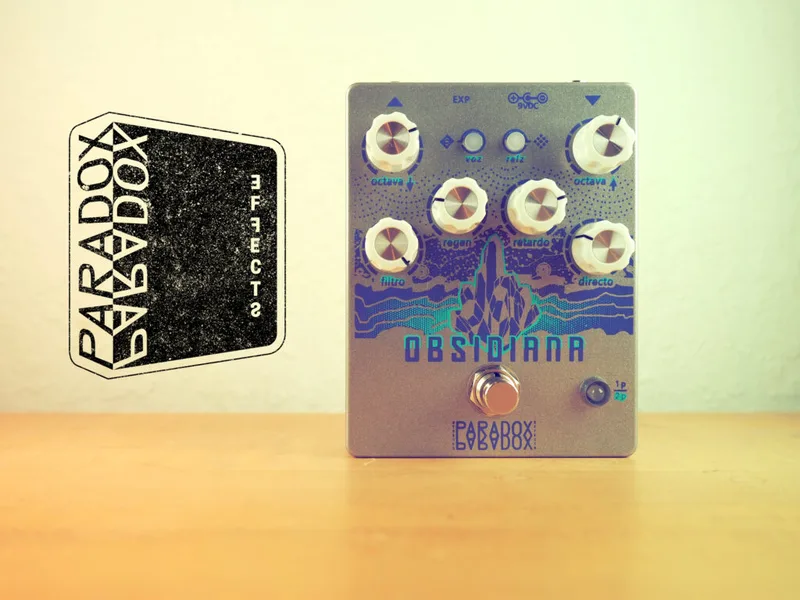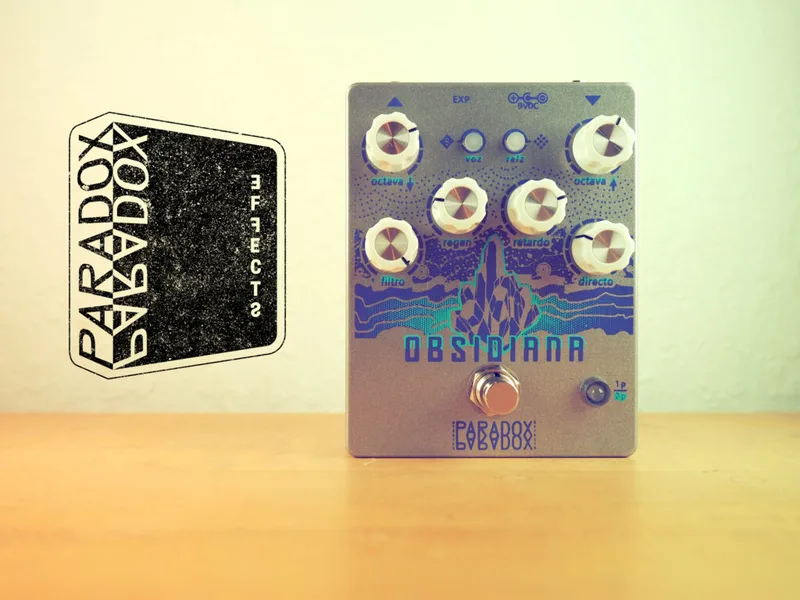



The Paradox Effects Obsidiana Octave Layering Engine is an octave pedal that layers octaves above and below your input signal, then lets you reshape those layers with filtering, feedback and two distinct voices. Pedal of the Day called it "an exciting, energetic effect that's sure to turn heads and add some new nuances to any recordings"1. It sits in the wider family of octave and pitch pedals, and the filter section gives it a foot in the filter pedal territory too.
The controls
The Obsidiana's knobs cover the octave mix, the filter and the timing of the layers1:
| Control | What it does |
|---|---|
| Octava Abajo | Controls the Octave Down setting |
| Octava Arriba | Does the same for the Octave Up |
| Regen | Sets the feedback of the octaved signals |
| Retardo | With Raiz off, controls the space between the attack and the voice of the note; with Raiz on, controls the space between the octave ramifications |
| Filtro | Filter control, with 1P and 2P modes |
The Filtro section has two filter modes. Mode 1P is a low pass filter; Mode 2P is a resonant low pass filter, and in 2P the sounds are more synth-like, creating more drastic and spatial changes1. The filter can also be swept from outside the pedal:
The Regen knob sets the feedback of the octaved signals, and the Octava Abajo knob controls the Octave Down setting. When Raiz mode is engaged, the Retardo knob instead controls the space between the octave ramifications1. Pedal of the Day notes that the octave parameter can also be controlled with an external expression pedal1.
If you plan to use that feature, an expression pedal is the piece of kit that plugs in for it.
Raiz mode and the two voices
The Raiz button is the pedal's main split between ordinary octaver behavior and something stranger. With the button off, you have a conventional octaver tracking the input signal. Engage Raiz and, in Pedal of the Day's words, "you get a 'crystalized' octaver with syncopated ramifications," creating granulated maps of octaves that evolve in time based on the Regen knob's position1. That makes Regen the key knob in Raiz mode: it sets the feedback of the octaved signals, and the evolving octave patterns are built from its position1.
The Voz button switches between the pedal's two voices:
- Obsidiana voice (Voz off): clear and crystalline with a touch of warmth and presence1
- Shift voice (Voz on): frequency modulations similar to a Leslie organ1
What reviewers said
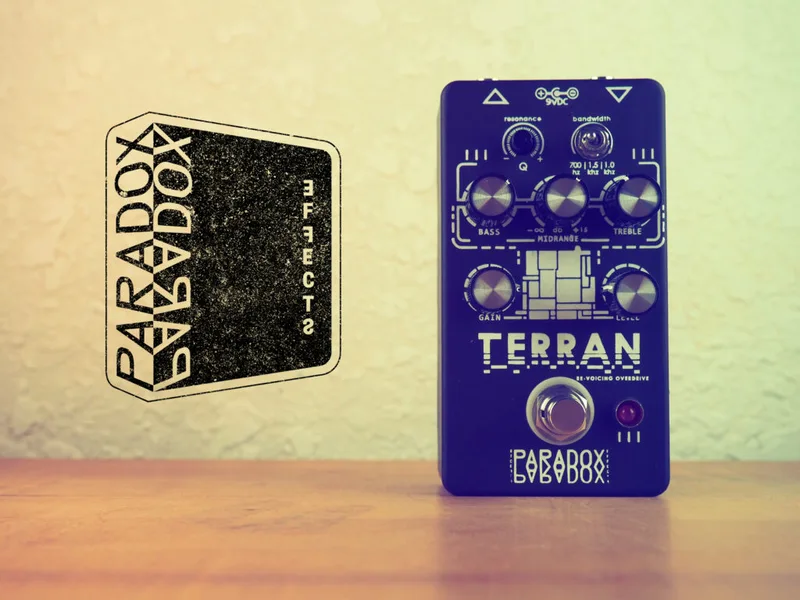
Pedal of the Day reviewed the Obsidiana in November 2020 and came away warmly. In a later review of the Terran re-voicing overdrive, the same publication described the Obsidiana as "a wonderful Octave Layering Engine from our friends at Paradox Effects, and couldn't have been happier"31. That later review also framed the Terran as taking "a left turn from the ambience of the Obsidiana," placing the Obsidiana on the atmospheric side of Paradox Effects' range3.
Videos
Paradox Effects
Paradox Effects
Paradox Effects
Questions
Can an expression pedal control the Obsidiana's filter?
Yes. Pedal of the Day notes that the filter parameter can be controlled with an external expression pedal, which lets you sweep the filter with your foot while playing. The pedal's Filtro knob covers the same parameter by hand, with a 1P low pass mode and a 2P resonant low pass mode that sound more synth-like.
What does the Raiz button do on the Obsidiana?
Raiz changes how the octaves behave. With the button off, the Obsidiana works as a conventional octaver tracking the input signal. Engage Raiz and you get what the reviewer called a crystalized octaver with syncopated ramifications, creating granulated maps of octaves that evolve in time based on the Regen knob's position. In Raiz mode the Retardo knob controls the space between the octave ramifications.
What is the difference between the Obsidiana voice and the Shift voice?
The Voz button switches between the two. With it off, you get the Obsidiana voice, described as clear and crystalline with a touch of warmth and presence. Switch it on and you are in Shift voice mode, which adds frequency modulations similar to a Leslie organ, giving the octaves a moving, rotating character.
What does the Regen knob do on the Obsidiana?
Regen sets the feedback of the octaved signals. In Raiz mode it becomes especially important, since the granulated maps of octaves that evolve in time are based on the Regen knob's position, so higher settings shape how those scattered octave layers develop as you play.
Sources (3)
- Paradox Effects Obsidiana Octave Layering Engine, Pedal of the Day, 2020-11-13
- Paradox Effects Futura Envelope Chorus, Pedal of the Day, 2021-03-17
- Paradox Effects Terran Re-Voicing Overdrive, Pedal of the Day (www.pedal-of-the-day.com), 2021-02-06