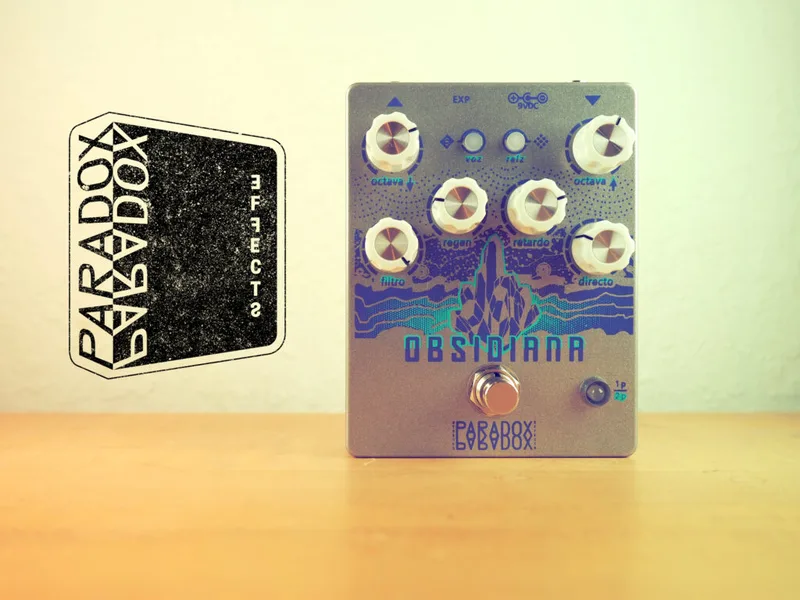



The Paradox Effects Obsidiana is an octave and pitch pedal that works as an "octave layering system in a polyphonic fashion," splitting your signal into two octaves, one up and one down1. Those octaved voices are then sent through a low-pass filter and a delay, with a Direct knob to reintegrate your clean guitar tone1. It is a hybrid design: the octaves are generated by DSP while the direct signal stays completely analog1.
Where a conventional octaver just tracks your input and adds an octave, the Obsidiana layers the octaves and lets them evolve over time. Pedal of the Day called it "an exciting, energetic effect that's sure to turn heads and add some new nuances to any recordings"2.
Octave layering with a filter and delay
The core of the Obsidiana is its two-octave split: one octave up, one octave down, tracked polyphonically1. From there the pedal sends both octaved signals through a low-pass filter and a delay (the Retardo knob), and a Direct knob reintegrates the clean guitar tone1. The Regen knob sets the feedback of the octaved signals, providing more upper and lower octaves to the wet signal, which Delicious Audio says creates a sensation similar to a sustained organ note1.
Two toggle buttons change the character of the whole engine:
| Button | Position | What it does |
|---|---|---|
| Raiz | OFF | Conventional octaver tracking the input signal, working with the Retardo (Lag) knob21 |
| Raiz | ON | "Crystalized" octaver with syncopated ramifications, generating granulated maps of octaves that evolve in time depending on the Regen knob position21 |
| Voz | OFF | Obsidiana voice: clear and crystalline octaves with a touch of warmth and presence1 |
| Voz | ON | Ancient voice: frequency modulations, similar to a Leslie organ1 |
With Raiz off, you have a conventional octaver tracking the input signal2. Engage it and the pedal becomes something else entirely: Pedal of the Day describes "granulated maps of octaves that evolve in time," driven by the Regen knob's position2.
The filter itself has two modes. In 1p it is a low-pass filter, brighter turned right and darker turned left. In 2p it becomes a second-order resonant low-pass filter that Delicious Audio says "sounds more of a synthesizer," with the Filtro knob or an expression pedal producing more drastic and spatial changes1. Pedal of the Day found the same thing: "In 2P, the sounds are more synth-like, creating more drastic and spatial changes"2.
The controls
The Obsidiana's knobs are labeled in Spanish, which is worth knowing before you hunt for a manual. Here is what each one does:
| Knob | What it controls |
|---|---|
| Octave Up | Level of the octave up1 |
| Filtro | The low-pass filter; in 2p mode the sweep gets more drastic and spatial1 |
| Retardo / Lag | With Raiz off, the space between the attack and the voice of the note, like a lag control; with Raiz on, the space between the octave ramifications21 |
| Regen | Feedback of the octaved signals, adding more upper and lower octaves to the wet signal21 |
| Direct | Level of the dry signal output21 |
The Retardo knob is really the delay side of the engine. Out of Raiz mode it controls the space between the attack of your note and the voice of the octave, similar to a lag control; in Raiz mode it controls the space between the octave ramifications21. Octava Arriba (the octave up level) does the same job for the upper voice2.
Expression pedal input
The Obsidiana has a TRS expression pedal input that controls the Filtro parameter1. The Filtro knob still determines the maximum and minimum of the filter sweep, so you set the range with the knob and the expression pedal moves the filter within it1. Pedal of the Day confirmed the same behavior in their demo2. If you already own an expression pedal, this is the parameter it sweeps.
Power
The Obsidiana has no battery option and draws at least 100mA, so it needs a proper 9V DC power supply, not a battery snap or a low-current daisy chain output1.
Paradox Effects recommends a regulated 9V DC supply with a 2.1mm diameter barrel, positive barrel and negative center1. The minimum current draw is 100mA1.
Videos
Paradox Effects
Paradox Effects
Paradox Effects
Questions
Does the Paradox Effects Obsidiana take a battery?
No. The Obsidiana runs on a 9V DC power supply only, with no battery option. Paradox Effects recommends a regulated 9V DC supply with a 2.1mm barrel, positive barrel and negative center, and the pedal draws at least 100mA, so plan on a proper power supply rather than a daisy chain.
Can you use an expression pedal with the Obsidiana?
Yes. The Obsidiana has a TRS expression pedal input that controls the Filtro (filter) parameter. The Filtro knob still sets the maximum and minimum of the filter sweep, so the expression pedal moves the filter within the range you have set with the knob.
Is the Obsidiana analog or digital?
It is a hybrid. The octaves are generated by DSP, but the direct signal path is completely analog. Delicious Audio describes it as combining the power of a DSP while maintaining a completely analog direct signal, so your clean tone never goes through conversion.
Does the Obsidiana have a dry signal control?
Yes. The Direct knob controls the level of your dry guitar signal, letting you reintegrate the clean tone alongside the two octaved voices. Set it low for mostly synthetic octave layers, or raise it to keep your original guitar sound in the mix.
Sources (2)
- Paradox Effects Obsidiana Octave Layering Engine, Delicious Audio, 2021-02-10
- Paradox Effects Obsidiana Octave Layering Engine, Pedal of the Day, 2020-11-13