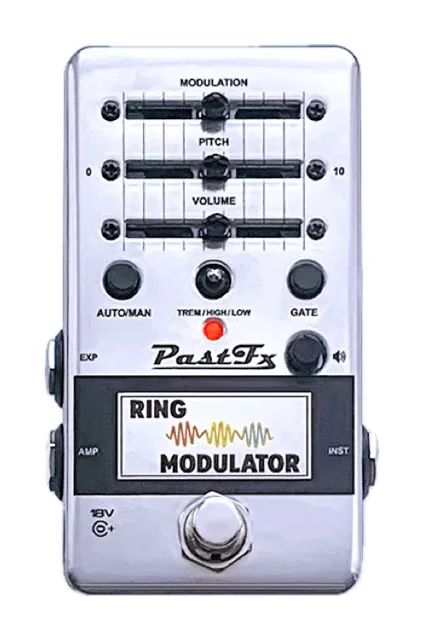


The PastFX Ring Modulator is a ring modulator pedal based on the vintage ring circuit used by Jeff Beck and others, miniaturized into a 1590B enclosure that PastFX describes as the smallest recreation of the circuit it knows of1. Where a ring modulator normally conjures metallic, clangy, otherworldly tones, this one also covers more familiar ground: Guitar Pedal X found it delivers tremolo, vibrato, metallic clang and sci-fi textures from one box2.
A ring modulator multiplies your guitar signal with an internal oscillator, producing sum and difference frequencies that were not in the original note. That is the source of the robot-like and sci-fi sounds. PastFX's take adds practical extras over the original circuit, including an expression jack, and it is built in small quantities because, as the maker puts it, it is a "time consuming build!"1
What it does: tremolo, vibrato and metallic ring tones
The pedal's range runs from usable modulation to full sci-fi. Guitar Pedal X's Stefan Karlsson reviewed it in July 2026 and found it works as a multi-modulator, covering classic tremolo and vibrato sounds as well as otherworldly sci-fi effects2. The three-position speed toggle includes a slower tremolo setting specifically for conventional amplitude modulation1.
The original Maestro circuit this pedal recreates had a similarly wide reach. The Maestro Ring Modulator RM-1A, designed by Tom Oberheim in 1972, was described as a pioneering guitar effects pedal whose versatility allowed "a wide range of effects, from clangy robot noises to swirly tremolo and even extreme distortion"3. PastFX's version keeps that breadth in a pedalboard-sized box.
Guitar Pedal X published suggested starting points for three of the pedal's modes2:
| Preset | Modulation | Pitch | Volume | Mode | Speed Range | Gate | Output Level |
|---|---|---|---|---|---|---|---|
| Tremolo | 4 | 8 | 5.5 | Manual | Trem | On | Noon |
| High | 5.5 | 4.5 | 5.5 | Manual | High | Off | Noon |
| Low | 5.5 | 1 | 5.5 | Manual | Low | Off | Noon |
The controls
The control set mixes sliders, toggles and a push-button12:
| Control | What it does |
|---|---|
| 3 sliders | Adjust the modulation and pitch parameters; PastFX describes them simply as "3 sliders that slide and do stuff"1 |
| Speed range toggle | Tremolo / High / Low, selecting the modulation speed range, with the tremolo position giving slower speeds12 |
| Auto Sweep / Manual push-button | Switches between automatic sweeping of the pitch and manual control2 |
| Auto/Man push-button | Expression control of Pitch; works with an EP-3 expression pedal on the "Other" switch setting1 |
| Level control | Adjusts the volume1 |
One thing to know before dialing it in: the sliders are very touchy. Karlsson found that "those sliders - the Pitch one in particular - are incredibly sensitive," requiring micro-millimeter adjustments in certain Speed Range modes2. He also preferred Manual mode over Auto Sweep in every instance2.
Power: 18V DC, 50mA
The PastFX Ring Modulator runs on 18V DC, not the 9V standard most pedals use. It draws 50mA through a 2.1mm Boss style negative tip jack1, so it needs an 18V output on your power supply or a dedicated adapter, and it cannot share a typical 9V daisy chain.
For comparison, other ring modulators on the market run at 9V, such as the JHS 3 Series Ring Modulator, which uses 9V DC center negative at 65mA4. The 18V requirement is part of reproducing the vintage circuit's behavior.
A miniature take on the Maestro RM-1B circuit
PastFX built the pedal around the MC1495L IC, an obsolete part from the original circuit1. That choice is central to the pedal's character, and it is also what makes the build slow: sourcing obsolete silicon and assembling each unit means the pedal is available only in small quantities1. PastFX also credits Scruffie for assistance in the project1.
The lineage goes back to the Maestro Ring Modulator RM-1A, designed by Tom Oberheim in 1972, a pioneering pedal in the ring modulator's history3. PastFX's version compresses that circuit into a 1590B enclosure, which the maker calls the smallest recreation of the circuit it knows of1.
What reviewers said
Guitar Pedal X's review was enthusiastic. Karlsson wrote:
"I have to say that I'm really delighted with this unit. It's totally rehabilitated my appreciation for ring modulators!"
He was especially taken with the core component, saying "that MC1495L IC sounds extraordinarily good!"2. His reservations were practical rather than tonal: the sensitivity of the sliders, especially Pitch, and a preference for Manual mode over Auto Sweep2.
On price, the review reported $399 AUD as the list price, equating to about $280, while USA customers pay $449 including the tariff, or $315 before it2. An earlier Guitar Pedal X news item from July 17, 2026 listed the same $399 AUD / $315 USD pricing, noting it was reduced from $449 AUD5.
Videos
Tri Pedal Reviews
macrossgeorge
Questions
Is the PastFX Ring Modulator true bypass?
Yes. PastFX lists true bypass among the pedal's features on its product page. When the pedal is bypassed, the signal passes through without the ring modulator circuit in the path, which matters for players keeping it on a larger pedalboard.
Which expression pedal works with the PastFX Ring Modulator?
PastFX says the Auto/Man pushbutton gives expression control of Pitch, and that it works great with an EP-3 expression pedal on the "Other" switch setting. The expression jack is one of the extra features PastFX added beyond the original vintage circuit.
Can the PastFX Ring Modulator run on 9V?
No. The pedal requires 18V DC through a 2.1mm Boss style negative tip jack, with a current draw of 50mA. It cannot run on a standard 9V supply, so it needs its own 18V output or a dedicated voltage source on a pedalboard power supply.
How much does the PastFX Ring Modulator cost in the US?
Guitar Pedal X reported in July 2026 that USA customers pay $449 including the tariff, which works out to $315 before it. The Australian list price was $399 AUD. PastFX notes the pedal is built in small quantities because it is a time consuming build.
What chip does the PastFX Ring Modulator use?
It is designed around the MC1495L IC, an obsolete part also used in the vintage ring circuit it recreates. Guitar Pedal X's reviewer felt this chip in particular sounds extraordinarily good, and it is central to why the pedal reproduces the original's character.
Sources (5)
- Ring Modulator, PastFx, 2026
- Guitar Pedal X, Guitar Pedal X, 2026-07-31
- Oberheim Ring Modulator RM-1A by Maestro, RockBoard PedalPedia, 2026
- 3 SERIES RING MODULATOR, JHS Pedals
- Guitar Pedal X, Guitar Pedal X, 2026-07-17