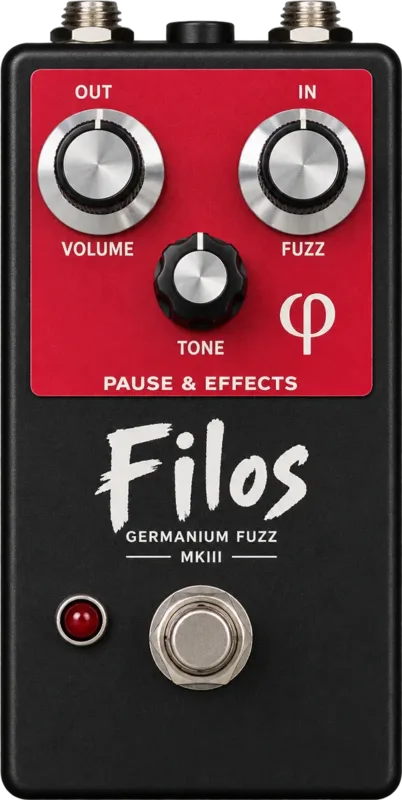


The Pause&Effects Filos is a handmade boutique germanium fuzz pedal, part of the builder's Modern Greek Alphabet Series. It is an analog circuit based on the classic Tone Bender MKIII, originally manufactured by Vox, Sola Sound, and Colorsound, and RockBoard's PedalPedia says it provides rich, harmonic saturation and vintage fuzz response1. If you are after a fuzz in the vintage British style rather than a modern high-gain distortion or overdrive, this is the territory it works in.
Controls
The Filos keeps the three-knob layout of its ancestor. The control interface includes parameters for Volume, Fuzz, and Tone to shape output gain and overall frequency balance1.
| Control | What it does |
|---|---|
| Volume | Sets the output level |
| Fuzz | Sets the amount of fuzz saturation |
| Tone | Shapes the overall frequency balance |
The original germanium Tone Bender MKIII likewise came with adjustable controls for the volume, amount of fuzz, and tone of the effect2, so the Filos follows the same arrangement.
Circuit and build
Pause&Effects constructs the Filos with selected vintage NOS germanium transistors, the same transistor family as the germanium version of the Tone Bender MKIII that the design is loosely based on12. The pedal is housed in a powder-coated 125B aluminum enclosure and features true-bypass switching1.
Germanium transistor pedals are known to be sensitive to what feeds them. With true-bypass switching, the Filos stays out of the signal path when off, which helps it behave predictably on a pedalboard.
Where it came from
The Tone Bender MKIII circuit the Filos draws on was originally manufactured by Vox, Sola Sound, and Colorsound1. According to Fuzzboxes.org's history of the circuit, the germanium version "featured a germanium transistor circuit that was loosely based on the earlier Bald" design, and it established the volume, fuzz, and tone control set that pedals like the Filos still use2.
Videos
Rolad
Rolad
Questions
Is the Pause&Effects Filos true bypass?
Yes. The Filos features true-bypass switching, so when the pedal is off, your guitar's signal passes through without the fuzz circuit loading it. That matters with germanium fuzzes, which can otherwise interact with the signal feeding them, and it lets the Filos sit on a board alongside other pedals without coloring your clean tone.
Does the Filos use germanium transistors?
Yes. Pause&Effects builds the Filos with selected vintage NOS germanium transistors, meaning new-old-stock parts rather than current production. Germanium is the transistor type used in the original Tone Bender MKIII circuit the Filos is based on, and it is a large part of the pedal's vintage-style fuzz response.
Is the Filos analog or digital?
The Filos is an analog pedal. Its circuit type is analog, in keeping with the 1960s Tone Bender MKIII design it follows, and it uses no digital processing.
What is the Modern Greek Alphabet Series?
The Modern Greek Alphabet Series is the builder's series of pedals that the Filos belongs to. Pause&Effects names pedals in this line after letters of the Greek alphabet, with Filos being one of them.
Is the Filos handmade?
Yes. Pause&Effects describes the Filos as a handmade boutique germanium fuzz pedal, housed in a powder-coated 125B aluminum enclosure.
Sources (2)
- Filos by Pause&Effects, RockBoard PedalPedia, 2026
- Vox Tone Bender MKIII • Fuzzboxes, Fuzzboxes.org, 2021-05-30