| Type | Fuzz circuit, first released 19651 |
| Designer | Gary Stewart Hurst, electronics engineer1 |
| Built and sold by | Sola Sound, from their London store, Musical Exchange4 |
| Original price | 14 guineas (MK1, 1965)14 |
| Transistors | Germanium in the MK1, MK1.5, MKII and early MKIII; silicon in 1970s MK3 units42 |
| Key versions | MK1 (1965), MK1.5 (1966), MKII (1966), MKIII564 |
The Tone Bender is the family of British fuzz circuits that Gary Hurst designed in London in 1965, and one of the first British-made fuzz boxes available to the public1. Hurst started from the American Maestro Fuzz-Tone, modified it, and ended up with a circuit of his own that produced more sustain than its American counterpart21. Over the following decade the design went through several distinct versions, the MK1, MK1.5, MKII and MKIII, built and sold under the Sola Sound, Vox, Marshall and Colorsound names, and it remains one of the most copied fuzz circuits in modern pedal building.
For a player, what the Tone Bender circuit means is germanium fuzz with attitude: a raw, primitive character in the early versions3, more sustain and output as the design grew, and a Bias control on many versions that lets you tune the fuzz to taste. It is also the direct ancestor of the Fuzz Face, which makes it a foundational circuit in the same way as the Rangemaster or the Zonk Machine.
Where the Tone Bender came from: Gary Hurst and the Maestro Fuzz-Tone
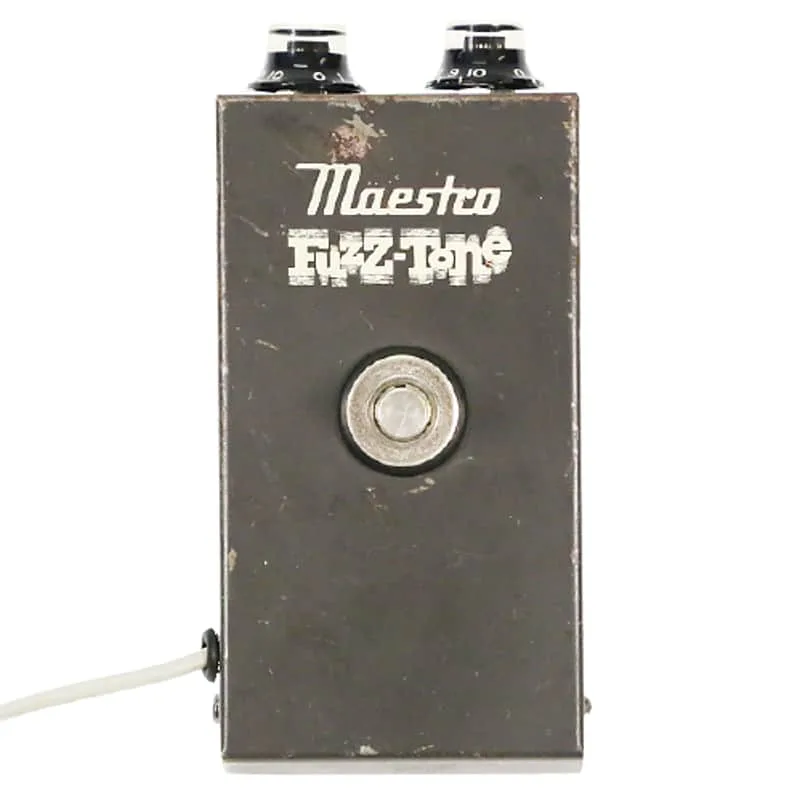
The story starts with the Gibson-built Maestro FZ-1 Fuzz-Tone, the American fuzz of 1962. BLAMMO! Electronics describes the FZ-1 as having "started the Great British Fuzz Pedal Boom by inspiring Gary Hurst to modify Vic Flick's (the James Bond Riff guitarist) personal pedal into the Tone Bender"78. JHS Pedals tells it the same way: "Building on the foundation of the American-made 1962 Maestro Fuzz Tone, Gary expanded what fuzz could do"8.
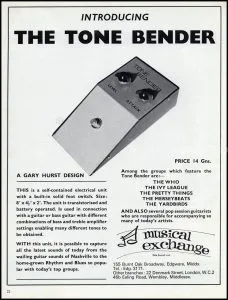
Hurst built his circuit from the back workbench of Macari's Musical Exchange on Denmark Street in London8. The UK fuzz box phenomenon began in 1965, when Hurst designed an effects pedal called a Tone Bender14. He approached the London retailer Sola Sound to market and distribute the pedal from their London store, Musical Exchange4. The MKI's three-transistor circuit was based on the Gibson Maestro Fuzz-Tone, but modified by Hurst to produce more sustain than its American counterpart1.
The MK1: three germanium transistors in a wooden, then metal, box
The first Tone Bender, the MKI, was a three-transistor circuit9110. The earliest prototype units were housed in a primitive wooden box case, and the wooden-case models featured top and rear jack sockets along with level and bias controls, which let the user tune in their fuzz tone4. The circuit in those wooden-case models consisted of one OC75 and two 2G381 germanium transistors4.
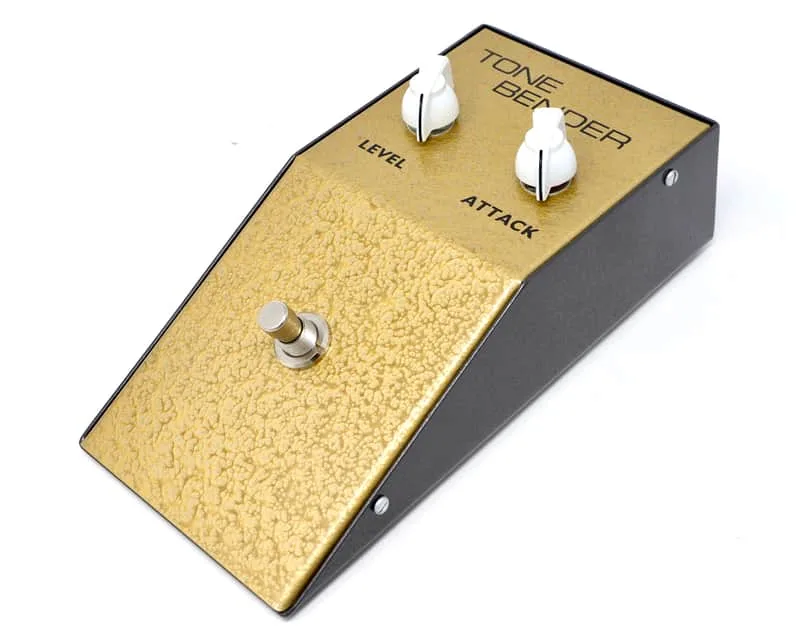
During 1965 Hurst re-housed the Tone Bender circuit into a metal casing, commonly known as the MK1 Tone Bender4. He changed the construction material to steel to live up to the rigours of stage use1. The early metal models featured hand-applied lettering covered with nail varnish to protect its fragility, in a flat gold finish4. The pedal sold for 14 guineas1.
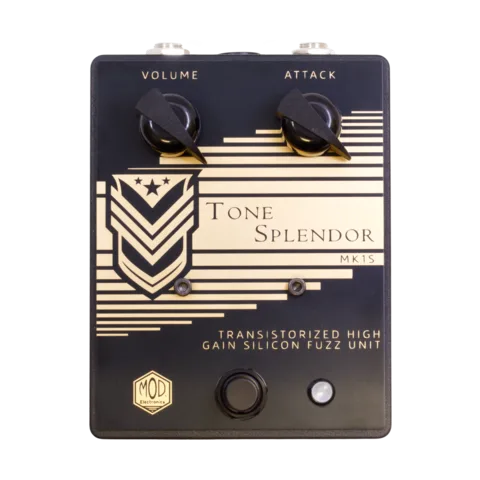
The germanium heart of the design is also its weakness. Mod Electronics, whose Tone Splendor MK1S kit recreates the circuit, notes that "the original MK1 design depended on the leakage current of its germanium transistors to function properly"3. That leakage varies from transistor to transistor, which is why no two vintage units sound quite alike. Mod Electronics describes the MK1 sound as having "a raw, primitive fuzz character which fits the early design of the original"3. Tru-fi's history of the circuit likewise identifies the Mark I as a three-transistor germanium design11.
Original wooden-case MK1 models are very rare, with only a small handful of examples produced4. Players who want the wooden-box look today generally turn to reproductions such as Jeds Peds' Simply Oak, a 4-knob germanium ToneBender housed in wood12.
The MK1.5: a two-transistor rework
The MK1.5 is an unofficial name given to the transitional two-transistor circuit that followed the MK1134. At its heart are two OC75 transistors14. These models were only produced for a short period4.
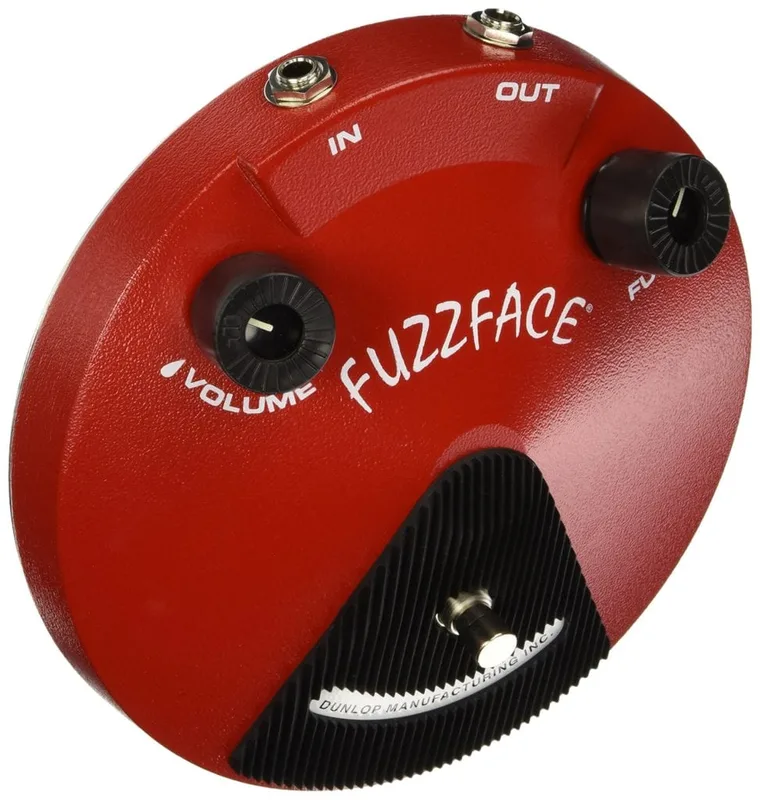
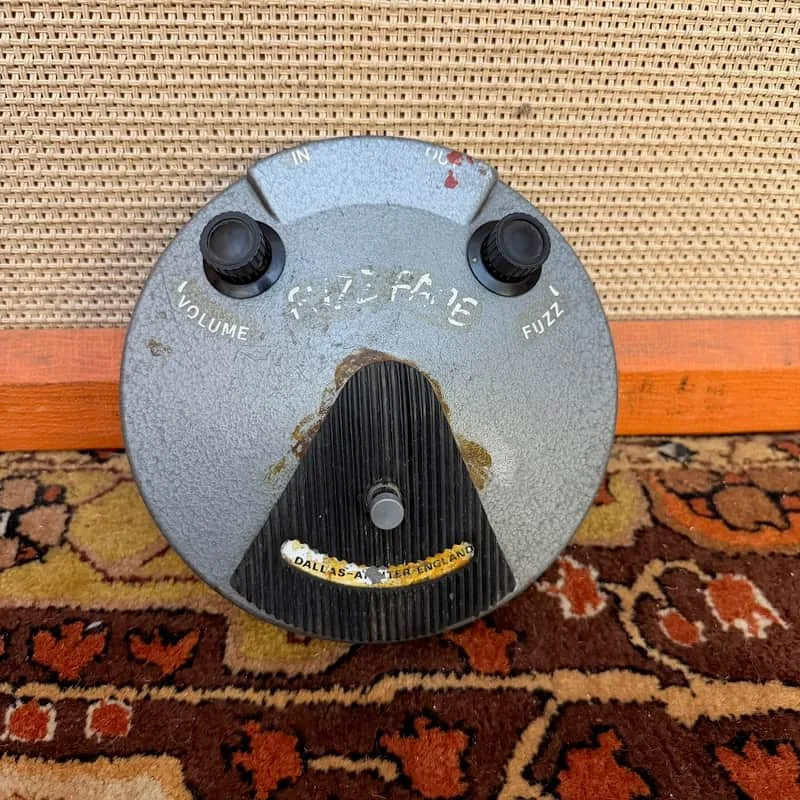
The MK1.5 matters far beyond its short production run. Red Witch Pedals calls it "Father of the Fuzz Face," because the Mk1.5 circuit inspired the Fuzz Face, which used different germanium transistors and had a much less tight bottom end14. RockBoard's PedalPedia likewise lists the Mk 1.5 as an inspiration for the Dallas Arbiter Fuzz Face13. So if you have ever wondered how the Fuzz Face came to be, the answer runs through this two-transistor British box.
The MK1.5 also has a documented place on record: it was the pedal used by The Beatles in Abbey Road Studio while recording Rubber Soul4.
The MKII: an extra gain stage for more sustain
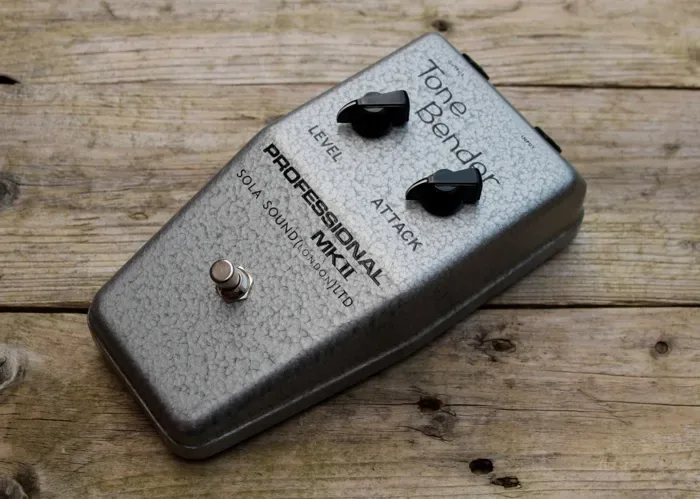
The original Tone Bender MKII was released in 19666, following the MK1 and the Mk1.55. It is a three-transistor fuzz circuit, the version most famously associated with the Sola Sound Tone Bender6. Where the MK1's circuit was already modified for more sustain than the Maestro Fuzz-Tone9, the MKII pushed further, and BLAMMO! Electronics describes its own point-to-point MKII reproduction as "tuned for a bit more sustain and output volume"15.
The MKII is the version players most often chase today. ThroBak Electronics calls it "the fabled 3 germanium Sola Sound Tone Bender MKii Professional used by Jimmy Page and Jeff Beck," while noting that vintage units had inconsistencies that ThroBak's Stone Bender set out to tame16. BLAMMO!'s P2P Tone Bender MKii is a hand-wired point-to-point version of the circuit with top-mounted jacks15.
The MKIII and the later Colorsound Tone Benders
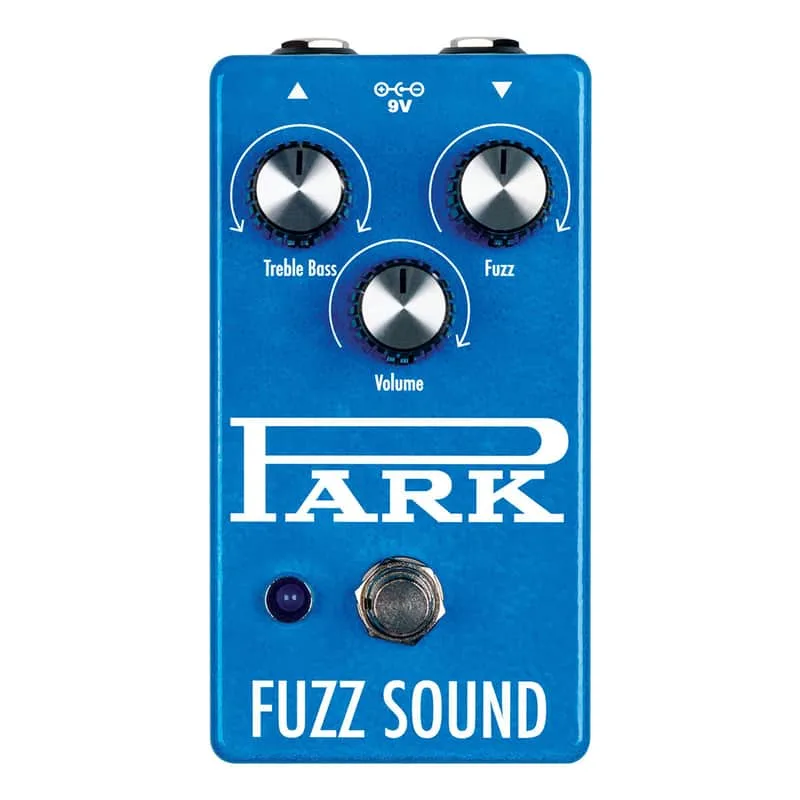
The MK3 brought a new punched metal casing, a circuit board and three OC75 transistors2. The classic Tone Bender MKIII circuit was originally manufactured by Vox, Sola Sound and Colorsound17. Analog Man's Sun Bender MKIV manual describes the Sola Sound, Colorsound and VOX Tone Bender MK-III and MK-IV as three-germanium-transistor circuits with a TONE knob, and notes that some RotoSound and Park fuzz pedals also used this circuit18.
The 1970s saw the MK3 change from the traditional germanium transistors to more consistent silicon units2. That change is the practical answer to the germanium problem: silicon transistors behave far more predictably from unit to unit, at the cost of the character germanium fans chase.
The versions side by side
| Version | Transistors | Controls | Notes |
|---|---|---|---|
| MK1 (wooden case) | One OC75, two 2G381 germanium | Level, Bias | Top and rear jack sockets; only a small handful produced4 |
| MK1 (metal case, 1965) | Three-transistor circuit | Level, Bias | Steel case for stage use; 14 guineas new41 |
| MK1.5 | Two OC75 germanium | Level, Bias | Short production run; inspired the Fuzz Face144 |
| MKII (1966) | Three germanium | Level, Bias, Attack | Sola Sound Tone Bender MKII Professional; used by Jimmy Page and Jeff Beck616 |
| MKIII | Three OC75 germanium, later silicon | Level, Bias, Tone | Punched metal case, circuit board; made by Vox, Sola Sound and Colorsound217 |
Tone Benders made for Vox, Marshall and Rotosound
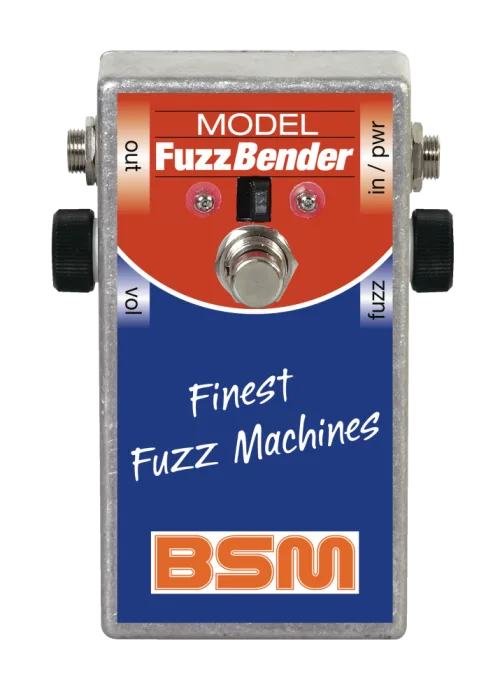
The Tone Bender also spread through OEM production. BSM's Bernd C. Meiser explains that Sola Sound built Hurst's circuit, slightly modified and in a large production number, as an OEM product for Vox, now called the Tone Bender (Mk1.5)19. The MKIII circuit, as noted above, appeared under the Vox, Sola Sound and Colorsound names, and in some RotoSound and Park fuzz pedals1718.
Pedals and kits based on the Tone Bender
The Tone Bender is one of the most cloned circuits in fuzz building, in every form from hand-wired reproductions to budget pedals and DIY kits.
| Builder | Product | Relationship to the Tone Bender |
|---|---|---|
| BLAMMO! Electronics | P2P Tone Bender MKii | Hand-wired point-to-point MKII circuit15 |
| ThroBak | Stone Bender | MKII circuit with vintage inconsistencies tamed16 |
| SolidGoldFX | Fuzzbox | Tone Bender Mk II style fuzz with Bias control20 |
| CopperSound | Renegade Multi-Bias Fuzz | Based on the MK1.5, with a bias toggle21 |
| Tone City | London Bender | British fuzz pedal22 |
| Jeds Peds | Silicon Tone Bender | A blend of the different Tone Bender versions, silicon, £35.0023 |
| Jeds Peds | Simply Oak | 4-knob germanium ToneBender with Vol, Tone, Fuzz and Bias12 |
| Mod Electronics | Tone Splendor MK1S | MK1-based kit3 |
| General Guitar Gadgets | Boutique Bender | 3-knob ToneBender variation with PNP germanium transistors, positive ground24 |
| Red Witch | Delilah | Mk1.5-based1425 |
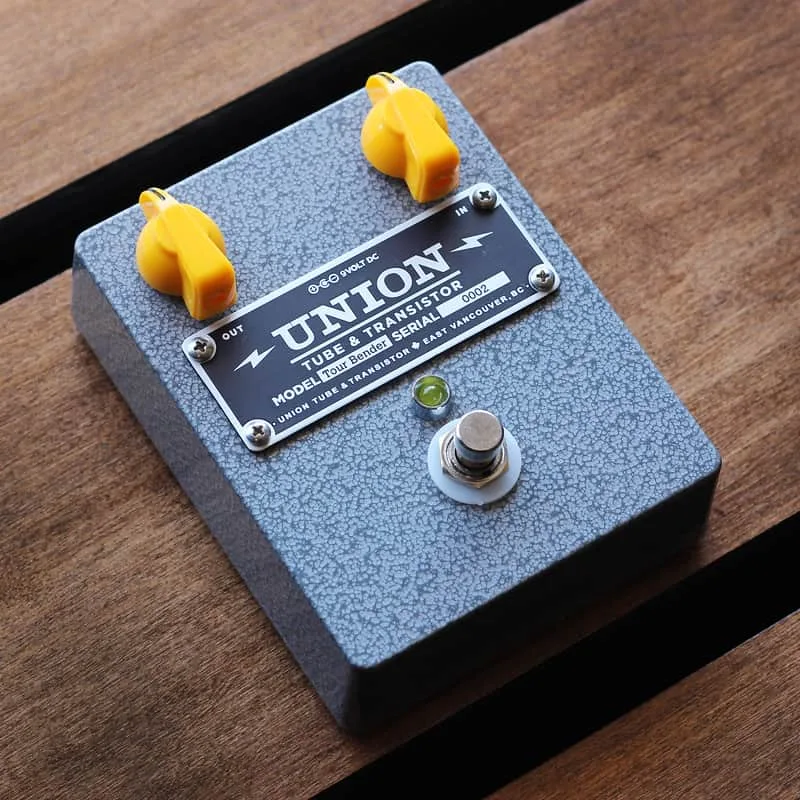
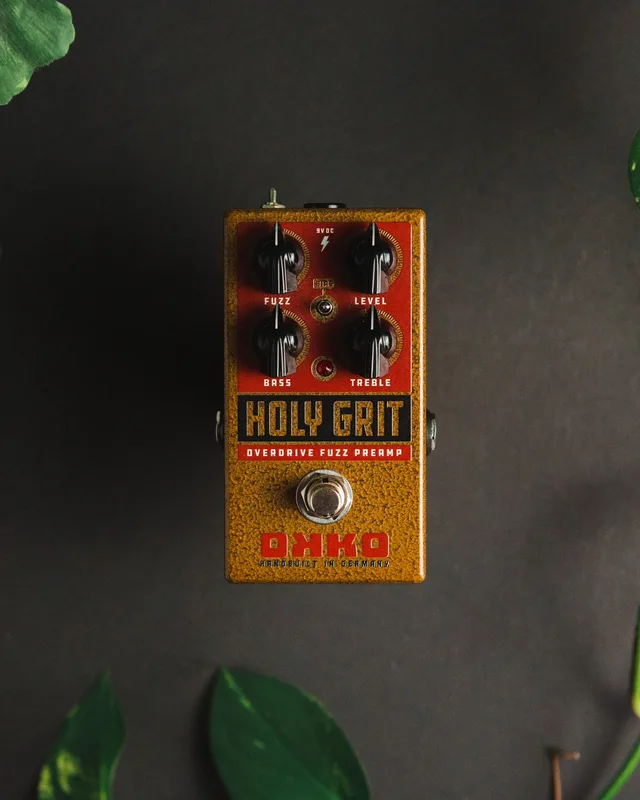
Several builders treat the Tone Bender and the Fuzz Face as two halves of one sound262719:
- Union Tube & Transistor's Tour Bender "takes aim at creating the legendary 60s tone of the Tone Bender and giving it an ability to clean up" like a Fuzz Face26
- Their Sone Bender "took from the gain of a Tone Bender but the ability to clean up like a Fuzz Face"27
- OKKO FX's Holy Grit is "based on the classic Fuzz Face/Tone Bender but heavily tweaked into something else"28
- BSM's FuzzBender Fuzz Machine lets the user switch between Fuzz Face and Tone Bender (Mk1.5) circuits with a lever switch19
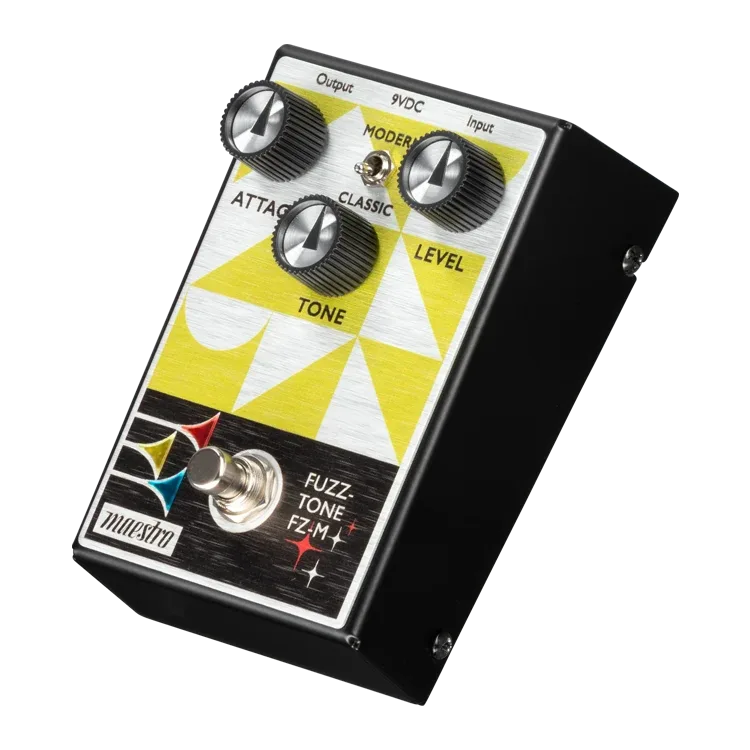
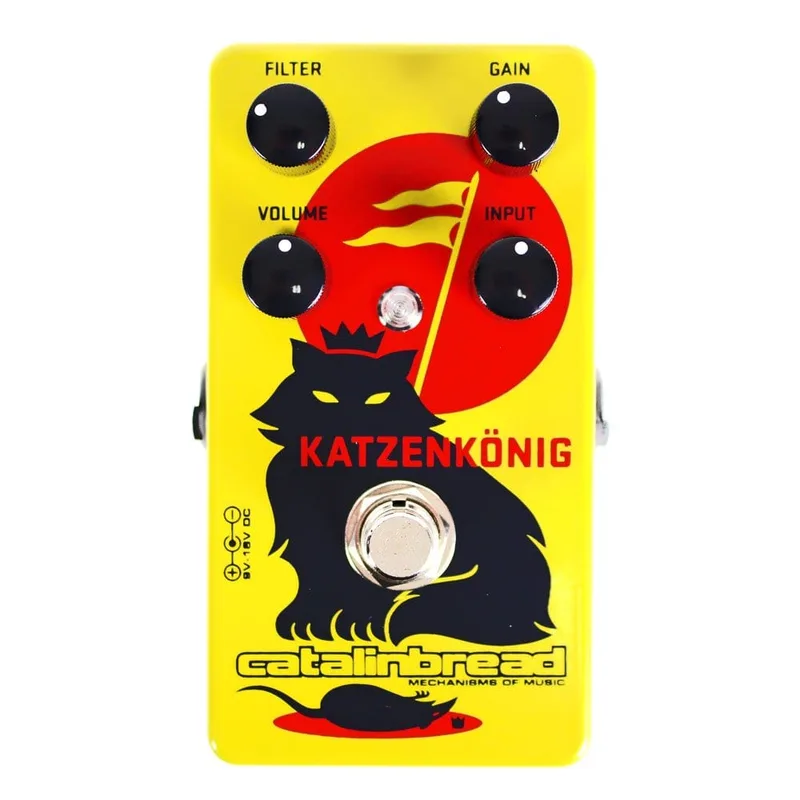
Hybrids go further. Jed's Pedals' Katzenkonig kit is "a Rat and a Tone Bender in one circuit"29, pairing the British fuzz with the RAT distortion. And the family tree runs forward, too: the Maestro FZ-1 that inspired Hurst also led to the Zonk Machine created by John Hornby Skewes7.
What the bias knob does
Many Tone Benders, from the wooden-case prototypes onward, carry a Bias control4. On a Tone Bender Mk II style circuit like the SolidGoldFX Fuzzbox, "Bias adjusts the operating point of the third transistor"20. Suhr's Brighton manual explains the principle generally: the bias control "adjusts the bias point of the transistor, which has a direct effect over the output waveform's shape and sound," with fully counter-clockwise as the standard setting30. In practice, turning the bias knob moves the fuzz from smooth and saturated toward gated and spluttery, and on germanium pedals it is also the fix for transistors that drift with temperature.
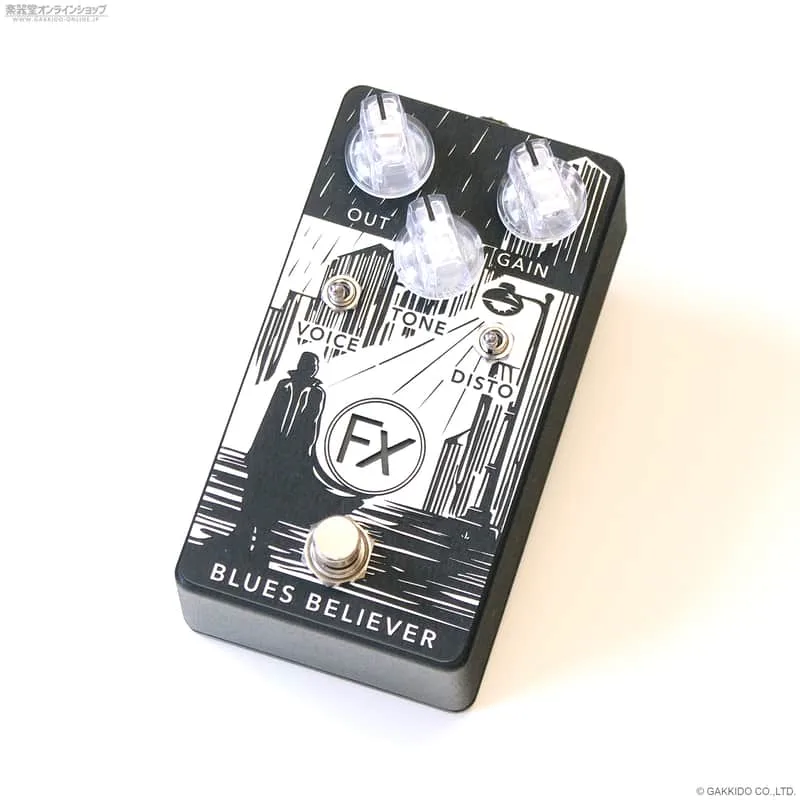
The Tone knob found on the MKIII and later versions is simpler. Anasounds describes the Tone control on their Blues Believer, a Tone Bender-style fuzz, as adjusting "the treble response on the output of the pedal, adding extra presence in a very musical way"31, or more plainly, controlling the brightness of your tone32.
Who used one on record
The documented player list is short but heavy:
- Aclam Guitars' research on The Beatles' fuzz tones reports that Gary Hurst personally gave a Tone Bender MKI to George Harrison, "but Paul was the one who ended up using it"33
- The MK1.5 was used by The Beatles at Abbey Road while recording Rubber Soul4
- Jimmy Page and Jeff Beck are associated with the Sola Sound Tone Bender MKII Professional16
- Jeff Beck's MKI use was reportedly hard on the hardware: due to his heavy use of the pedal, he smashed the unit with heavy foot stomping movements while playing on stage1
What originals are worth
The MK1 sold for 14 guineas when new14. Today, Red Witch Pedals reports that Tone Bender Mk1.5 units "sell (on the very rare occasion they appear on Ebay or Reverb) for upwards of $5000"14. Wooden-case MK1 models are rarer still, with only a small handful produced4, which puts them beyond most players' reach and explains the healthy market in reproductions listed above.
Pedals on this page
News
Questions
What transistors are in a Tone Bender?
It depends on the version. The wooden-case MK1 used one OC75 and two 2G381 germanium transistors, the MK1.5 used two OC75s, and the MK3 carried three OC75s. Later 1970s MK3 units switched from germanium to more consistent silicon transistors. Modern reproductions follow the same split: some builders use germanium, others silicon for stability.
Is a Tone Bender the same as a Fuzz Face?
No, but they are related. The two-transistor MK1.5 circuit inspired the Fuzz Face, which used different germanium transistors and had a much less tight bottom end. Several modern builders, including Union Tube & Transistor and BSM, make pedals that combine Tone Bender gain with Fuzz Face-style cleanup, which shows how closely players compare the two.
Who used a Tone Bender on records?
Gary Hurst personally gave a MKI to George Harrison, but Paul McCartney was the one who ended up using it, and the MK1.5 was the pedal The Beatles used at Abbey Road while recording Rubber Soul. Jimmy Page and Jeff Beck are associated with the Sola Sound Tone Bender MKII Professional.
Why are germanium Tone Benders hard to mass produce?
The original MK1 design depended on the leakage current of its germanium transistors to function properly, and germanium transistors vary widely from unit to unit. Vintage MKII units were known for these inconsistencies. That is why the 1970s MK3 moved to silicon, and why modern builders either hand-sort germanium or offer bias controls to tune each pedal.
What does the bias knob on a Tone Bender do?
It adjusts the operating point of a transistor, which directly shapes the output waveform and therefore the sound. On the SolidGoldFX Fuzzbox, a Tone Bender Mk II style fuzz, the Bias control sets the operating point of the third transistor. Turning it lets you move from a cleaner, gated fuzz to a smoother, more saturated one.
How much is an original wooden-box Tone Bender worth?
Original wooden-case MK1 models are very rare, with only a small handful produced, and Red Witch Pedals reports that Mk1.5 units sell on the rare occasions they appear on eBay or Reverb for upwards of $5000. The MK1 originally sold for 14 guineas when new in 1965.
Sources (33)
- Wooden Case Prototype MKI Tone Bender, britishpedalcompany.com
- Tone Bender History, British Pedal Company, 1970
- Tone Splendor MK1S, Mod Electronics (modkitsdiy.com), 2026
- Tone Bender History, britishpedalcompany.com, 1965
- BALTIC BLUE FUZZ (OC-BBFn), One Control USA
- Boy Meets Barrows: A Fuzz Story, EarthQuaker Devices, 2026-02-11
- Skronk Machine, BLAMMO! Electronics
- BENDER - JHS Pedals, JHS Pedals
- Wooden Case Prototype MKI Tone Bender, British Pedal Company
- Tone Bender 'MKI' players list • Fuzzboxes, fuzzboxes.org, 2026-02-22
- The Sound of Rock, tru-fi.com
- Simply Oak, Jed's Pedals (jedspeds.co.uk)
- Taras Bulba V2 by Drunk Beaver, RockBoard PedalPedia, 2026
- Delilah - Ultra Rare Fuzz - Red Witch Pedals, Red Witch Pedals
- P2P Tone Bender MKii, BLAMMO! Electronics
- ThroBak Stone Bender guitar effects pedals, Tone Bender voiced., ThroBak Electronics, 2026
- Filos by Pause&Effects, RockBoard PedalPedia, 2026
- sunbenderMKIV.docx, Analog Man, 2021-08
- FuzzBender Fuzz Machine, BSM - Finest Treble Booster (treblebooster.net), 2025
- FUZZBOX - BENDER FUZZ - SolidGoldFX, SolidGoldFX
- Multi-Bias Fuzz Pedal, CopperSound Pedals
- TONE CITY® London Bender-British Fuzz Guitar Effect Pedal-TONE CITY ▏Analog Pedals & Power supplies, Tone City Audio, 2026
- Silicon Tone Bender, Jeds Peds (jedspeds.co.uk)
- 3-Knob Tone Bender™ Clone: DIY Fuzz Kit, PCB & Schematic, General Guitar Gadgets, 2014-05-15
- TONEHOME, TONEHOME - the World of Vintage Guitar Effects Pedals
- Tour Bender, Union Tube & Transistor
- Sone Bender, Union Tube & Transistor
- HOLY GRIT, OKKO FX
- Katzenkonig, Jed's Pedals
- Brighton_Manual.pdf, Suhr, 2026
- blues believer, Anasounds, 2025-01-27
- Blues Believer, Anasounds, 2026-09-16
- Ultimate tone research, sounding like the Beatles, Aclam Guitars, 2021-04-27