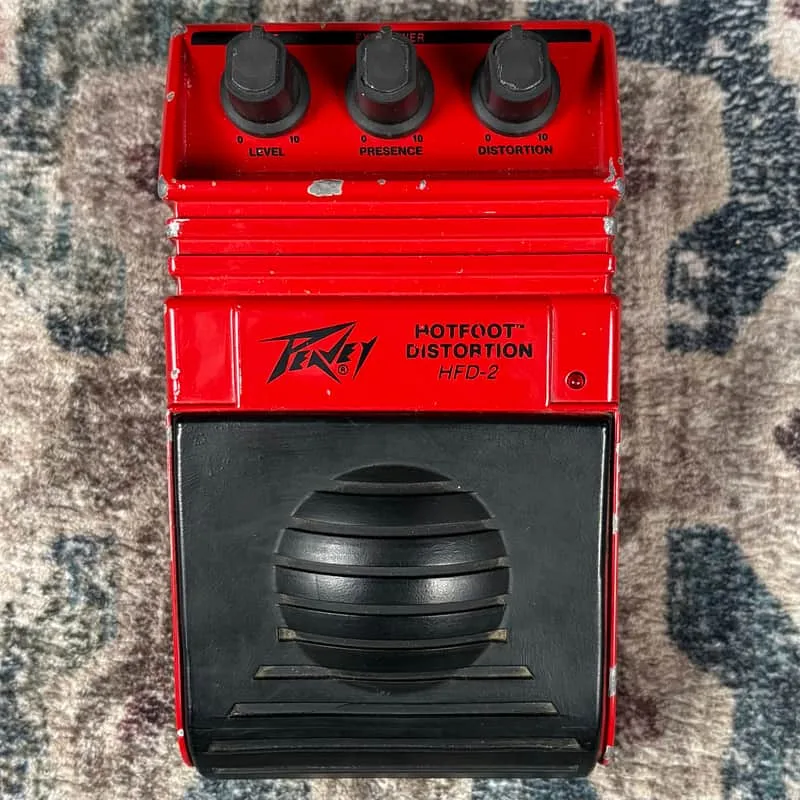


The Peavey HFD-2 Hotfoot Distortion is a distortion pedal whose circuit sits very close to the ProCo Rat. A technical analysis published at Guitar FX Layouts traced the board and concluded it is "more or less 1:1 with a Rat, but with added JFET input buffer which also takes care of the bypass buffering"1. That buffer is the pedal's main departure from the Rat it follows, and it shapes how the pedal behaves on a board, especially around switching and use with a looper.
Circuit and how it differs from a Rat
The HFD-2 follows the Rat's layout closely enough that the analysis treats the two as near equivalents, with the JFET input buffer as the added element1. For a player, the practical difference is the bypass design rather than the distortion itself.
The same analysis notes one point of interest for DIY builders: "If you change the values at 1K5 and 47R, both leading to 2µ2 caps, you can get yourself a Rat with a JFET buffered bypass." In other words, the Hotfoot's distinguishing feature can be reproduced on a standard Rat layout by changing two resistor values1.
Buffered bypass, not true bypass
The HFD-2 is a buffered bypass design, not true bypass. The JFET input buffer remains in the signal path and also handles the bypass buffering, and the analysis notes that "the method of taking the distortion out when bypassed is also worth a mention"1.
A few points about how that switching works:
- The bypass is buffered, with the JFET input buffer doing the bypass buffering1
- The distortion circuit is taken out of the signal path when bypassed1
- Only a 2PDT stomp switch is needed for the bypass, and it takes care of the LED and silencing the circuit too1
Buffered bypass is less common on distortion pedals than true bypass, and the analysis makes a point of it: "We seem to have very few effects with buffered bypass"1. For players, a buffer at the input can matter on long cable runs or large boards; see Buffer Pedals for how standalone buffers work.
Because the input buffer stays in circuit, players using the HFD-2 circuit with a looper should account for it. The analysis advises builders to "put a 1meg pull down resistor at the input....otherwise it will charge the input cap and POP"1.
What reviewers said
The published technical analysis at Guitar FX Layouts was favorable on both the circuit and its bypass. Its reviewer wrote: "For some reason i've always loved Rat derivatives more than the original real thing. This one's no exception. And the bu[ffered bypass]..."1. The same reviewer found the buffered bypass "isn't bad at all"1.
Videos
BearAmps
sato1966
Matt Marquette
Questions
Is the Peavey Hotfoot Distortion a Rat clone?
By circuit, very nearly. A technical analysis published at Guitar FX Layouts traced the HFD-2 and described it as more or less 1:1 with a Rat, with the addition of a JFET input buffer that also takes care of the bypass buffering. The same analysis notes that changing the values at the 1K5 and 47R resistors, both leading to 2µ2 caps, turns the layout into a Rat with JFET buffered bypass.
Is the Peavey HFD-2 true bypass?
No. The HFD-2 uses buffered bypass: a JFET input buffer stays in the signal path and also handles the bypass buffering. The analysis notes that the method of taking the distortion out of circuit when bypassed is worth a mention, and that only a 2PDT stomp switch is needed for the bypass, which takes care of the LED and silencing the circuit.
What transistors does the Hotfoot Distortion use for its buffers?
The original pedal uses J231 JFETs for its buffers, according to the circuit analysis at Guitar FX Layouts. JFET input buffers are a common choice because they present a high input impedance to the guitar's pickups.
Does the Hotfoot Distortion work with a looper?
It can, but builders of the circuit are advised to add a 1meg pull down resistor at the input when using it with a looper. Without it, the looper can charge the input cap and cause a pop. On the original pedal this is already part of the design question around its buffered input.
Sources (1)
- Guitar FX Layouts: Peavey Hotfoot Distortion, tagboardeffects.blogspot.com, 2013-12-24