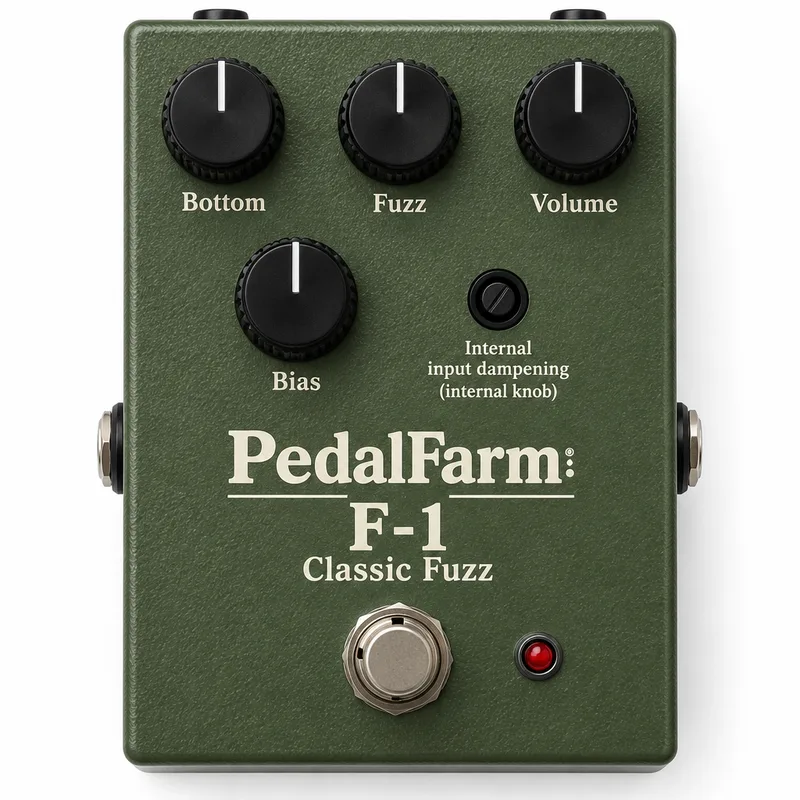


The PedalFarm F-1 Classic Fuzz is a hand-built fuzz pedal that takes on the Fuzz Face circuit and adds controls and refinements aimed at today's pedalboards. Pedal of the Day described it as taking the Fuzz Face "with some additions and upgrades for today's modern world," and its verdict was that it is "an excellent re-imagining of a classic fuzz, the F-1 fits smoothly into any signal chain or effects pedal setup."1
The controls
The F-1 keeps the Fuzz Face idea but re-works the control set. Here is what each control does, as described in the Pedal of the Day review1:
| Control | What it does |
|---|---|
| Bottom | Lets you dial in just the right amount of bottom end for your rig and sound1 |
| Fuzz | Modified to give a better balance to the fuzz range across the sweep of the knob; the lower half of the sweep almost puts you in overdrive territory1 |
| Volume | Extended to provide a louder output signal1 |
| Bias | Lets the user find exactly the sound they are looking for; lower bias voltages yield more spitting fuzz, while higher voltages smooth out the fuzz and create more asymmetry1 |
| Internal input dampening | A knob on the inside that dampens the input signal, slightly cleaning up the fuzz1 |
The Bottom knob is the headline addition. Pedal of the Day notes that "the circuit is exactly the same as the classic original when the Bottom control is at its maximum setting," so a player who wants the stock Fuzz Face response can get it, and a player who wants less low end or a tighter response can dial it in.1
The internal input dampening knob is worth knowing about before you buy or set up the pedal: it sits inside the enclosure, so reaching it means taking the back plate off rather than reaching for a top-mounted control. Pedal of the Day called it "an excellent way" to clean up the fuzz by damping the input signal.1
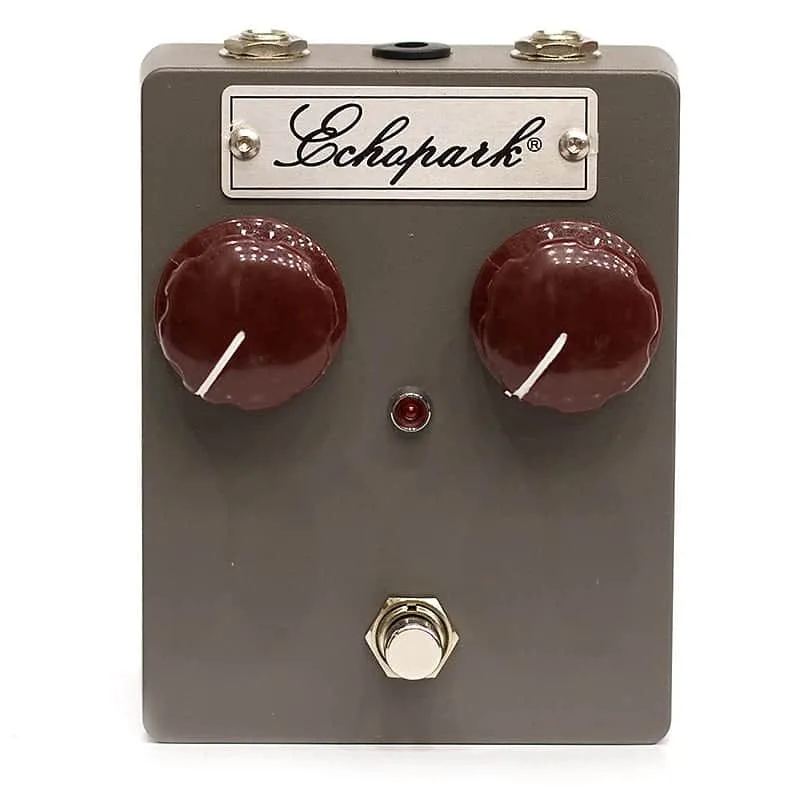
The F-1's transistors are BC182 or BC183 types, measured and paired. That distinguishes it from the similarly named Echopark F-1 Fuzz, a different pedal that Premier Guitar describes as using two germanium transistors.12
Using it as a boost and with different pickups
Two practical points from the review:
- As a boost: the F-1 can be used as a boost for an over-driving amp by turning the fuzz all the way down and the volume up, which links it to the territory covered by boost pedals and overdrive pedals.1
- With humbuckers and single coils: Pedal of the Day found the F-1 well suited for humbucker-equipped guitars as well as single coils, and said it "opens up sounds previously unavailable from the classic FF circuit."1
What reviewers said
Pedal of the Day's summary verdict on the F-1:
"An excellent re-imagining of a classic fuzz, the F-1 fits smoothly into any signal chain or effects pedal setup."
The same review praised the build, saying the pedal is hand-built using top quality parts and detailed craftsmanship, with high-grade components used to ensure optimal performance.1
For comparison, the Echopark F-1 Fuzz, which shares the F-1 name but is a different design, drew a warm verdict from Premier Guitar in 2023: the reviewer praised its "remarkably great fuzz tones and touch sensitivity," its "killer, streamlined looks" and ease of use, while noting it is a bit expensive, and found it excelled at driving dirty sounds into zones from fiery to outrageous with higher-gain amps.2 Delicious Audio's Griffin Jennings described that pedal as "a unique take on the Fuzzrite, using germanium transistors like the original," with a slightly more expensive version adding a diode clipping switch for additional textural options.3
PedalFarm describes the PedalFarm F-1 Classic Fuzz as hand-built using top quality parts and detailed craftsmanship, with high-grade components used to ensure optimal performance.4
Videos
Pedal of the Day
Pedal of the Day
Questions
What is the Bottom knob on the PedalFarm F-1 for?
The Bottom knob lets you dial in just the right amount of bottom end for your rig and sound. Pedal of the Day notes that the circuit is exactly the same as the classic original Fuzz Face when the Bottom control is at its maximum setting, so turning it down is where the F-1 departs from the original.
Does the F-1 use silicon or germanium transistors?
The PedalFarm F-1 is built with two BC182 transistors, or optionally the BC183 transistors, all measured and paired. That sets it apart from the Echopark F-1 Fuzz, which Premier Guitar describes as using two germanium transistors.
Can the F-1 be used as a boost?
Yes. According to Pedal of the Day, the F-1 can be used as a boost for an over-driving amp by turning the fuzz all the way down and the volume up.
Does the F-1 work with humbuckers?
Pedal of the Day found the F-1 well suited for humbucker-equipped guitars as well as single coils, and said it opens up sounds previously unavailable from the classic Fuzz Face circuit.
Is the F-1 the same circuit as the original Fuzz Face?
Not quite. The F-1 takes on the Fuzz Face circuit with additions and upgrades for the modern world. Pedal of the Day notes the circuit is exactly the same as the classic original only when the Bottom control is at its maximum setting; the Fuzz and Volume controls have also been re-voiced.
Sources (4)
- PedalFarm F-1 Classic Fuzz, Pedal of the Day, 2020-11-23
- Echopark F-1 Fuzz Review, Premier Guitar, 2016-03-31
- Best Fuzzrite Clones And Evolutions In 2023, Delicious Audio, 2022-08-10
- PedalFarm F-2 Professional Fuzz, Pedal of the Day, 2021-02-13