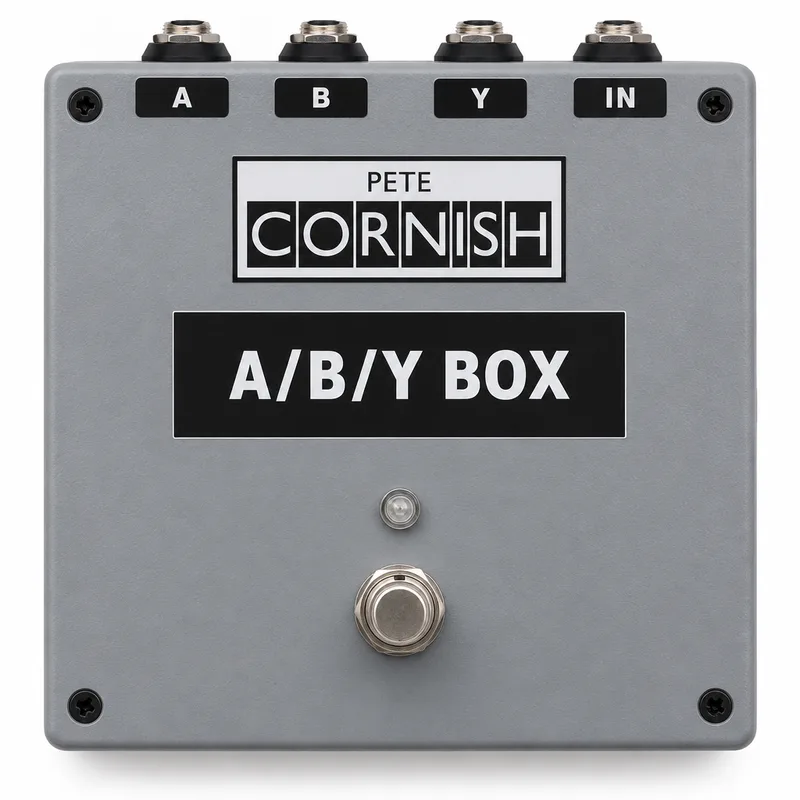
The Pete Cornish A/B/Y Box is a signal routing box that takes one instrument and sends it to either of two amplifiers, or to both at the same time. It sits in the switching family of pedals, but unlike a simple passive A/B box it is an active unit: Pete Cornish says its input impedance is identical to a high quality tube amplifier, and it carries the company's Unity Gain Class A Line Driver (LD-1), so your guitar sees a load much like plugging straight into a good amp1.
The input accepts active or passive guitars, basses or other signal generating instruments1. Each unit is hand built, wired and tested by Pete, Lynda and Mingus Cornish1.
What it does: one instrument to two amps
The core job is amp switching. Output A is unbalanced unity gain and low impedance, suitable for feeding amplifier inputs or effects units that then feed an amp1. Output B is ground lifted on a TRS jack at the same level and impedance as Output A, and Pete Cornish describes it as suitable for feeding a second amplifier direct or via additional effects units1. That ground lift matters when you run two amps off different mains circuits: it breaks the ground loop that would otherwise hum.
Because both outputs are driven rather than simply split, the box behaves more like a buffered distribution point than a passive splitter. Its input impedance is identical to a high quality tube amplifier, and it carries Pete Cornish's Unity Gain Class A Line Driver (LD-1), with Output A unbalanced unity gain and low impedance, suitable for feeding amplifier inputs or effects units which are then fed into an amplifier input5.
This unit is NOT suitable for feeding amplifier outputs to different loudspeakers. It routes instrument level signals, not speaker level signals2.
The footswitch, outputs and LEDs
The switching is simple. Pressing the A+B footswitch (LED on) sends identical signals to Output A and Output B, so both amps run together1. Output status is shown by two sets of LEDs: when the A+B LED is off, the active output is indicated by LED A or LED B1.
| Control | What it does |
|---|---|
| A+B footswitch | Sends identical signals to Output A and Output B when engaged (LED on)1 |
| LED A / LED B | Shows which output is active when the A+B LED is off1 |
| Output A | Unbalanced unity gain, low impedance, for amp inputs or effects1 |
| Output B | Ground lifted on TRS jack, same level and impedance as Output A, for a second amp1 |
Power: 9V to 24V DC or battery
It also takes a battery. Replacement is via a drawer, the preferred type is an MN1604, and the battery switches on when you insert the IN/PWR jack, so pulling the input plug powers the unit down1.
The supply voltage affects the maximum output level:
| Supply | Maximum output |
|---|---|
| 9V DC | +9dBm / 2.24 Vrms / 6.25V peak to peak2 |
| 24V DC | +18dBm / 6.2Vrms / 17.6V peak to peak1 |
Other measured specifications from the maker: input impedance 1Mohm (with a 9V DC supply), minimum output impedance 2Kohm, output noise -110dBm (10KHz bandwidth), and frequency response within +/- 1dB from 15Hz to 40KHz2.
How it compares with the A/B/C Box
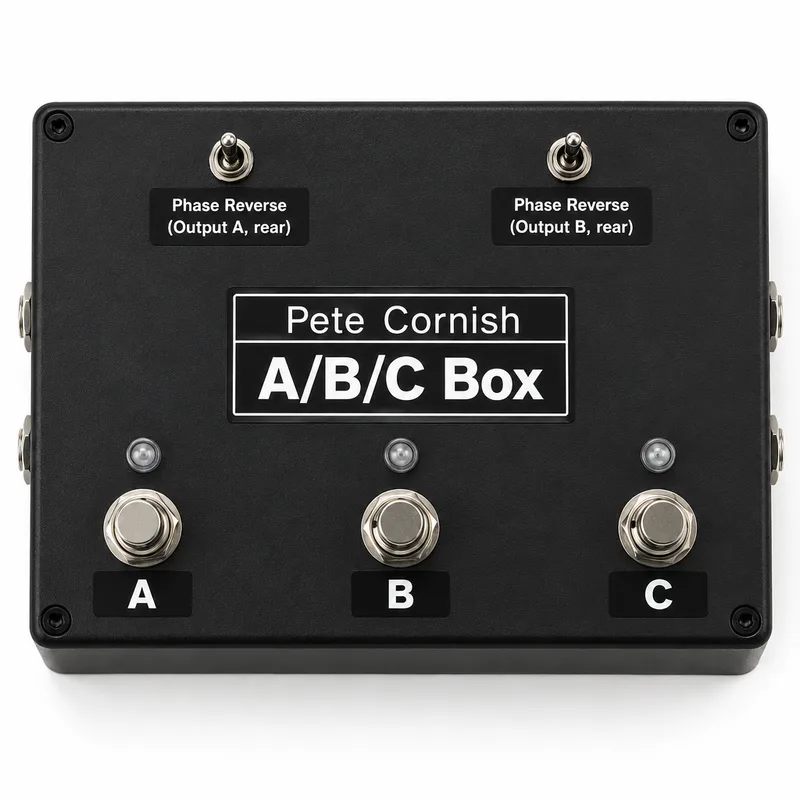
Pete Cornish also makes an A/B/C Box, a three way signal splitter with a buffer preamp that feeds up to three amps, with low impedance balanced outputs that allow long cable runs without loss6. Where the A/B/Y Box gives you two outputs plus a both at once switch, the A/B/C Box gives three individually switched outputs, with Outputs A and B floating to prevent ground loops6. The A/B/C Box is a dual voltage unit: a 9.6V DC adapter (BOSS PSA series or similar) gives performance identical to battery power, and it accepts up to 18V DC from a smoothed and regulated adapter capable of supplying 20mA6.
| A/B/Y Box | A/B/C Box | |
|---|---|---|
| Outputs | Two, plus A+B both mode | Three |
| Ground handling | Output B ground lifted on TRS | Outputs A and B floating to prevent ground loops |
| Supply range | 9V to 24V DC or MN1604 battery | 9.6V DC to 18V DC, dual voltage |
| Maximum output | +18dBm with 24V DC | +15dBm with 18V DC |
Warranty and support
The unit carries a twelve month warranty from date of purchase covering original manufacturing faults, with normal wear, misuse, unauthorized modifications and accidental damage excepted1.
Questions
Does the Pete Cornish A/B/Y Box take a battery?
Yes. The box has a battery drawer for easy replacement, and Pete Cornish specifies an MN1604 type battery. The battery is switched on only when a plug is inserted into the IN/PWR jack, so unplugging the input cable powers it down. It also accepts any stabilized, noise free DC supply between 9V and 24V.
Does the Pete Cornish A/B/Y Box have a ground lift?
Yes. Output B is ground lifted on a TRS jack, at the same level and impedance as Output A. Pete Cornish describes it as suitable for feeding a second amplifier directly or through additional effects units, and the lift helps prevent ground loop hum between two amps.
Can it switch between two speaker cabinets?
No. Pete Cornish states plainly that the A/B/Y Box is not suitable for feeding amplifier outputs to different loudspeakers. It is an instrument level routing box that sits between your guitar and your amp inputs, not a speaker level switcher.
Who builds Pete Cornish pedals?
Each Pete Cornish A/B/Y Box is hand built, wired and tested by Pete, Lynda and Mingus Cornish at the Pete Cornish Partnership in the UK. The company's first guitar effects board was built for Yes guitarist Peter Banks in 1972.
Sources (6)
- Pete Cornish A/B/Y Box, Pete Cornish, 2021
- Pete Cornish A/B/Y Box, Pete Cornish, 2018
- Grey Series Effects Pedals, petecornish.co.uk, 2026-03-31
- Battery Free Effects Pedals, petecornish.co.uk, 2026-03-31
- Effects Pedal Board Systems, Pete Cornish
- Pete Cornish A/B/C Box, Pete Cornish, 2014