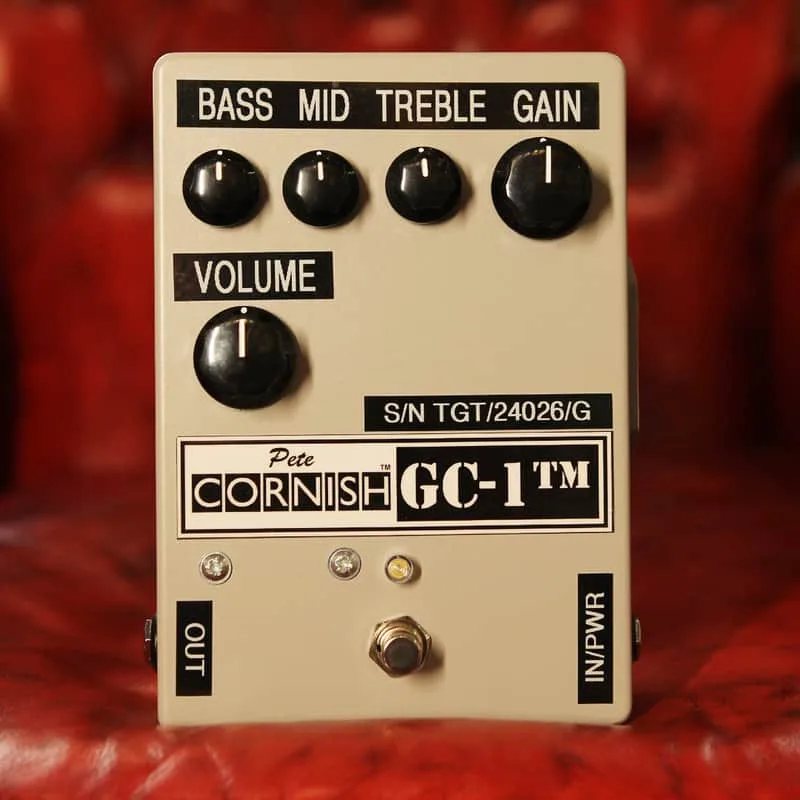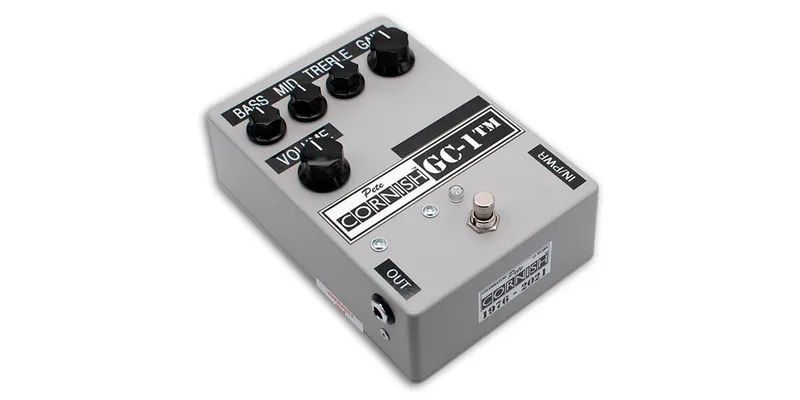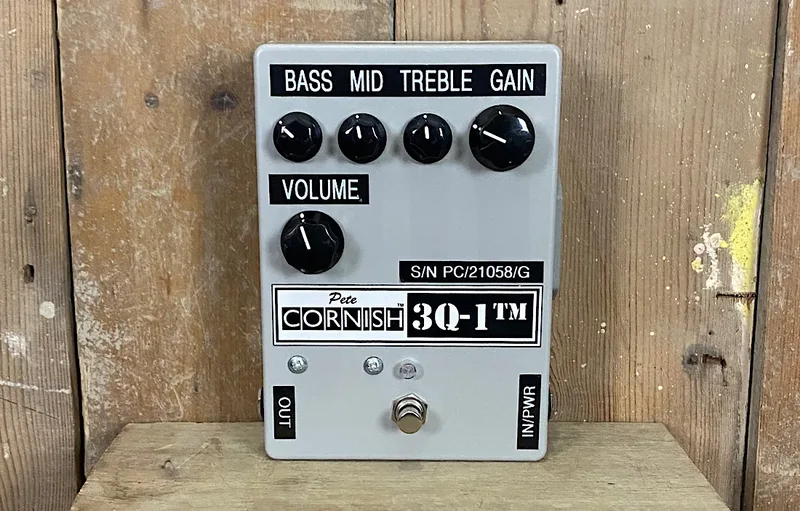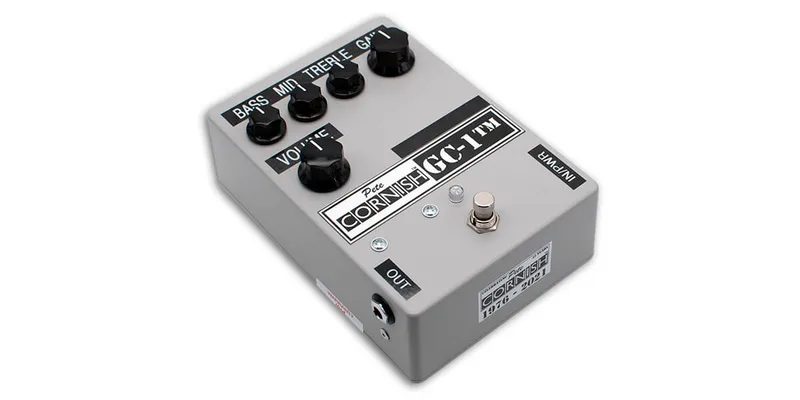


The Pete Cornish Battery Free GC-1 is an overdrive and boost pedal with a three-band active EQ and a built-in buffer, launched in 2021 for the company's 45th year of building stage equipment1. Pete Cornish describes it as a completely new three-stage design featuring both hard and soft clipping stages with automatic switching between them as the gain increases, and says it has a wider gain range than any of the company's previous pedals1. Each unit is hand built, wired and tested by Pete, Lynda and Mingus Cornish1.
The "Battery Free" part of the name is the point of difference from the standard GC-1: this version has no battery compartment and runs from a 9V DC adapter only1. Pete Cornish lists it in its battery free range as a "HIGH GAIN CRUNCH WITH B/M/T ACTIVE TONE BOOST/CUT"2.
A three-stage overdrive with hard and soft clipping
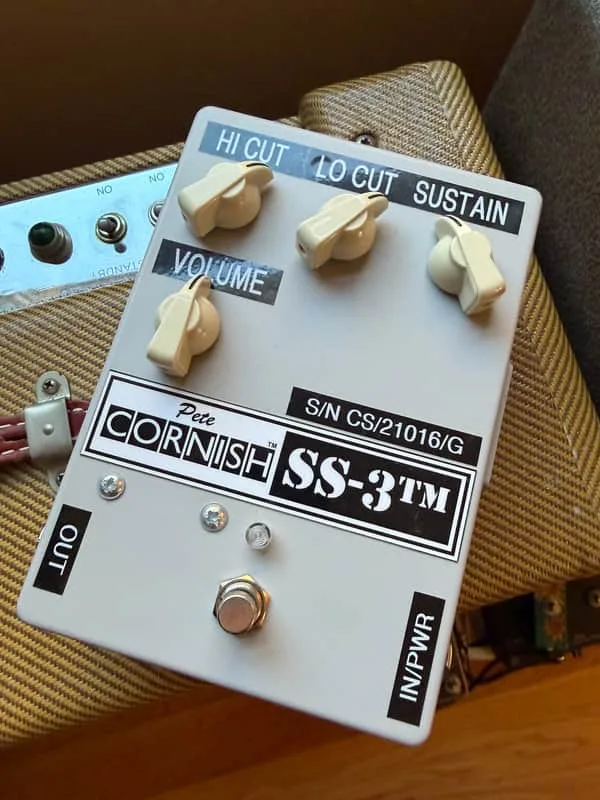
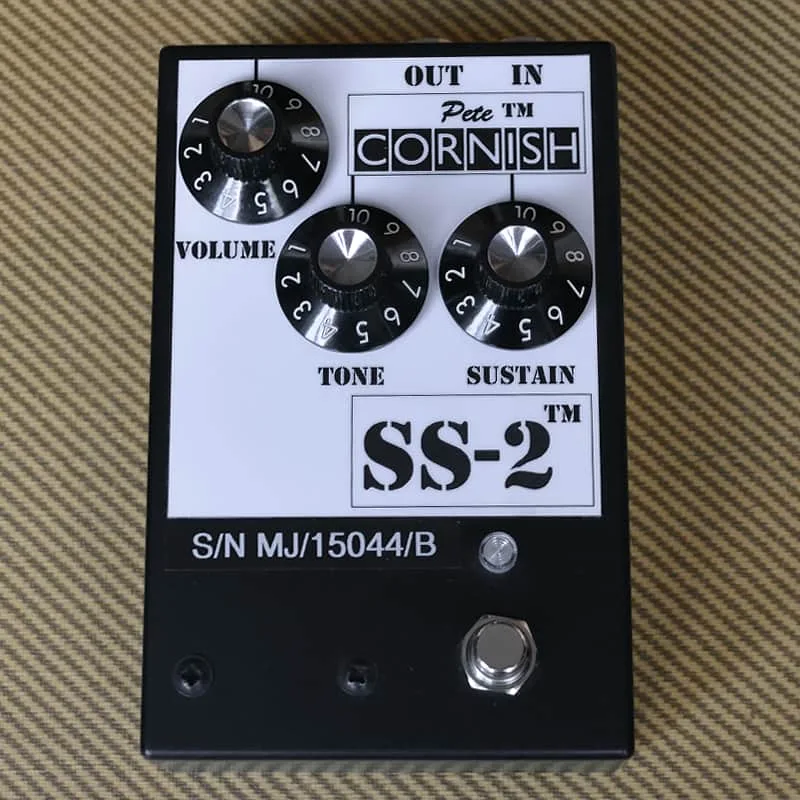
Pete Cornish presents the GC-1's circuit as a new three-stage design in which hard and soft clipping stages hand over to each other automatically as the gain control rises3. The maker maps the gain range onto familiar territory from earlier Cornish pedals: with gain at minimum the pedal sits in the Soft Sustain area of the SS-2 and SS-3, low gain gives what the maker calls a Smooth and Transparent Blues Crunch, increasing the gain passes gradually through the gain structures of the G-2 and P-2, and maximum gain reaches what the maker calls High Energy Sustain1. The maker also describes the sound at low gain as having "amazing Bottom End Retention" and being "Refined and Warm sounding without getting muddy"1.
The GC-1 is described as a high gain crunch drive that can deliver soft and transparent sustain at low gain levels, '70s Marshall-style overdrive at medium levels, and intense overdrive at maximum gain3.
An independent technical analysis by Aion FX, which traced the GC-1 circuit in 2023, tells a more skeptical story. Their conclusion45:
"In the end it was a bit of a letdown: a CC-1 with several value swaps."5
Aion FX found the GC-1's clipping to be the same as the Pete Cornish CC-1, which Pete Cornish describes as having two soft clipping stages, with no hard clipping present5. They also note the build uses a vintage-style etched single-sided PCB with epoxy-potted component blocks5. On their Cepheus project page, Aion FX describes the CC-1 as "a fully original circuit that's not based on anything else," designed primarily with op-amps, and says the GC-1 was found identical to the CC-1 other than changes in component values4.
The controls
The Battery Free GC-1 has five controls: Gain, Bass, Middle, Treble and an output Master Volume. The Master Volume is there, in the maker's words, "to allow for perfect matching between bypassed and boosted/EQ'd signal level"1.
| Control | What it does |
|---|---|
| Gain | Sets overall boost from +20dB (10X) at minimum to +56dB (640X) at maximum1 |
| Bass | Cut or boost, +/- 16dB at 50Hz1 |
| Middle | Cut or boost, +/- 15dB at 950Hz1 |
| Treble | Cut or boost, +/-17dB at 4KHz1 |
| Volume | Output master volume for matching bypassed and boosted levels1 |
The neutral position of the three tone controls is 12 o'clock, and equal amounts of bass, mid and treble cut are also available1. Pete Cornish says the three active tone bands in this family of pedals are completely independent, with no interaction between the Bass, Middle and Treble controls6.
Gain: +20dB to +56dB
The gain range is the widest of any Pete Cornish pedal to date, according to the maker1. With Gain and Volume both at 100%, overall boost is +56dB, which the maker expresses as 640X; at minimum gain the pedal still provides +20dB, or 10X1. That minimum setting is what puts the pedal into the Soft Sustain territory of the SS-2 and SS-3, so even at its lowest gain the GC-1 works as a substantial clean boost, and the three-band EQ shapes it further.
Power: 9V DC, 20mA
The Battery Free GC-1 takes no battery. It needs an adapter to run, so it cannot be used without a power supply.
The adapter should be noise free, fully stabilized at 9V DC and capable of supplying 20mA. The coax connector is 5.5/2.1mm with a negative center pin1. For players running multiple pedals, Pete Cornish recommends the Voodoo Lab Pedal Power 2 Plus as meeting these criteria; for a single unit, the BOSS PSA series1.
The LD-1 buffer and bypass
The pedal includes Pete Cornish's well established Class A input buffer, the LD-1, together with a radio frequency suppressor1. The buffer is fully active in bypass mode, which the maker says is there "to prevent losses associated with long cables and/or load impedances"7. In other words, with the pedal switched off the signal still passes through the LD-1 rather than a true bypass wire, keeping the high end intact on long cable runs. Players comparing buffered and true bypass designs can read more on the buffer pedals page.
Battery Free GC-1, GC-1 and Deluxe GC-1
The GC-1 comes in several versions. The standard GC-1 takes a 9V battery, preferred type MN1604, replaced through a removable drawer, and the battery switches on when a jack is inserted into the IN/PWR ON jack8. The Deluxe GC-1 shares the same three-stage design, the same automatic switching between clipping stages, the same +20dB to +56dB gain range and the same three-band active EQ, and also runs on a 9V battery with the MN1604 preferred type and drawer replacement7. The Battery Free GC-1 covers the same ground on adapter power alone1.
All versions carry the same warranty: twelve months from date of purchase, with repairs of any original manufacturing fault carried out, normal wear, misuse, unauthorized modifications and accidental damage excepted, and the warranty voided if the guarantee labels are damaged or removed1.
Videos
Simon Gotthelf Music
Electric Mojo Guitars
Simon Gotthelf Music
Questions
Does the Pete Cornish Battery Free GC-1 take a battery?
No. The Battery Free GC-1 is built without a battery compartment and runs only from a 9V DC adapter. Pete Cornish also makes a standard GC-1 that does take a battery, switched on when a jack is inserted into the IN/PWR ON jack, with a preferred MN1604 battery replaced through a removable drawer.
What power supply does the Pete Cornish GC-1 need?
A noise-free, fully stabilized 9V DC adapter capable of supplying 20mA, with a 5.5/2.1mm coax connector and a negative center pin. For powering several pedals Pete Cornish recommends the Voodoo Lab Pedal Power 2 Plus, and for a single unit the BOSS PSA series.
Is the buffer active when the GC-1 is bypassed?
Yes. The pedal includes Pete Cornish's Class A input buffer, the LD-1, together with a radio frequency suppressor, and the buffer is fully active in bypass mode. This is intended to prevent signal losses from long cables and low load impedances even when the pedal is switched off.
What is the difference between the Battery Free GC-1 and the Deluxe GC-1?
The two share the same three-stage design, the same +20dB to +56dB gain range and the same three-band active EQ. The Deluxe GC-1 adds a 9V battery with a removable drawer, while the Battery Free GC-1 runs from an adapter only. Both carry a twelve month warranty.
What is the LD-1 buffer in the GC-1?
The LD-1 is Pete Cornish's well established Class A input buffer, fitted together with a radio frequency suppressor. It stays fully active in bypass mode so the pedal does not cause the high frequency and level losses that long cable runs and low load impedances can produce.
How long is the warranty on the Pete Cornish GC-1?
Twelve months from the date of purchase. Pete Cornish will repair any original manufacturing fault in that period, but the warranty excludes normal wear, misuse, unauthorized modifications and accidental damage, and it is voided if the guarantee labels are damaged or removed.
Sources (8)
- PETE CORNISH Battery Free GC-1, Pete Cornish, 2021
- Battery Free Effects Pedals, petecornish.co.uk, 2026-03-31
- Pete Cornish GC-1 High Gain Crunch Drive, Delicious Audio, 2021-07-26
- Cepheus Amp Overdrive / Cornish CC-1 & GC-1, Aion FX, 2020-09-11
- Tracing Journal: Cornish GC-1, Aion FX, 2023-10-06
- Pete Cornish CC-1, Pete Cornish, 2025
- Pete Cornish Deluxe GC-1, Pete Cornish, 2021
- Pete Cornish CC-1, Pete Cornish, 2021