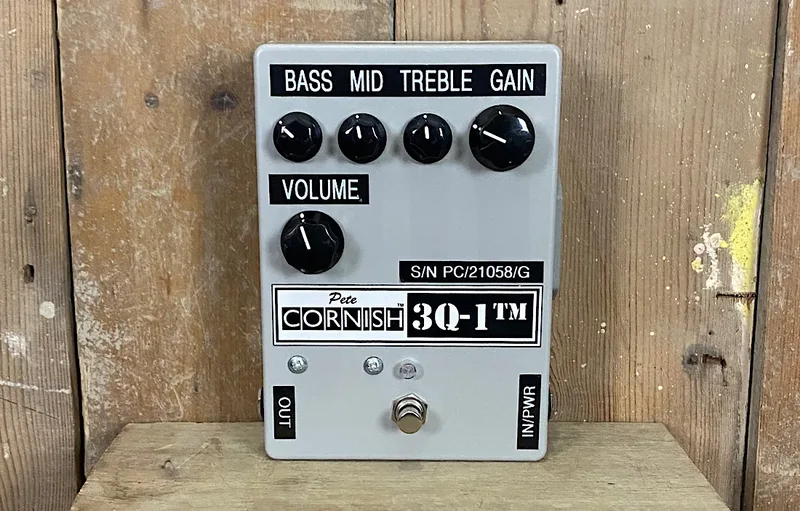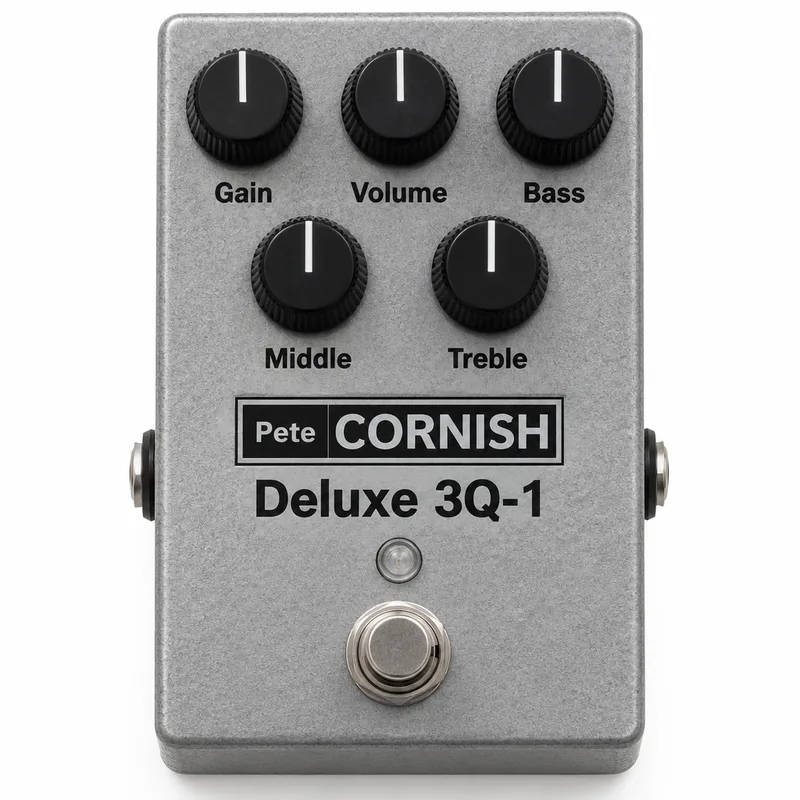
The Pete Cornish Deluxe 3Q-1 is a tone and volume boost pedal, presented by the maker as a completely new and original design rather than a variant of an existing product1. It sits in the boost lane: its job is to raise the level of your signal and shape its tone, not to add clipping of its own. The first stage is a variable gain linear boost with a flat frequency response, with a gain range of 0 to +20 dB, described by the maker as a tenfold (10X) increase1. With the Gain control at 100% and the Volume control at 100%, the overall boost is +20 dB1.
Following that clean boost stage is a three band active EQ, and after the tone circuit the maker has included a second fixed gain linear boost stage, placed there to compensate for the volume reduction that happens when the tone controls are used in cut mode2. In practice that means pulling back bass or treble does not silently lower your overall level, which is a common annoyance with passive tone controls.
What it does to your sound
The signal path has three parts. First, the variable gain linear boost with a flat frequency response: flat means it lifts the whole spectrum evenly, without the treble emphasis of a treble boost or the midrange hump some boosters add. Second, the three band active EQ, which lets you cut or boost bass, middle and treble. Third, the fixed gain linear boost stage that makes up the level lost when the EQ bands are set to cut12.
The maker publishes the range of the bass band: the Bass control covers plus or minus 16 dB at 40 Hz1. Maximum signal output with the Volume control at 100% is +10 dBm, 2.5 V RMS, or 6 V peak to peak1, which is a healthy output level for driving an amplifier or a later pedal hard.
| Stage | What it does |
|---|---|
| First stage | Variable gain linear boost, flat frequency response, 0 to +20 dB (10X)1 |
| Tone circuit | Three band active EQ, Bass range plus or minus 16 dB at 40 Hz21 |
| Second boost stage | Fixed gain linear boost after the EQ, compensating for level lost in cut mode2 |
Controls and hardware
The pedal is housed in a rugged die-cast box with lined control knobs1. The footswitch is a heavy duty custom made all-metal unit with a large cap and a protection ring, plus a Hi-Brite LED so the on state is easy to see on a dark stage1. At 171 x 121 x 55 mm it is a medium sized enclosure, in line with the maker's other hand built pedals1.
Powering it
The Deluxe 3Q-1 runs on 9V DC. The maker specifies that the adapter should be noise free and fully stabilised at 9V DC, and capable of supplying 20mA1. The coax connector is 5.5/2.1mm with a center pin that is negative1, the same arrangement as most common pedal power supplies.
For players powering several pedals, Pete Cornish recommends the Voodoo Lab Pedal Power 2 Plus as meeting its criteria, and for a single unit the BOSS PSA series1. On the related battery free 3Q-1 page, the maker also recommends isolated ground power supplies of that type and advises against daisy chaining3.
The Deluxe 3Q-1 also runs on a battery, unlike the battery free version of the 3Q-1. Battery replacement is through a removable drawer, the battery switches on when you insert the IN/PWR ON jack, and the preferred battery type is the MN160412.
The buffer and bypass
The input is fully buffered using Pete Cornish's LD-1 Class A unity gain line driver with an RF filter, and that buffer is also active in bypass mode1. For a player, this means the pedal always drives the cable ahead of it with a low impedance signal, which preserves treble over long cable runs, but it also means the Deluxe 3Q-1 is not a true bypass pedal: something placed in front of it always sees a buffered input. The same buffered bypass arrangement appears on the earlier 3Q-1 pages3.
Where it came from
The 3Q-1 line goes back to the battery free 3Q-1, which the maker introduced as new for 20162. That pedal shared the same architecture: a variable gain linear boost with flat frequency response and a 0 to +20 dB gain range in the first stage, a three band active EQ, and the same +20 dB overall boost with Gain and Volume at 100%23. The Deluxe 3Q-1 adds the battery drawer and carries the design forward, and the maker states it is not a variant of any existing product but a completely new and original design1.
Warranty
The warranty covers twelve months from the date of purchase. Should a fault occur in that period, the unit is returned post paid to the maker, which repairs original manufacturing faults. The warranty is voided if the guarantee labels are damaged or removed, and normal wear, misuse, unauthorized modifications or accidental damage are excepted1.
Questions
Does the Pete Cornish Deluxe 3Q-1 run on a battery?
Yes. The Deluxe 3Q-1 has a removable battery drawer for easy replacement, and the battery switches on when a plug is inserted into the IN/PWR ON jack. Pete Cornish specifies the MN1604 9V battery as the preferred type, so it can run without a power supply at all.
Is the Pete Cornish Deluxe 3Q-1 buffered when bypassed?
Yes. The input is fully buffered using Pete Cornish's LD-1 Class A unity gain line driver with an RF filter, and that buffer stays active in bypass mode. The pedal therefore always presents a buffered input to whatever comes before it in the signal chain.
How much boost does the Deluxe 3Q-1 give?
With the Gain control at 100% and the Volume control at 100%, the overall boost is +20 dB. The first stage on its own is a variable gain linear boost with a flat frequency response, with a gain range of 0 to +20 dB, which is a tenfold increase in signal.
What power supply does the Pete Cornish Deluxe 3Q-1 need?
It needs a 9V DC supply that is noise free and fully stabilised, able to supply 20mA. The coax connector is 5.5/2.1mm with a centre pin that is negative. Pete Cornish recommends the Voodoo Lab Pedal Power 2 Plus for powering several pedals, or a BOSS PSA series adapter for a single unit.
Where is the Pete Cornish Deluxe 3Q-1 made?
Each unit is hand built, wired and tested by Pete, Lynda and Mingus Cornish. Pete Cornish is a small British maker, and the company's product pages describe this hands on construction as applying to every unit it produces.
What is the warranty on the Pete Cornish Deluxe 3Q-1?
The warranty runs for twelve months from the date of purchase and covers repair of original manufacturing faults, with the unit returned post paid to the maker. It is voided if the guarantee labels are damaged or removed, and normal wear, misuse, unauthorized modifications or accidental damage are not covered.
Sources (3)
- Pete Cornish Deluxe 3Q-1, Pete Cornish, 2025
- Pete Cornish 3Q-1, Pete Cornish, 2016
- Pete Cornish 3Q-1, Pete Cornish, 2016