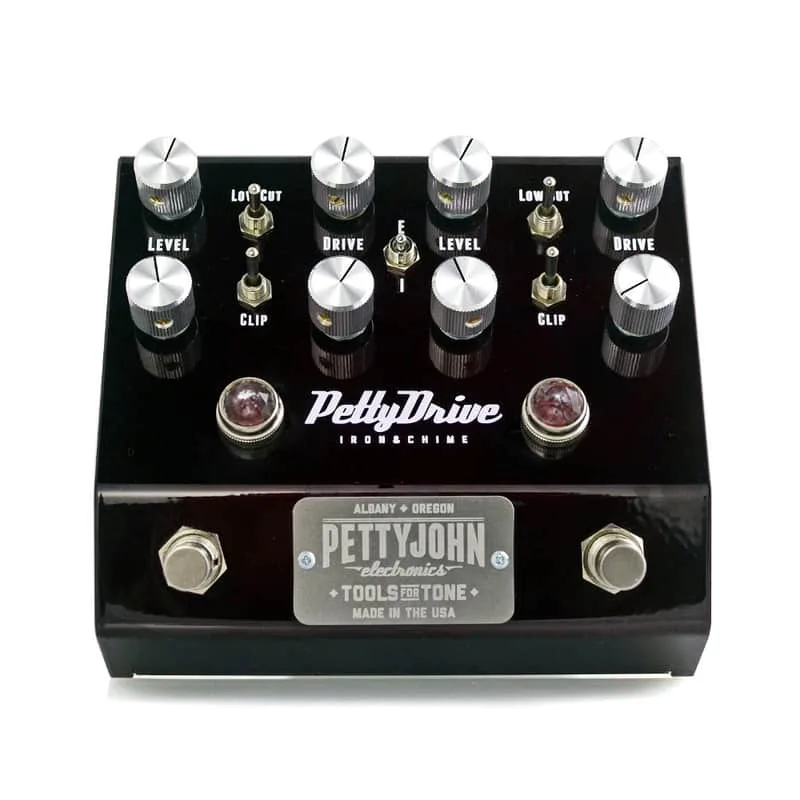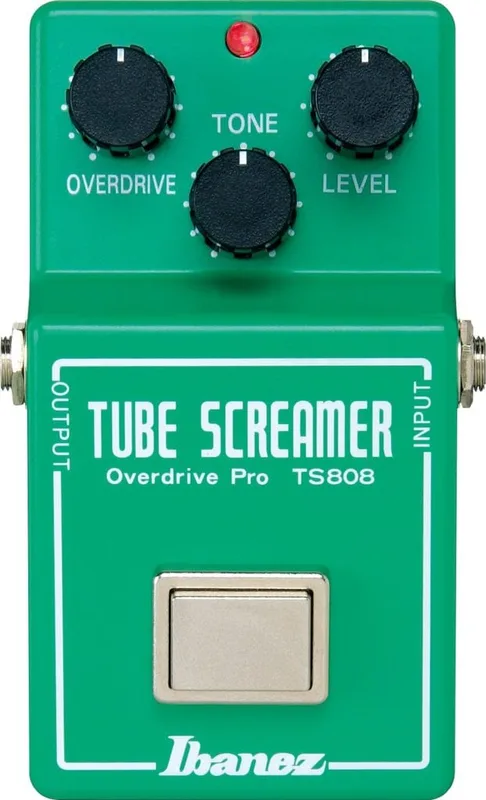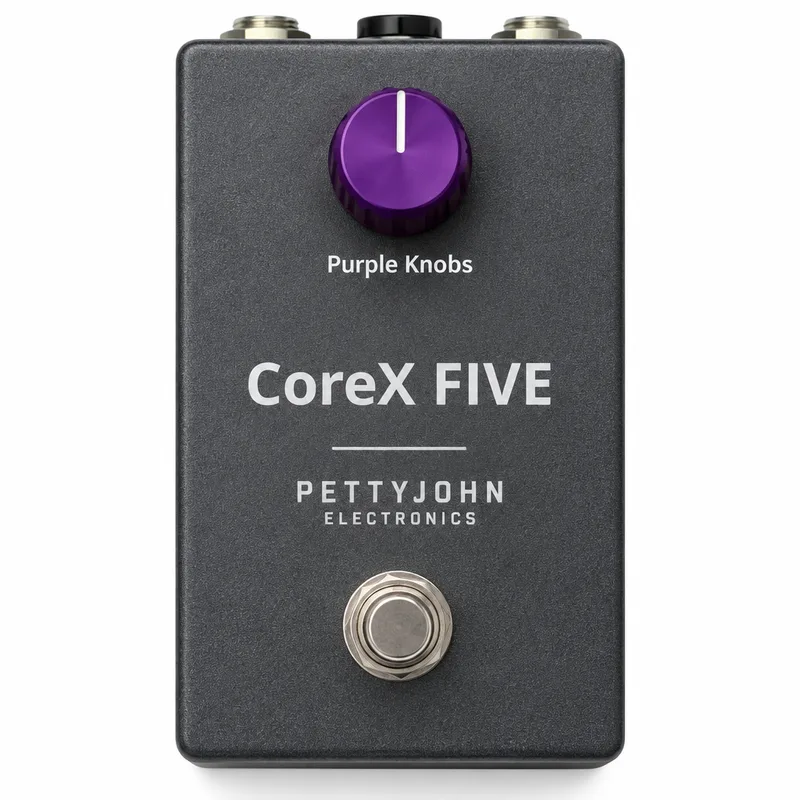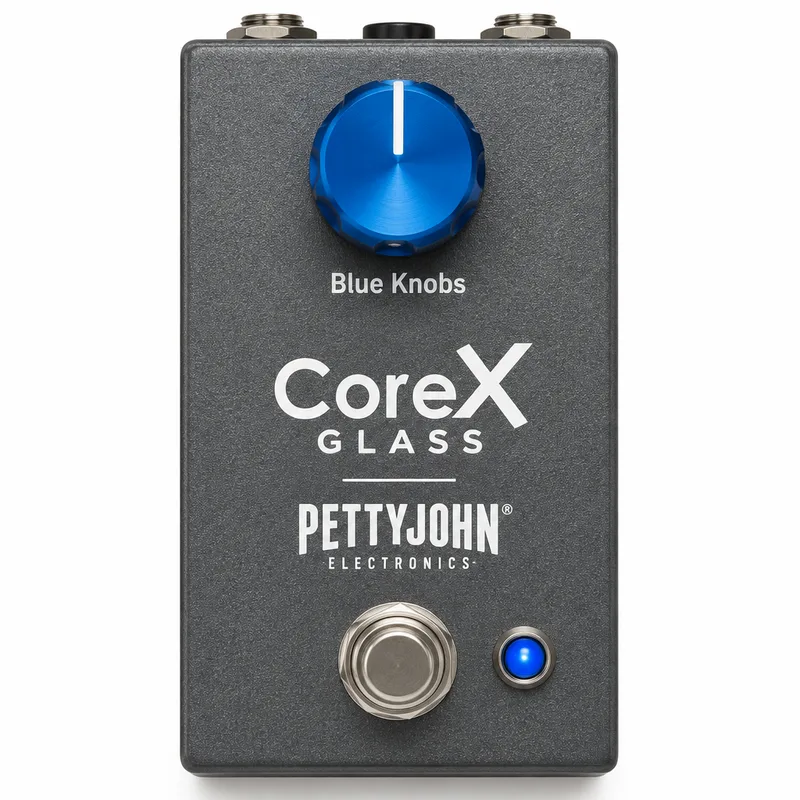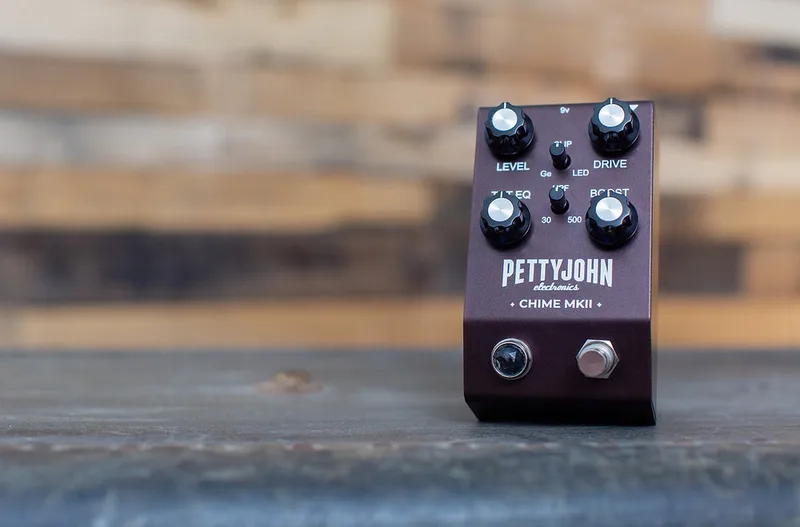


The Pettyjohn Electronics CHIME MKII is a boutique low-gain preamp and overdrive pedal, a major update to the company's signature low-to-medium gain overdrive, the CHIME1. It was announced ahead of the NAMM show in January 20192. Inside, it uses classic TL072 and JRC4558 op-amp stages, with a Burr Brown OPA input and output buffer2.
What sets the MKII apart for a player is its power section: a proprietary supply that takes a standard 9V adapter and delivers a full 36 volts of internal headroom, with up to 10 times the current of the previous version2. Pettyjohn says this gives the pedal its headroom and dynamic response from a supply of only 9 volts1.
A low-gain preamp and overdrive on a 4558 chip
The CHIME MKII sits in the low-to-medium gain range, built around carefully implemented TL072 and JRC4558 stages that Pettyjohn says were chosen for warmth and feel2. The 4558 chip sits at the heart of the clipping stage, and the pedal's internal mini toggles live around it1.
The design lineage goes back to the original CHIME, a low to medium gain overdrive in the series23. The CHIME MKII is a major update to that signature low-medium gain overdrive, built around a 4558 chip2. Where the V1 offered its Tubbs setting through internal toggles, the MKII carries the upgrades over from that earlier version.
The original CHIME also carried a Boost control that Pettyjohn described as a pre-boost, increasing gain before the clipping amp in a way the company compared to a "Top Boost" control on some British amplifiers4. The maker's own guidance on the V1 was to learn the relationship between the Boost and Drive knobs, saying there is a world of tone locked inside that pairing3.
Power: 36 volts inside from a 9V supply
The MKII's headline change is its high-voltage power section. It runs 36 volts of internal power from a standard 9V adapter drawing 150mA, with up to 10 times the current of the previous version2. Pettyjohn describes this as an extremely robust supply that delivers a huge amount of headroom2.
The original CHIME took a different route: it ran on 9 to 18V DC, and its dual-rail power section effectively provided 18 to 36 volts of internal voltage swing, which the company translated as extra headroom for a studio-grade feel4. The MKII brings that internal voltage range to the pedal full time from a single 9V supply.
The MKII needs a standard 9V adapter capable of supplying 150mA. Its proprietary 36V internal supply is built into the pedal, so no special high-voltage power brick is required2.
From the original CHIME to the MKII
The original CHIME was released nearly three years before the MKII and became Pettyjohn's most popular pedal to date2. The MKII update adds several changes over the V1:
- Clipping mix knob: a mini pot that blends between germanium and LED clipping, replacing the V1's internal-toggle approach to clipping2
- Preamp Mode: an internal mini toggle bypasses the clipping stage, making the pedal a clean tone-shaping preamp and boost with no clipping at all2
- 36V internal power: the new proprietary supply described above2
- Direct-coupled stages: internally direct coupled for what the maker calls the purest signal path possible2
- Added frequency range: wide enough that Pettyjohn suggests using it as a bass or acoustic preamp1
The V1's well-known Tubbs setting was reached through internal toggles; on the MKII, the clipping knob's LED side gets you there, and Pettyjohn notes that players who truly want the original V1 Tubbs setting can open the back panel and set the toggle to the left of the 4558 chip1.
Four ways to use it
Pettyjohn's own usage guide describes several ways to set up the MKII1:
- In preamp mode, use it as a first, always-on pedal at the front of your board.
- Thanks to the added frequency range, use it as a bass or acoustic preamp.
- Set the clipping knob to about 9 or 10 o'clock for boost use.
- For the original V1 Tubbs setting, open the back panel and use the toggle to the left of the 4558 chip.
- Boost: set the clipping knob to about the 9 to 10 o'clock position, where the pedal works as a boost1.
- Dirt: full counter-clockwise on the clipping knob is full germanium clipping1.
- Tubbs: the LED side of the clipping knob gives the Tubbs setting from the original V11.
- Preamp: with Preamp Mode engaged, use it as a first, always-on pedal at the front of the board1.
The company positions the pedal as a boutique low-gain preamp/overdrive, crediting designer Stephen with having outdone himself in creating it1.
Who uses it
Pettyjohn names Shawn, a session guitarist from Nashville, Tennessee, as a CHIME user, saying it is his go-to, always-on pedal1. The company also recommends the MKII itself as a first always-on pedal at the front of a board in Preamp Mode1.
Videos
Pettyjohn Electronics
A77.STUDIO
Claudio Tristano
Questions
Can the Pettyjohn CHIME MKII be used as a bass or acoustic preamp?
Yes. Pettyjohn says the MKII's added frequency range lets it work as a bass or acoustic preamp, and its Preamp Mode, set by an internal mini toggle, bypasses the clipping stage entirely so it acts as a clean tone-shaping preamp and boost with no clipping at all.
What setting on the CHIME MKII clipping knob works as a clean boost?
Pettyjohn suggests setting the clipping knob to about the 9 to 10 o'clock position for boost use. Full counter-clockwise is full germanium clipping, while the LED side of the knob gives the Tubbs setting from the original CHIME.
What is the difference between the Pettyjohn CHIME V1 and MKII?
The MKII adds a 36-volt internal power supply from a standard 9V adapter, a clipping mix knob that blends germanium and LED clipping, Preamp Mode, and extended frequency range. The V1 ran on 9 to 18V DC and reached its Tubbs setting through internal toggles instead of the knob.
Can I leave the CHIME MKII always on at the front of my pedalboard?
Yes. Pettyjohn recommends using Preamp Mode, which bypasses the clipping stage, as a first always-on pedal at the front of the board. The company also notes a Nashville session guitarist uses the CHIME as his go-to always-on pedal.
Sources (4)
- 4 Ways To Use The CHIME MKII, Pettyjohn Electronics, 2019-02-28
- Pettyjohn Chime MKII, Delicious Audio, 2019-01-25
- A Drive For All Occasions, Pettyjohn Electronics, 2018-12-13
- Pettyjohn Electronics Releases the Chime OverDrive, Premier Guitar, 2016-05-13