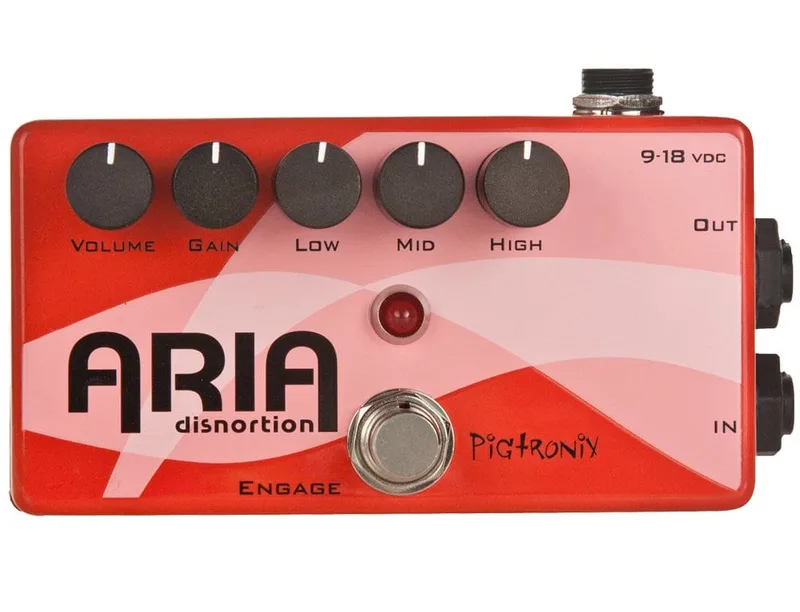


The Pigtronix Aria Disnortion is an analog overdrive pedal from Pigtronix, aimed at players who want a wide range of distorted tones in one box. Pigtronix bills it as a versatile analog overdrive device1, and its street price was listed at $149 in Premier Guitar's review1.
Where it gets interesting is how far the gain can go. Premier Guitar's reviewer found that the Aria does not sit neatly in the overdrive category, noting that it has more high-gain fuzz-like qualities than a transparent overdrive, and that it excels when treated as a fuzz1.
"Pigtronix may bill the Aria as an overdrive, but it really excels when it’s treated as a snorting, squealing boar of a fuzz box."
Delicious Audio's reviewer heard the same versatility, describing the overall tonality as much smoother and more musical than other pedals in its league, ranging from creamy violin-like distortion to thrash metal2.
The controls: gain and 3-band active EQ
The Aria carries five knobs and a very bright colored LED indicator2. The core of the control set is a Gain knob plus a 3-band active EQ with Bass, Mid and Treble controls, which Premier Guitar's reviewer called very flexible1.
With the three EQ knobs and the Gain knob set at noon, the Aria delivered what the reviewer described as a rich, punchy distortion with a lot of high-frequency content1. Because the EQ is active rather than a simple passive tone roll-off, each band can boost as well as cut, which is what gives the pedal its range from creamy to aggressive.
| Control | What it does |
|---|---|
| Gain | Sets the amount of drive, from creamy distortion up to high-gain fuzz-like territory12 |
| Bass | Active EQ band for low end1 |
| Mid | Active EQ band for midrange1 |
| Treble | Active EQ band for high end1 |
Overdrive, fuzz, or something in between
The question of what category the Aria belongs to is where the two published reviews agree it is unusual. Premier Guitar's reviewer wrote1:
"I wonder if classifying the pedal strictly as an overdrive doesn't sell it short. To me, the Aria has more high-gain fuzz-like qualities than the transparent overdrive associated with a vintage Ibanez Tube Screamer."
For a player, that means the Aria can cover jobs that would normally call for separate overdrive and fuzz pedals: lower gain settings for rhythm parts, and the top of the Gain range for saturated lead tones. Delicious Audio placed its smoothness above other pedals in its league, with the 3-band EQ helping dial in anything from violin-like sustain to metal2.
The manual and getting started
The Aria's manual is worth reading before diving in. Delicious Audio's review notes that it describes the philosophy behind the pedal and provides starting point settings, which the reviewer found quite useful2. Pigtronix also makes a bold claim for the pedal itself, saying it will "make you write new songs"2.
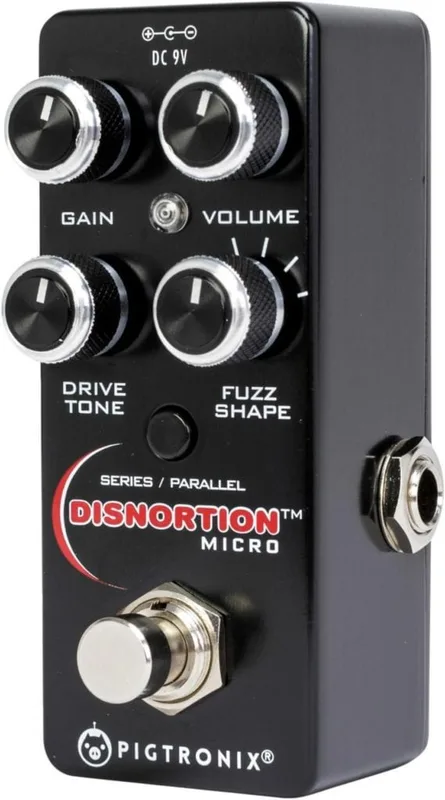
Players comparing compact options may also want to look at the Pigtronix Disnortion Micro, a smaller version of the original Disnortion distortion/fuzz pedal.
Videos
ProGuitarShopDemos
Pigtronix
Questions
Is the Pigtronix Aria Disnortion an overdrive or a fuzz?
Pigtronix bills the Aria as an overdrive, but Premier Guitar's reviewer found it behaves more like a high-gain fuzz, describing it as excelling when treated as a snorting, squealing fuzz rather than a transparent overdrive. It covers ground from creamy distortion to thrash metal levels of gain.
Is the Aria Disnortion analog?
Yes. Premier Guitar describes the Aria as a versatile analog overdrive device, and Pigtronix itself touts it in those terms. The pedal is built around analog circuitry with a 3-band active EQ for shaping the distorted tone.
Does the Aria Disnortion manual include sample settings?
Yes. Delicious Audio's review notes that the Aria Disnortion manual describes the philosophy behind the pedal and provides starting point settings, which the reviewer found quite useful for dialing in tones.
Sources (2)
- Pigtronix Aria Disnortion Pedal Review, Premier Guitar, 2010-10-27
- Pigtronix Philosopher's Tone & Aria Disnortion Reviews, Delicious Audio, 2010-06-28
 Pete Thorn