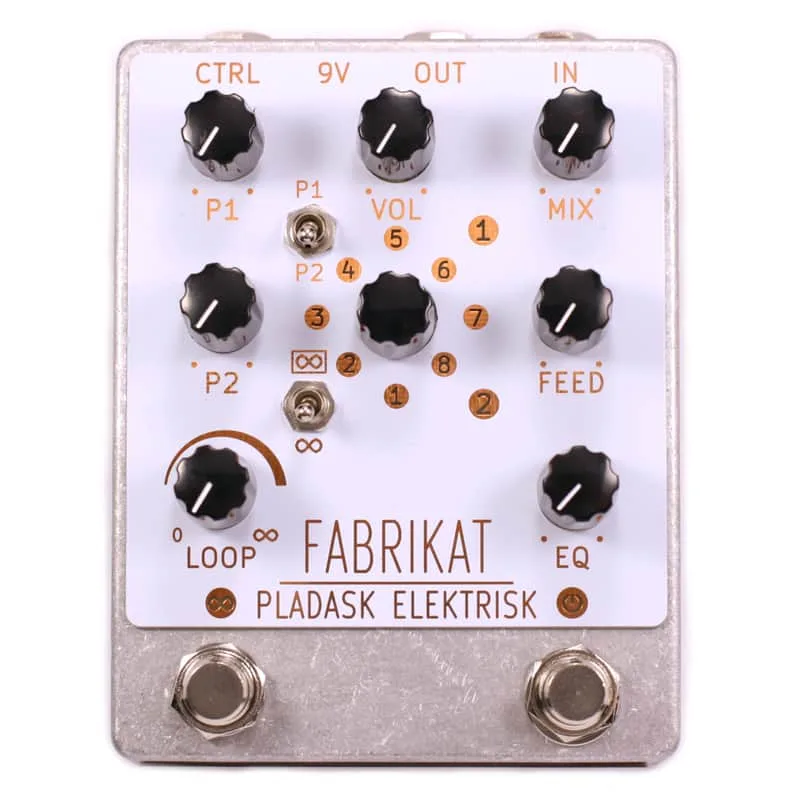


The Pladask Elektrisk FABRIKAT is what the Norwegian maker calls "a 100% inorganic, experimental multi-effects processor featuring 16 algorithms focusing on granular synthesis and modified sample playback"1. In plain terms, it records your signal into a digital buffer and then chops, stretches, freezes, reverses and rearranges it. Pladask Elektrisk describes the territory it covers as "synthetic ambiance, sonic deconstruction and spectral choirs"1.
It is a multi-effects pedal in form, but the maker designed it for two kinds of use: "FABRIKAT is aimed for use both as a guitar pedal and as a tabletop device as some of its algorithms greatly reward live" tweaking of the controls1. The current version is the FABRIKAT v3, which "differs slightly to the older versions"1; earlier units include a v2 and a goldplate version, and the maker says the goldplate and handstamped graphics versions "differ in operation, not audio"2. The v2 was developed in tandem with the BandOrg FORM2 workshop series, with BandOrg funding the software development2.
Granular synthesis and sample playback in a pedal
Granular synthesis works by breaking audio into very short snippets, called grains, and rearranging them. The FABRIKAT's granular programs can time-stretch and scrub material without changing its pitch, and its sample playback programs treat the buffer like a tape recorder whose speed you can push, pull and stop. The maker suggests thinking of bank 2's playback algorithms as "similar to manipulating the playback speed of a tape recorder," combinable with the feedback control for ascending and descending pitch shifting2.
Because the buffer holds up to 1000 ms of audio (100 to 1000 ms on some algorithms), you can feed it a chord, freeze it, and then scrub through it, shuffle it, or replay it at a fraction or multiple of its original speed. The maker notes that some algorithms "greatly reward live" manipulation1, which is why the tabletop use case matters as much as the pedalboard one.
The 16 algorithms in two banks
The FABRIKAT has 16 algorithms divided into 2 banks1. A rotary encoder selects algorithms 1 through 8; jumping from 8 to 1 crosses over into the other bank. The two banks break down like this:
| Bank | Algorithms | What they do |
|---|---|---|
| B1 | 1 to 5 | Time stretch systems; algorithm 1 has a variable buffer of 100 to 1000 ms, the rest use a 1000 ms buffer1 |
| B1 | 6 and 7 | Freeze/scrub systems1 |
| B1 | 8 | Beat repeater, a non-randomized single grain system with a buffer of 10 to 1000 ms13 |
| B2 | 1 to 5 | Variable speed sample playback systems, like manipulating tape recorder playback speed1 |
| B2 | 6 to 8 | Shuffle systems1 |
A few algorithms illustrate the range. On bank 1, Time Stretch with Buffer Size gives you a buffer of 100 to 1000 ms on P1 and stretching speed on P2, where the middle position freezes the audio, clockwise runs forward, counterclockwise runs in reverse, and the extremes return to original speed2. Time Stretch with Grain Size uses a 1000 ms buffer and sets grain size from 10 to 200 ms, which adjusts the timbre: shorter grains skew toward lower frequencies2. Time Stretch Random Pendulum generates random direction changes at a rate of 0 to 10 Hz, alternating between forward and reverse stretching2.
On bank 2, Sample Playback 1 Head Manual Sweep offers a 100 to 1000 ms buffer on P1 and playback speed and pitch on P2, where the extremes give +1 octave in reverse or forward and the middle position causes a tape stop2. Shuffle Delay behaves as a regular delay with P2 at minimum, with clockwise rotation increasing the shuffling and the FB knob adding accumulative shuffling2. The Shuffler randomly rearranges the buffer content, with P2 setting grain size from 20 to 400 ms: small grains skew low in frequency, large grains become delay-like2.
The beat repeater on bank 1 algorithm 8 has its own character. The maker describes it as "a non-randomized single grain system giving it a harsh and static quality"3.
Controls
The control surface is built around two footswitches and a set of knobs, with the two P knobs taking on a different job in every algorithm.
| Control | What it does |
|---|---|
| Algorithm selector (rotary encoder) | Selects algorithms 1 to 8; jumping between algorithms erases the DSP memory buffer; jumping from 8 to 1 switches bank1 |
| B1/B2 switch | Chooses between the algorithms in bank 1 or 2; after changing bank the selector must be readjusted before the DSP skips from the running algorithm3 |
| MIX | Sets the dry/wet balance from 100% dry to 100% processed audio1 |
| FEEB | Sets the amount of resynthesis feedback across the DSP and the EQ control; excessive runaway feedback makes the bypass LED flicker as a warning when bypassed1 |
| VOL | Sets master volume; unity gain at 12 o'clock, max gain +16dB2 |
| Right footswitch | Bypass; holding longer than 500 ms only momentarily changes its status1 |
| Left footswitch | Overrides the LOOP knob with the infinity-toggle setting; holding longer than 500 ms only momentarily changes the LOOP setting1 |
On the v2, activating the left footswitch causes the L.SW knob to override the LOOP knob, letting you swap between LOOP settings on the fly2.
The P1 and P2 knobs are where the algorithms live. In the Freeze/Scrub algorithm with Spread, for example, P1 controls grain randomization: it "adjusts the fluidity of the freeze effect. Static at min."3
Buffer size parameters are destructive: adjusting them permanently alters the content of the buffer. All other P1 and P2 parameters are non-destructive1.
Power and connections
The FABRIKAT runs on a 9 VDC center negative supply, the normal BOSS/Ibanez/1Spot type12. It does not support battery operation12. The v3 manual lists a current draw of 100 mA1 while the v2 manual lists ~90 mA2; the two manuals disagree, so budget for the higher figure. Input impedance is 1MΩ and output impedance is <1kΩ12.
The EXP socket accepts an expression pedal or a control voltage source of 0 to 3.3V1. A toggle switch maps the input to either the P1 or P2 knob, with the center position inactive1, so an expression pedal or a modular synth's CV output can sweep a parameter in real time.
Inside the pedal are two miniature switches for line-level sources: Z/10 reduces the input impedance to 100kOhm, and -9dB adds a -9dB input pad. The maker notes the pad changes the unity position of the volume knob23. There is also an unlabeled trimpot associated with the expression input that the maker says should not be adjusted23.
Videos
Pedal of the Day
aBunchOfPedals
collector//emitter
Questions
Does the FABRIKAT run on batteries?
No. The maker states plainly that the FABRIKAT does not support battery operation. It needs a 9 VDC center negative power supply of the common BOSS, Ibanez or 1Spot type, drawing around 90 to 100 mA depending on the version, so plan on a pedalboard power supply rather than a battery.
Can the FABRIKAT be used with synths or line-level sources?
Yes. The stock input impedance is 1MΩ, suited to guitars, but inside the pedal are two miniature switches: Z/10 drops the input impedance to 100kOhm and -9dB adds a -9dB input pad. Both are described by the maker as useful for line level signals. Note that the pad changes where the volume knob sits at unity gain.
Can you control the FABRIKAT with control voltage?
Yes. The EXP socket accepts an expression pedal or a control voltage source of 0 to 3.3V. A toggle switch maps the input to either the P1 or P2 knob, with the center position inactive, so a modular system or other CV source can sweep one parameter in real time.
Why does the FABRIKAT erase the buffer when switching algorithms?
Because the DSP memory buffer is shared across the 16 algorithms, and jumping between them erases its content. The maker also notes that buffer size parameters are destructive: adjusting them permanently alters what is stored in the buffer, while all other P1 and P2 parameters are non-destructive.
Sources (3)
- FAB3_manual_ENG.pdf, Pladask Elektrisk, 2023
- FABRIKATv2_Manual_ENG.pdf, Pladask Elektrisk, 2023
- FABRIKAT_Manual_ENG.pdf, Pladask Elektrisk, 2023