

The Pladask Elektrisk FALMA is a random modulation pedal offering both tremolo and vibrato. Instead of the repeating sine or square wave of a conventional tremolo, its amplitude and frequency modulation come from noise that has been shaped into modulation sources, so the depth and speed of the wobble never settle into a fixed pattern1.
The maker describes the thinking behind it in the manual: unpredictable systems appear lifelike, and random modulation is often used to apply context or history to a sound, like an impression of instability or old age. The project came from a desire to investigate methods for random waveform generation, using linear interpolation, accumulation and recursion to shape noise into what the designer considers pleasant modulation sources2.
Random tremolo and vibrato from a digital clock
The FALMA is digital, built around a digital signal processor. What makes it unusual is that the system clock is exposed as a knob. The CLK control sets the DSP's clock frequency, which sets both the sample rate, meaning audio fidelity, and the character and modulation speed of the AM and FM functions. Turning the clock down degrades the audio and changes how the modulation behaves, and low clock settings produce background noise on the wet signal path that can be removed with the TONE parameter12.
The modulation itself is random amplitude modulation for the tremolo side and random frequency modulation for the vibrato side. On the original FALMA, the AM modulation source is a linearly interpolated noise stream, so the volume swells follow a wandering contour rather than a fixed LFO1.
The controls
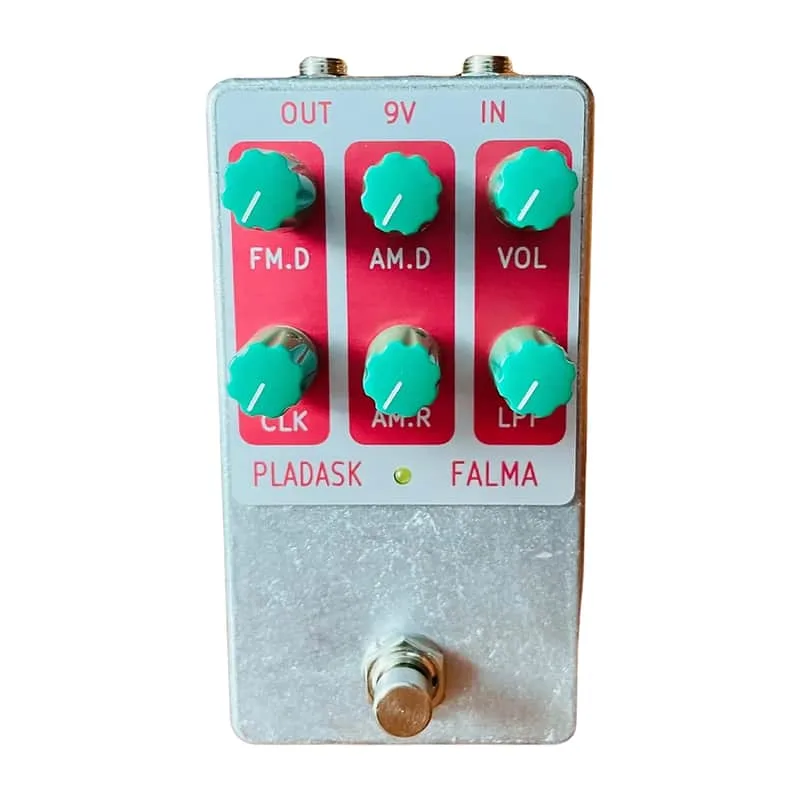
The original FALMA and the v2 share a control set, with slightly different names on the knobs.
| Control (original / v2) | What it does |
|---|---|
| AM / AM.D | Random amplitude modulation, the tremolo depth. Zero depth at noon on the original; slow modulation counterclockwise, fast clockwise12 |
| FM / FM.D | Random frequency modulation, the vibrato depth. Zero depth at noon on the original; two speed options, slow counterclockwise and fast clockwise from noon12 |
| CLK | DSP system clock frequency. Sets the sample rate and the character and speed of the modulation. Low settings add background noise12 |
| TONE | Low pass filter, flat at maximum, down to a 700 Hz cutoff at minimum. On the v2 it is an active 2nd order filter12 |
| VOL (v2 only) | Master volume. Unity gain at 12 o'clock, maximum gain +16dB2 |
| Footswitch | Bypass switch. Holding it longer than 500 ms only momentarily changes its status12 |
Two things are worth noting as a player. First, the depth knobs on the original sit at zero at noon, so turning them either way adds depth, counterclockwise giving relatively slow modulation and clockwise fast1. Second, the v2's VOL knob means the pedal can add up to +16dB of gain, so it can serve double duty as a boost, where the original has no volume control of its own2.
The FALMA does not support battery operation, and the stereo version is not compatible with Strymon brand power supplies. Plan on a isolated 9V DC output with the standard center negative 2.1mm plug13.
The original FALMA, the v2 and the stereo version
The pedal has gone through three stages. The original FALMA drew 100 mA and measured 126 x 60 x 67 mm1. The v2 kept the same concept and power requirements but drew 150 mA, measured 126 x 66 x 60 mm, and added the VOL master volume control2.
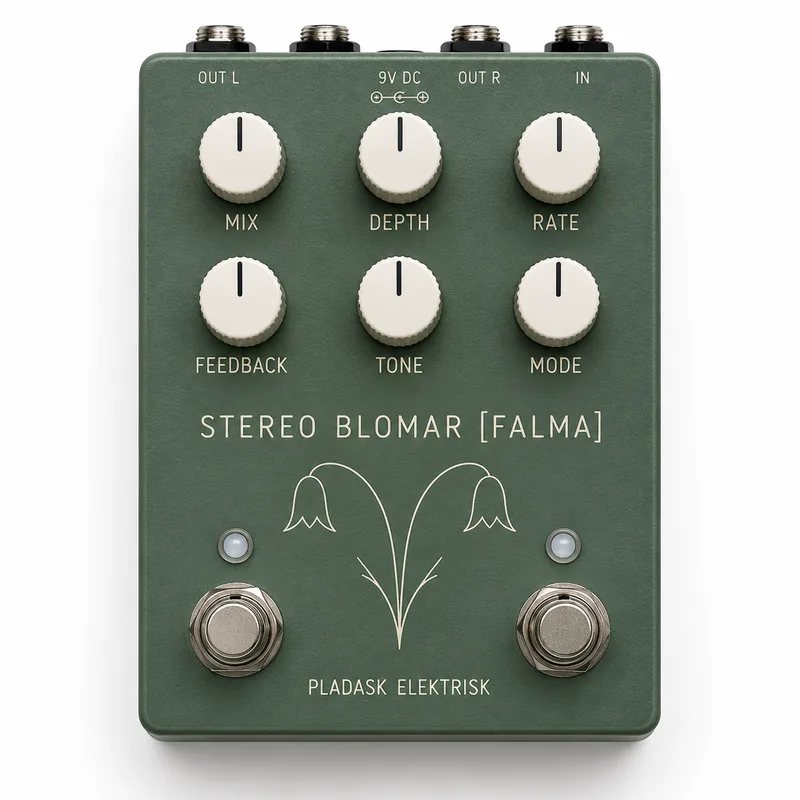
The current version is the STEREO FALMA [BLOMAR], which the maker describes as two pedals in one: FALMA is a random vibrato, tremolo and panning effect, while BLOMAR is an octave and pitch shifting effect achieved through low latency, dual grain granular synthesis. Stereo expands the concept by allowing asynchronous modulation between the channels, so the two outputs can wander independently. Input and output are stereo TRS34.
The two faceplates are the only difference between the stereo FALMA and BLOMAR versions. As the maker puts it34:
"Get either to get both. Only difference is the faceplate, either emphasizing the functionality of one or the other."
Both stereo versions offer stereo input and output via TRS connections34. See the Pladask Elektrisk STEREO FALMA [BLOMAR] page for the stereo pedal in full.
How it differs from the Draume
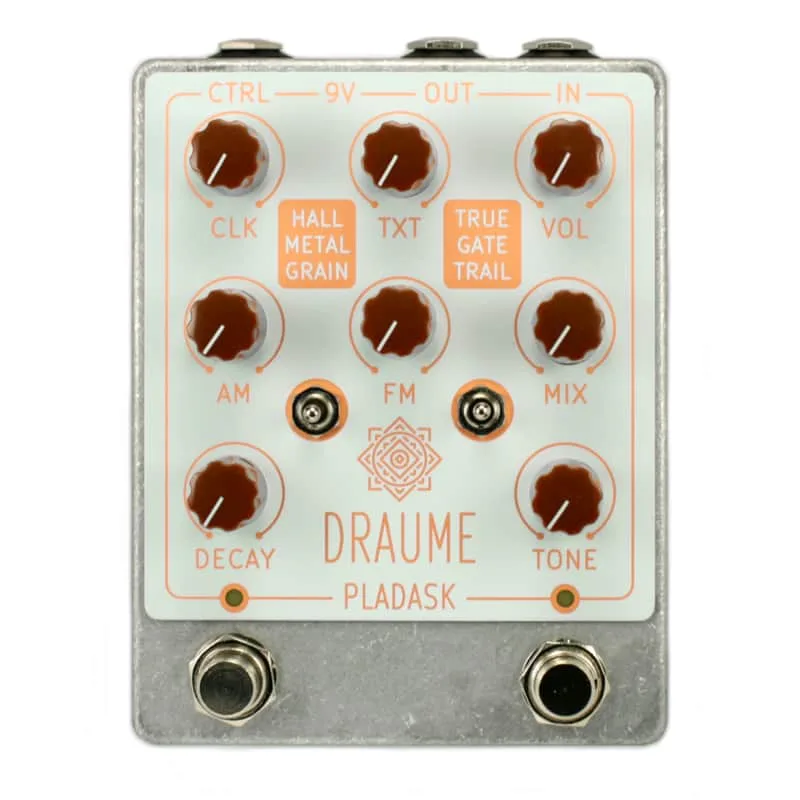
The FALMA shares its parameter names with Pladask Elektrisk's Draume reverb pedal, but the maker states that the waveforms of the modulators are different from those found in the Draume, even though the knobs read the same. The Draume is a reverb with post reverb processing, while the FALMA is a dedicated modulation pedal with no reverb of its own1.
Videos
Sound Isles
GuitarWithGabe
Pedal Me Softly
Questions
Does the Pladask Elektrisk FALMA run on a battery?
No. The maker states plainly in the manual that the FALMA does not support battery operation. It needs a 9V DC center negative power supply with a standard 2.1mm plug, the same type used by common pedalboard supplies. The stereo version adds that it is not compatible with Strymon brand power supplies.
Is the FALMA analog or digital?
It is digital. The FALMA runs on a digital signal processor, and its CLK knob sets the system clock frequency, which in turn sets the sample rate and the character and speed of the modulation. Lower clock settings lower the audio fidelity and can add background noise.
Can the FALMA footswitch work as a momentary switch?
Yes. The footswitch is the bypass switch, but holding it longer than 500 ms only momentarily changes its status, on both the original FALMA and the v2. This lets you dip into the effect for a moment with your foot rather than latching it on.
How is the FALMA different from the Pladask Draume?
The FALMA shares parameter names with the Draume reverb pedal, but the maker states that the waveforms of the modulators are different. The Draume is a reverb with post reverb processing, while the FALMA is a dedicated random tremolo and vibrato pedal with no reverb.
Does the FALMA add volume boost?
Yes, on the v2. Its VOL knob is a master volume with unity gain at 12 o'clock and a maximum gain of +16dB, so it can push your amp harder as well as cut back. The original FALMA manual does not list a VOL control.
Sources (4)
- FALMA_manual_ENG.pdf, Pladask Elektrisk, 2023
- FALMA2_manual_ENG.pdf, Pladask Elektrisk, 2023
- STEREO FALMA BLOMAR, Pladask Elektrisk, 2025-10-13
- STEREO BLOMAR FALMA, Pladask Elektrisk, 2025-10-13