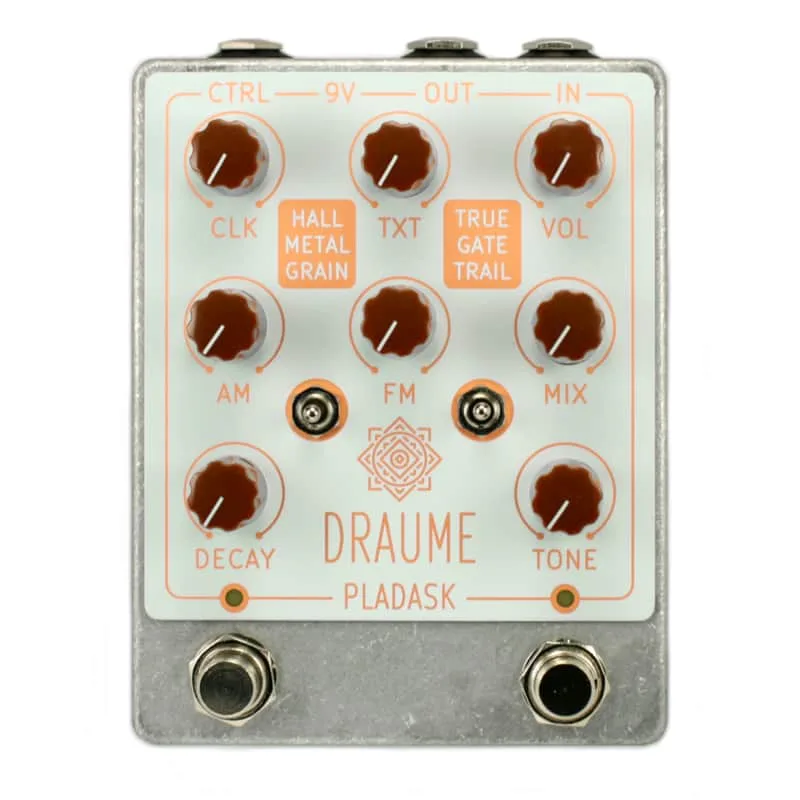


The Pladask Elektrisk DRAUME is a digital reverb pedal built around a specific idea: that digital reverb does not have to recreate the sound of a real space, but can be a creative effect in itself, free from the constraints of real-life emulation1. Pladask Elektrisk describes it as "an exploration of artificial reverberation" that "combines post-reverb processing with decay and system clock control to break the spatial illusion"2.
In practical terms, that means the DRAUME gives you three reverb algorithms, then lets you push them somewhere no room would ever go: random vibrato and tremolo applied after the reverb, digital saturation, and a clock control that shifts the engine's pitch and texture. Delicious Audio called it "an extremely creative digital reverb that combines post-reverb processing with decay and system clock control"1. The manual notes the pedal is dedicated to Lynch and Badalamenti, a fitting reference for its dark, unstable character3.
The DRAUME is currently listed as out of stock on the maker's site, with a note that it is "planned for porting to new stereo hardware" and will be restocked when that work is ready2.
Reverb that breaks the spatial illusion
Most reverb pedals try to sound like a room, a plate or a spring. The DRAUME starts from the opposite premise. As Delicious Audio's Paolo De Gregorio put it, the design holds "that digital reverb is not supposed to recreate the sound of a space, but should be a creative effect in itself, free from real-life emulation constraints"1.
The tool for breaking that illusion is the combination of three things: a decay control that can run long enough for the reverb to become the whole piece, post-reverb processing that modulates and saturates the wet signal, and a system clock control that shifts the entire engine. The clock runs from 12kHz to 50kHz, and moving it changes the pitch and lo-fi character of the reverb rather than just its length1. The result is a reverb that can swell, shimmer, degrade and destabilize rather than simply fade.
The controls
The DRAUME's knobs are mostly applied after the reverb itself, which is what gives the pedal its character: you are not shaping the input, you are mangling the output523.
| Control | What it does |
|---|---|
| VOL | Master output volume. Unity gain is near 12 o'clock, max gain is +16dB3 |
| MIX | Dry/wet balance from 100% dry to 100% processed audio5 |
| CLK | System clock frequency, from 12kHz to 50kHz, shifting pitch and lo-fi character1 |
| DECAY | Reverb decay length, up to roughly 10 minutes in HALL with CLK at noon3 |
| AM | Random amplitude modulation depth, a tremolo applied post-reverb3 |
| FM | Random frequency modulation depth, a vibrato applied post-reverb, lo-fi like a worn tape3 |
| TXT | Saturation and texture amount, noticeably digital but pleasant, applied post-reverb3 |
Two footswitches sit alongside the knobs. The right one is the bypass switch; holding it longer than 500 ms only momentarily changes its status, so a quick tap toggles and a long hold gives you a moment of the other state3. The left footswitch sets DECAY to maximum, which Delicious Audio describes as a way of triggering momentary swells1. It follows the same 500 ms hold rule5.
The right toggle switch selects the bypass mode3:
- TRUE: true bypass3
- GATE: true bypass, with the reverb decay minimized when the pedal is bypassed3
- TRAIL: buffered bypass with reverb trails; in this mode the MIX and VOL knobs still affect the overall mix and volume while bypassed3
Inside the pedal are a few service adjustments: a Z/100 switch that reduces input impedance to 10kOhm, a PAD switch that adds a -10dB input pad, a BBP GAIN trimpot that sets the dry signal volume in TRAIL bypass mode, and an unlabeled trimpot associated with the expression input that the manual says should not be adjusted3.
The clock can also be driven externally. The CTRL (v1) or EXP (v2) socket accepts a TRS expression pedal or a CV signal from 0 to 3.3V to control the clock frequency parameter; once a control signal is connected, the CLK knob becomes inactive53.
Hall, Metal and Grain modes
The left toggle selects one of three reverb types3.
- HALL: an "artificial, thinly veiled hall reverb," using the same base reverb as the (Re)FORM reverb algorithm but with less pre-delay in v2. Maximum decay is approximately 10 minutes with CLK at noon5.
- METAL: a cold sounding reverb reminiscent of a metal chamber. At maximum decay it becomes slightly unstable, edging toward self oscillation in the lower frequency range3.
- GRAIN: a granular synthesizer performing recursive random grain shuffling. The v1 system contains 5 simultaneous grains, more dense than the FABRIKAT shufflers. At minimum decay the shuffling is inactive; at maximum decay the audio is recursively split into new grains3.
The three modes cover a wide range: HALL for long, conventional-ish spaces, METAL for cold, unstable drones, and GRAIN for granular textures that rebuild your signal from fragments35.
History and versions
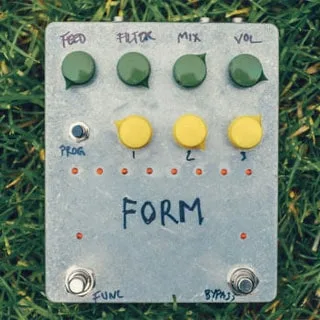
The DRAUME evolved from algorithms Pladask Elektrisk developed for the BandOrg FORM53. The pedal has gone through two versions, and the maker published a document explaining the differences.
Version 2 is a complete internal redesign, the result of re-evaluating the electronics and algorithms after constructive feedback on v16. The changes include:
- Better signal-to-noise ratio6
- HALL with less pre-delay6
- METAL and GRAIN replaced by new algorithms with different timbre and behavior6
The maker was candid about who the update is for, stating that v2 "is not aimed as a cash-grab towards v1 owners" and that v1 owners happy with their pedal probably should not warrant another purchase6.
What reviewers said
Reviewers responded to the DRAUME's willingness to be strange. Pedal of the Day, reviewing it in June 2020, wrote14:
"The Draume is like no other pedal we've come across before, in all the best of ways."4
Delicious Audio's Paolo De Gregorio concluded that it is:
"a very interesting and creative reverb pedal that should find fans in the community of experimental guitarists and synth players"1
Both reviews frame the pedal the same way: not a workhorse reverb for mixing into a mix, but a tool for experimental guitarists and synth players who want reverb as a generative, unstable texture14.
Videos
Ambient Endeavors
aBunchOfPedals
Anne Sulikowski
Sources (6)
- Pladask Elektrisk Draume Reverb, Delicious Audio, 2021-01-18
- DRAUME | PLADASK ELEKTRISK, Pladask Elektrisk, 2022-02-04
- DRAUME_manual_ENG.pdf, Pladask Elektrisk, 2023
- Pladask Elektrisk Draume Artificial Reverberation, Pedal of the Day, 2020-06-23
- DRAUME_manual_ENG_2.pdf, Pladask Elektrisk, 2023
- DRAUME_version_difference.pdf, Pladask Elektrisk, 2023