

The PLBR Effects Maritimus Fuzz is a fuzz pedal and the first pedal released by Croatian builder PLBR Effects1. Its circuit is a BMP-type fuzz, meaning it follows the Big Muff Pi template, and Delicious Audio described it as "a swiss army knife of BMP type fuzz pedals" because of how many voices it packs into one box1.
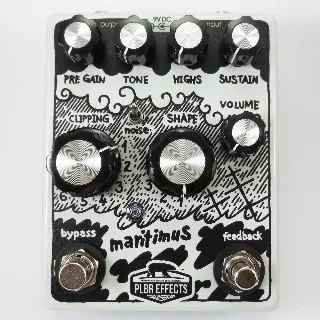
What makes it more than a straight Big Muff clone is switching. A six-position Clipping switch changes the clipping devices in the circuit, and a three-position Shape switch changes the EQ curve, so one pedal covers a wide spread of fuzz tones without touching a soldering iron. There is also a momentary Feedback button for drone and octave effects1.
A BMP-type fuzz with six clipping options
The Big Muff Pi circuit uses diodes to clip the signal and create its fuzz. The Maritimus lets you choose which clipping devices do that job, and each choice compresses the fuzz differently1.
The six options on the Clipping switch are1:
- Silicone diodes
- Germanium diodes
- Schottky diode/LED pair
- LED diodes
- MOSFET
- No diodes (with a warning of a high increase in volume)
The no-diodes setting is worth a note for anyone with a set volume level on their amp or mixer:
The maker warns that the no-diodes clipping position produces a high increase in volume. Set your levels before switching to it, especially live or on a recording.
On top of the clipping switch, the Shape switch offers three EQ curves: a classic BMP EQ with a small mids dip, heavily scooped mids, or punchy mids1. Between the two switches, the same pedal can go from a compressed, mid-scooped wall to a louder, more open and mid-forward sound.
The controls
The Maritimus keeps the Big Muff's familiar knob layout and adds its own switching on top. Here is what each control does1:
| Control | What it does |
|---|---|
| VOLUME | Controls the output volume |
| PRE GAIN | Controls the amount of signal entering the fuzz circuit |
| SUSTAIN | Controls the amount of fuzz, which increases sustain when turned up |
| TONE and HIGHS | EQ controls shaped by the SHAPE switch |
| SHAPE switch | Selects the EQ curve: classic BMP with small mids dip, heavily scooped mids, or punchy mids |
| CLIPPING switch | Selects one of the six clipping options |
| FEEDBACK button | Momentary button for drone, octave and squeal sounds |
The Feedback button is the wild card. It is momentary, so it only acts while you hold it, and it engages what the maker calls "crazy drone/octave/squeal sounds which heavily depends on CLIPPING, NOISE and SUSTAIN controls"1. In practice that means the button's behavior changes with your knob settings, so it works as an expressive effect rather than a fixed sound.
Power and bypass
The Maritimus runs on a 9V DC negative center supply with a 2.1mm barrel plug and draws about 4mA, which is light enough that it shares a daisy chain with most pedals without issue1. It uses a true bypass switch, so the circuit is out of the signal path when the pedal is off1.
There is no battery option. PLBR Effects states plainly why:
"Our products do not have battery snaps or battery compartments due to ecological reasons."
The Maritimus family and the Narwhal
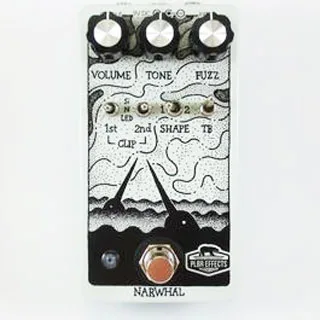
The Maritimus Fuzz was followed by the Narwhal, a fuzz/distortion that Delicious Audio described in May 2018 as a new pedal from the Croatian maker, noting that "like it's big brother Maritimus, it brings numerous possibilities dialing in your favorite fuzz tones"2. The Narwhal is also a BMP-type pedal but takes a different approach to switching: it has two separate gain toggles for its clipping stages and three clipping options per stage, silicone (compressed), no diode (less compressed and loud) and LED (open, with more distortion)3.
There is also a related pedal called the Maritimus Distortion Fuzz, which Pedal of the Day described as the bug brother of the Narwhal Distortion Fuzz4. It is a distortion and fuzz pedal with its own control set: Pre-Gain sets the signal into the fuzz circuit, Tone controls the EQ sweep, Highs sets the curvature of the high mids and treble, and a Volume control sets the overall output4. It also has a Feedback footswitch that sends the signal into octave squeal sounds4.
What reviewers said
Pedal of the Day reviewed the Maritimus Distortion Fuzz in June 2018 and found the switching approach paid off in range4:
"the Maritimus is a distortion and fuzz pedal that carries a boatload of tones and styles, enough to fit any style and band you'll ever be a part of"
The same reviewer called the Narwhal "one of the funnest fuzzes we've seen come through as of late"4, which gives a sense of how the PLBR line landed with the press at the time.
Videos
Patrick Hunter
Eirik Stordrange
Pedal of the Day
Questions
Does the PLBR Maritimus Fuzz take a battery?
No. PLBR Effects states that its products do not have battery snaps or battery compartments, for ecological reasons. The Maritimus runs on a 9V DC negative center 2.1mm barrel supply only, drawing about 4mA, so a standard pedalboard power supply is all it needs.
Is the PLBR Maritimus Fuzz true bypass?
Yes. The Maritimus Fuzz uses a true bypass switch, so when it is off the signal passes through without the circuit coloring it. The maker's sibling pedal, the Narwhal, also uses true bypass switching.
What does the Feedback button do on the Maritimus?
The Feedback control is a momentary button that engages drone, octave and squeal sounds. How it behaves depends heavily on the positions of the Clipping, Noise and Sustain controls, so different settings on those knobs produce very different results when the button is held.
What clipping options does the Maritimus offer?
Six, selected with the Clipping switch: silicone diodes, germanium diodes, a Schottky diode and LED pair, LED diodes, MOSFET clipping, and no diodes at all. Each option compresses the fuzz differently, and the no-diode setting comes with a warning of a high increase in volume.
How is the Maritimus Distortion Fuzz different from the Maritimus Fuzz?
The Maritimus Distortion Fuzz is a separate pedal described as the bug brother of the Narwhal Distortion Fuzz, itself a variant in the same family. It is a distortion and fuzz pedal with its own control set, including a Feedback footswitch that sends the signal into octave squeal sounds.
What is the PLBR Maritimus Fuzz based on?
It is a BMP-type fuzz circuit, meaning it follows the design of the Big Muff Pi. Delicious Audio described it as a swiss army knife of BMP type fuzz pedals, because its clipping and EQ switches let one box cover a wide range of fuzz voices.
Sources (4)
- PLBR Effects Maritimus Fuzz, Delicious Audio, 2018-02-22
- PLBR Effects Narwhal Distortion Fuzz, Delicious Audio, 2018-05-11
- PLBR Effects Narwhal Distortion Fuzz, Pedal of the Day, 2018-05-11
- PLBR Effects Maritimus Distortion Fuzz, Pedal of the Day, 2018-06-18