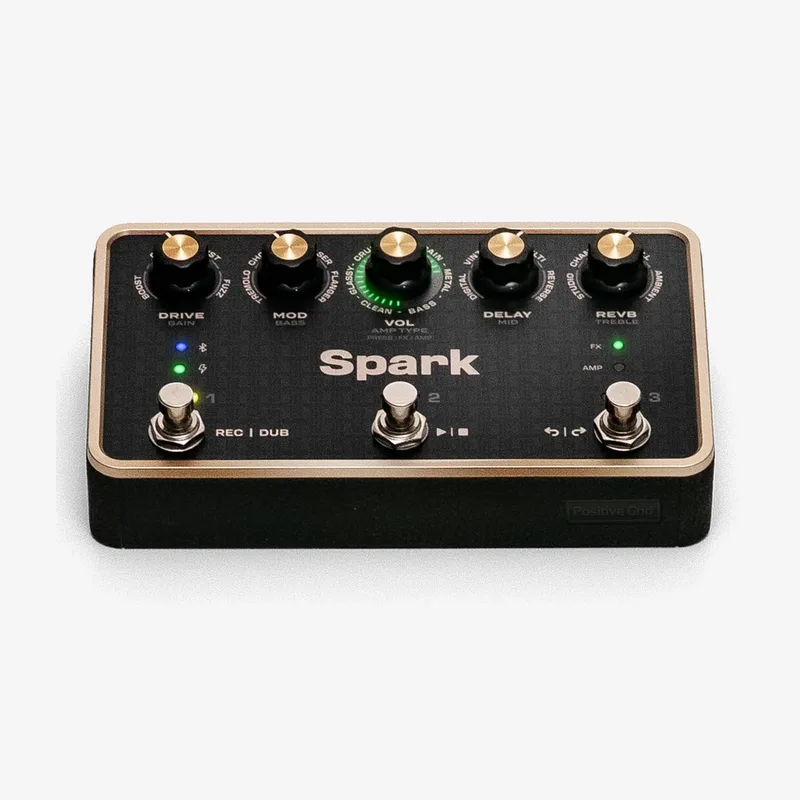


The Positive Grid Spark Pedal is a digital amp and effects pedal that packs the company's Spark practice-amp tones into a floor unit you can run on a battery. It combines amp modeling, EQ and effects into a playable sound you can hear immediately, with 33 amp models and 43 effects, plus access to more than 100,000 community-created tones through ToneCloud1. It supports electric guitar, acoustic guitar and bass guitar1, and it launched on 9 September 2026 at $199 in the US2.
Guitar.com's reviewer described it as the pedal that "effectively distills the important bit from its amp brethren into a 6×4" floor unit"3. It is Positive Grid's first speakerless Spark product, aimed at players who want the Spark sound straight into headphones, a PA or a recording setup rather than out of a combo amp1.
What the Spark Pedal does: Spark amp tones in a pedal
The pedal combines amp modeling, EQ and effects in one signal path, so a single box can carry a full rig sound. Positive Grid's pitch for it is simple: "No menus. No complex routing. Just legendary tone, anywhere you plug in."5 The stereo 1/4" line outputs are designed for direct connection to PA systems, powered speakers or recording interfaces, and the 1/8" headphone output covers silent practice1.
Because it runs on the same HD Tone Engine as the Spark 2 amp, which Positive Grid calls "the world's best-selling practice amp"1, the tones are the same family players already know from the amp line. MusicRadar's reviewer noted the shared lineage: "it's the same tone engine after all"4.
The Spark app adds two notable features on top of the pedal's own controls5:
- Text to Tone: describe the sound you want in natural language and the pedal generates a matching amp and effects setup automatically.
- Auto Chords: play a song through the app and it shows you the chords in real time.
The app requires Android 8.1 or later on that platform5.
The controls and the four modes
The top panel keeps things deliberately amp-like: Gain, Bass, Mid and Treble knobs, four knobs for effects and amp tone control, and a center knob that serves as the Amp/FX mode selector, plus one multifunction control knob for amp selection and volume5. Three steel footswitches handle preset switching and looper control, with their job changing depending on the mode1. Six multi-color LED indicators show preset and looper status, alongside global status, power and connection indicators5.
| Mode | What it does |
|---|---|
| Amp Mode | The main knob selects amp types while the gain, bass, mid and treble knobs adjust your amp tone, "exactly like a traditional amp head"5 |
| FX Mode | The knobs select and control drive, modulation, delay and reverb effects directly from the pedal1 |
| Preset Mode | Switch between saved presets in real time1 |
| Looper Mode | Direct access to recording, overdubbing, playback, stop, undo and loop clearing1 |
The looper
The built-in looper offers 60 seconds of loop time per layer, with record, overdub, play, stop, undo and clear functions all hands-free from the footswitches5. While a loop plays, you can switch between pre-selected presets in the Red and Green banks by pressing footswitches 2 and 3 together, which lets you change your whole sound under a running loop5.
Power, battery and connections
The Spark Pedal runs on DC 5V/1A over USB, with a built-in 3000mAh rechargeable lithium-ion battery rated for up to 7 hours of play and a full charge time of about 4.5 hours via USB-C15. The USB-C port also handles firmware updates and works as an audio interface for recording5.
The rear panel carries the power button, a pair button, the 1/4" input, two line outputs, an expression pedal input (1/4" TRS), the USB-C port, two MIDI ports and the headphone output5. MIDI input and output use 1/8" TRS connections, and the box includes two adapters for standard 5-pin DIN MIDI devices1.
The USB-C power requirement means this is not a standard pedalboard pedal running off a conventional power supply. Power it from USB (DC 5V/1A) or run it on the internal 3000mAh rechargeable lithium-ion battery.
In the box you get a USB-C to USB-C cable, two 1/8" to 5-pin DIN MIDI adapters and a quick start guide5. The chassis is built to take pedalboard life: Positive Grid describes "a rugged chassis and heavy-duty steel footswitches" that "stand up to real-world use"1. GuitarPlayer's review notes it is manufactured in Vietnam6.
Where it comes from: the Spark amp line and HD Tone Engine
The Spark Pedal runs on Positive Grid's HD Tone Engine, the same DSP architecture as the Spark 2 amp7. Positive Grid describes it as built on the same HD Tone Engine as Spark 2, and reviewers note it is the same tone engine as the Spark amp line, including Spark 23. The pedal is a digital unit, using Positive Grid's HD Tone engine, the same architecture found in the latest Spark 2 amp3.
What reviewers said
Reviews have been positive, with some reservations about live usability.
MusicRadar's review rated the sounds at four and a half stars, finding the tones polished and versatile and the effects lush: "there's a sense of depth and space that makes noodling around on this thing flat-out addictive."4 Build quality also earned four stars, with the reviewer finding it "sturdy and robust" enough to handle touring strain4. On price, the review called it "pretty competitively priced"4.
The same review was harder on navigation, rating usability four stars and concluding: "I still think navigation could be improved to make the pedal easier to use in a live setting."4 The reviewer's specific complaint was that too many functions sit on the single central control knob: "Honestly, I think it's too much to put into a single control."4 Testing was done with a Gibson Les Paul Standard loaded with Burstbucker Pro pickups, recorded straight into Pro Tools4.
Guitar.com rated the pedal 8 out of 10, concluding that "this is still a very impressive and fun to use product that ticks a lot of boxes"3. GuitarPlayer's review found a lot to like and noted that the pedal is competitively priced4.
At launch, gearnews.com listed the pedal at $185.00 / £169.00 / 199.00€ at Thomann and Sweetwater8, while Positive Grid's own US price is $1995 and MusicRadar reported it at £169/$199 at announcement2.
Videos
Andertons Music Co
Positive Grid
Positive Grid
Questions
How long does the Spark Pedal battery last?
Positive Grid rates the built-in 3000mAh rechargeable lithium-ion battery at up to 7 hours of play time per charge. A full recharge takes approximately 4.5 hours over USB-C. The pedal can also run while connected to USB power.
Can the Spark Pedal be used as a USB audio interface?
Yes. The USB-C port handles charging, firmware updates and audio interface duty, so you can record the pedal's processed output straight into a computer. MusicRadar's reviewer recorded it into Pro Tools this way, testing it with a Gibson Les Paul Standard.
Does the Spark Pedal work with the Spark app and ToneCloud?
Yes. It connects to the Spark app, which adds features like Text to Tone, where you describe a sound in plain language and the app builds a matching amp and effects chain, and Auto Chords, which shows chords in real time for a song played through the app. It also reaches ToneCloud, with more than 100,000 community-created tones.
Can I use the Spark Pedal with headphones?
Yes. The rear panel includes a 1/8-inch stereo headphone output, alongside two 1/4-inch stereo line outputs for PA systems, powered speakers or recording interfaces, so silent practice and direct recording are both covered.
Is the Spark Pedal true bypass?
MusicRadar's review lists the bypass as true bypass. Positive Grid's own product pages do not state a bypass specification, so the true bypass claim comes from the press rather than the maker.
How many presets can the Spark Pedal store?
Up to six custom presets across two banks, saved and recalled from the three steel footswitches. In Preset Mode you can switch between saved presets in real time, and while a loop plays you can jump between pre-selected presets in the Red and Green banks by pressing footswitches 2 and 3 together.
Sources (8)
- Spark PEDAL, Positive Grid
- Positive Grid unveils the Spark Pedal, MusicRadar, 2026-09-09
- Positive Grid Spark Pedal review: another box of tricks, Guitar.com, 2026-09-18
- Positive Grid Spark Pedal, MusicRadar, 2026-09-09
- Spark PEDAL, Positive Grid
- We review the Positive Grid Spark Pedal Amp and Effects Modeler: “There's a lot to love here, GuitarPlayer, 2026-09-09
- Positive Grid Announces Spark PEDAL, Bass Gear Magazine, 2026-09-09
- Positive Grid Spark Pedal: Amp Modeling, FX & Looper!, gearnews.com, 2026-09-09