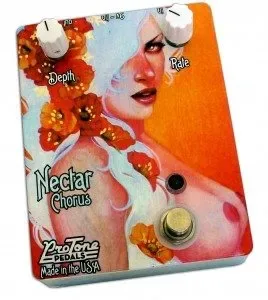
The ProTone Pedals Nectar Chorus is a chorus pedal released in February 2012, sporting only two knobs, depth and rate1. It is a chorus in the straightforward sense: it layers a modulated copy of the signal against the dry sound to produce that classic doubled-chorus texture, and it is built to do so without coloring what the player already has. Reviewer Jonathan Moody, writing in Bass Musician Magazine, described the effect as super clean and clear, like layered tracks of bass rather than a stepped-on pedal, and said that despite personal settings the pedal keeps the player's tone1.
What it sounds like
Moody's overall verdict was that the Nectar is a simple to use chorus that sounds as clean and clear as the artwork on top of it1. The emphasis throughout his review is on transparency: the pedal adds the layered chorus sound while staying out of the way of the instrument's own voice.
"Despite your personal settings, this chorus pedal keeps your tone, giving you that layered chorus sound"
Controls
The Nectar keeps its control layout to two knobs1.
| Control | What it does |
|---|---|
| Depth | Sets the chorus depth, from shallow settings to one that makes the effect ring modulator-like1 |
| Rate | Sets the speed of the modulation, from a very slow, sweeping motion to a lightning-quick sputter1 |
Moody wrote that what impressed him was the range these two knobs have, calling it very wide1. At the shallow, slow end the Nectar behaves as a conventional chorus; pushed to the extremes of both controls it moves into ring modulator-like territory, which puts some of the character of a vibrato or experimental pitch effect within reach of a two-knob chorus.
On bass
The Nectar was reviewed by a bass player, and it held up in working conditions. Moody took it to a run of gigs in the pit for "The Last Five Years," playing the show on fretless electric bass, which he called probably the Super Bowl of shows on electric bass1. On fretless, he found the chorus clear and clean, working with his fretless sound instead of putting its own signature spin on it1. For players looking at chorus from a bassist's angle, it sits alongside the wider field of bass pedals as an effect that leaves the fundamental intact.
Price and construction
Moody noted that the Nectar may have a pricetag that some might find "prohibitive," and tied that to how the pedal is made: ProTone pedals are built by hand on every level1. No price figure is given in the review, so the honest summary is that it was positioned as a costly pedal for its category, with hand-built construction offered as the counterweight.
Questions
Is the ProTone Nectar Chorus handmade?
Yes. Writing in Bass Musician Magazine in 2012, reviewer Jonathan Moody noted that ProTone pedals, including the Nectar Chorus, are built by hand on every level. That hand-built construction was part of how he framed the pedal's price, which he described as one some players might find prohibitive.
Does the ProTone Nectar Chorus work with bass?
Yes. Moody reviewed the Nectar Chorus as a bass player and took it to a run of gigs playing fretless electric bass in the pit for the show The Last Five Years. He found the chorus clear and clean, working with his fretless sound rather than putting its own signature spin on it.
How many knobs does the ProTone Nectar Chorus have?
Two: depth and rate. Depth sets the chorus depth, and rate sets the speed of the sweep. Moody was impressed by how wide the range of those two knobs is, from a very slow sweeping motion to a lightning-quick sputter.
Can the Nectar Chorus sound like a ring modulator?
At its extremes, yes. Moody wrote that the depth control can go from a shallow setting to one that pushes the effect toward ring modulator-like territory, while the rate control runs from slow sweeps to a fast sputter. Most of the pedal's range sits well inside conventional chorus sounds.
How expensive is the ProTone Nectar Chorus?
The review does not give a price figure. Moody described the Nectar Chorus as having a pricetag that some might find prohibitive, framing it as a pedal at the higher end of what players pay for a chorus, balanced against its hand-built construction and clean sound.
Sources (1)
- ProTone Pedals Nectar Chorus by Jon Moody, Bass Musician Magazine, 2012-07-01