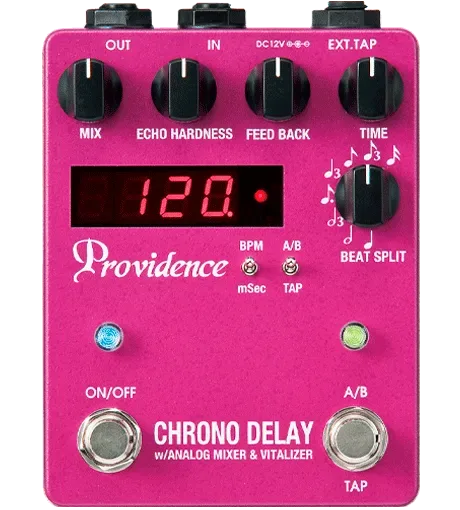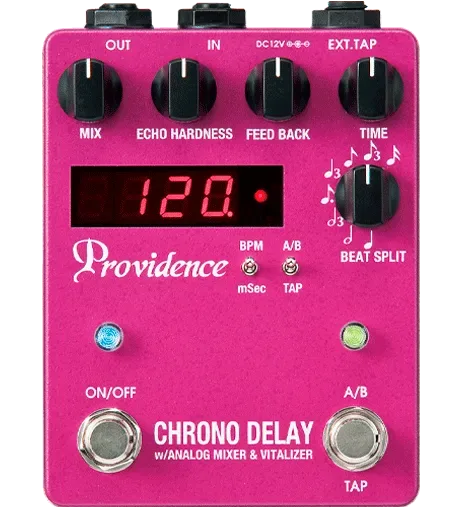


The Providence Chrono Delay DLY-4 is a digital delay pedal from Japan-based Providence, announced by its US distributor Godlyke on March 10, 20111. It replaced Providence's earlier delay models: the press release described it as replacing the "highly sought after Delay-80's model"1, and Premier Guitar later called it the successor to the "cult-classic DLY-83"2.
What sets the DLY-4 apart from many digital delays is its signal path. The dry signal never gets converted: it stays in the analog domain from input to output, passing through Providence's Vitalizer circuit, which the maker says prevents signal degradation, and an analog mixer that recombines the direct signal with the delayed signal31. Only the repeats are digital, converted back to analog and then shaped by analog Echo Hardness, Feedback and Mix controls1. Pedal of the Day's reviewer put the result plainly:
"it sounds about as analog as any digital delay we've ever encountered"4
A digital delay with an analog dry path
The core design idea is a hybrid one. Your guitar's dry signal runs through the Vitalizer, an analog circuit Providence also uses in its switching products, and an analog mixer circuit recombines it with the delay signal31. The delayed signal is generated digitally, then converted back to analog before the Echo Hardness, Feedback and Mix controls process it1. Vintage Guitar described the result as "a high-resolution delay effect" with "extraordinary depth" and a natural blend with the direct signal5.
For a player, the practical benefit is that the tone you hear when the pedal is on stays close to the tone you hear when it is off, since the dry path never passes through an analog-to-digital conversion. Pedal of the Day also noted the pedal's "ease of use and ability to conjure up killer sounds quickly" as one of its strengths, in a "nice-sized, pedalboard-friendly enclosure"4.
The controls
The DLY-4's front panel carries five knobs, two toggle switches and two footswitches32. Premier Guitar's reviewer walked through what each knob does2:
| Control | What it does |
|---|---|
| Time | Sets delay time from 1 to 2700 ms2 |
| Beat Split | Chooses the rhythmic subdivision of the repeats2 |
| Echo Hardness | Adjusts the delayed signal's mids and highs2 |
| Feedback | Sets the number of repeats (analog control)1 |
| Mix | Blends the delay signal with the direct signal (analog control)1 |
The two toggle switches handle modes and display. One selects between A/B and Tap tempo modes for the second footswitch2; the other switches the delay time display between milliseconds and beats per minute3. The two footswitches at the bottom of the pedal are On/Off and A/B or Tap, depending on the mode setting2.
Two features stand out for players who work with tempo. The Beat Split knob selects seven delay time variations, from half notes to eighth-note triplets, against a quarter-note reference3. Premier Guitar's reviewer found it "a breeze to get the exact rhythmic subdivisions I wanted from the repeats," and called the beats-per-minute display option "a major convenience" for syncing delays in time2. The A/B preset memory stores two delay time settings that can be recalled from the footswitch, so you can toggle between two tempos mid-song3.
Echo Hardness is the tone control of the repeats. Premier Guitar's reviewer described it as sharpening the repeats, making them more defined and almost percussive21:
"It’s a little like being able to move between the qualities of a tape delay setting to a digital sound with the turn of a single knob."2
In either mode setting, the reviewer found the pedal "quiet and rich sounding," with lush, warm and clear repeats2.
Power: 12V DC, supply included
The DLY-4 runs on 12V DC and draws 110mA3. An AC adapter is included, with different models supplied for different regions: the PAP-712DCJ for North America and Japan, the PAP-712DCE for Europe, and the PAP-712DCU for the UK3.
The DLY-4 does not run on a standard pedal supply. Providence notes that using another company's power supply may void the warranty, so plan on the included adapter, which supplies 12V DC at 110mA3.
A momentary, non-latching footswitch sold separately can be connected to the EXT.TAP jack for remote tap operation. When an external switch is used, the onboard A/B and TAP footswitch is dedicated to A/B preset switching31.
What reviewers said
Premier Guitar reviewed the DLY-4, testing it with a Gibson ES-339 and a Mesa/Boogie Tremoverb, both in front of the amp and through its effects loop2. The review noted the pedal "carries a hefty street price of $449"2. On the plus side, the reviewer praised the Beat Split knob, the BPM display and the Echo Hardness control, concluding:
"if optimum delay time control and analog sounds are what you need in a pedal, the Providence Chrono is hard to top."2
Pedal of the Day's earlier review focused on the same strengths: the 2700ms maximum delay time, the note divisions available from Beat Split, the VITALIZER technology in the dry path, and how quickly usable sounds come up4.
Videos
ProvidenceSoundMovie
Brett Kingman
The Pedal Zone
Questions
Does the Providence DLY-4 have tap tempo?
Yes. The delay time is set precisely according to the tempo tapped on the TAP footswitch, and a toggle switch selects between A/B and Tap tempo modes. In A/B mode the same footswitch recalls two memorized delay times instead.
What is the maximum delay time on the Chrono Delay?
The Time knob sets delay time from 1 to 2700 milliseconds, which is 2.7 seconds. The delay time can be displayed in milliseconds or in beats per minute, and the Beat Split knob selects rhythmic subdivisions from half notes to eighth-note triplets.
Is the Providence Chrono Delay stereo?
No. Premier Guitar's review notes that the pedal lacks stereo output. Its connectors are standard 1/4-inch INPUT and OUTPUT jacks plus an EXT.TAP jack for a remote tap footswitch and a DC12V power input.
Can I use an external tap switch with the DLY-4?
Yes. A momentary, non-latching footswitch sold separately can be connected to the EXT.TAP jack for remote tap operation. When an external switch is used, the onboard A/B and TAP footswitch is dedicated to A/B preset switching.
Does the DLY-4 run on 9V?
No. It runs on 12V DC at 110mA, and an AC adapter is included with the pedal. Providence notes that using another company's power supply may void the warranty, so a standard 9V pedal supply is not the right choice here.
Sources (5)
- Godlyke Releases Providence DLY-4 Chrono Delay, Premier Guitar, 2011-03-10
- Providence Chrono Delay DLY-4 Pedal Review, Premier Guitar, 2011-10-18
- PROVIDENCE, Providence, 2026
- Providence Chrono Delay DLY-4, Pedal of the Day, 2016-11-28
- Godlyke Providence DLY-4 Chrono Delay, Vintage Guitar magazine, 2011-03-10