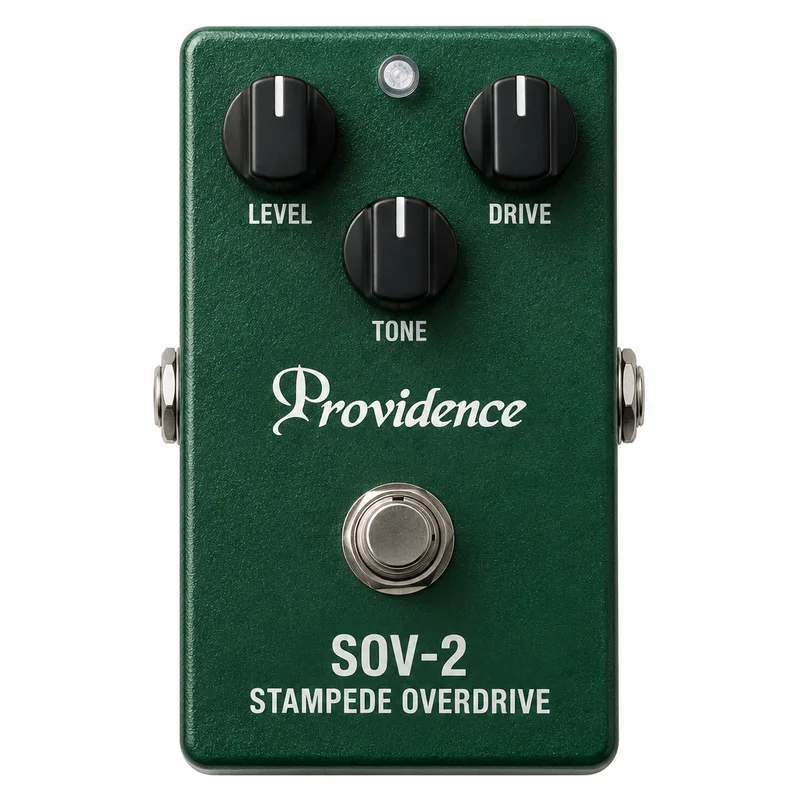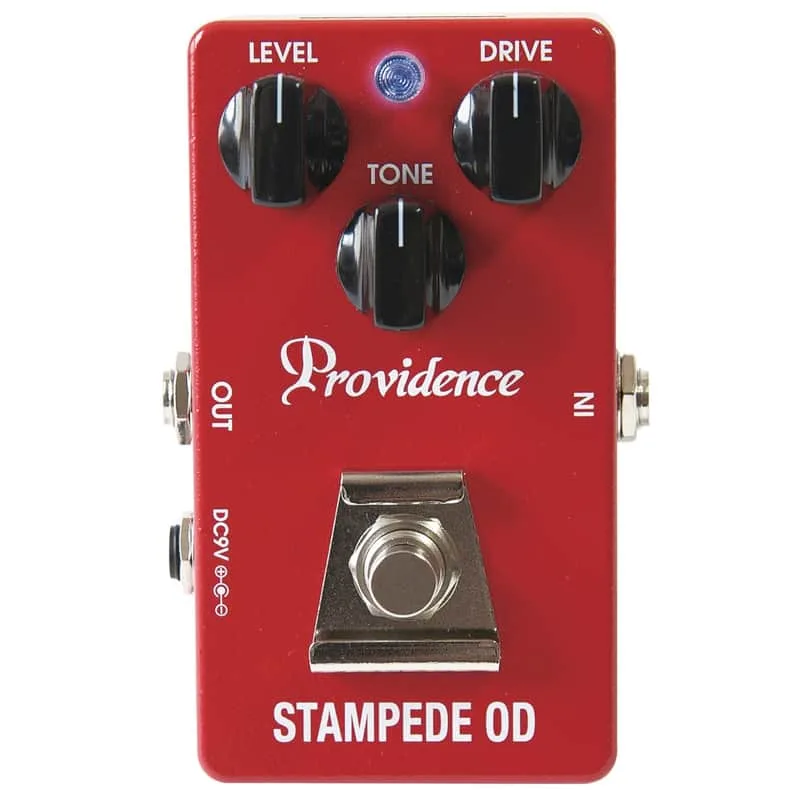


The Providence Stampede OD SOV-2 is an analog overdrive pedal designed, in Providence's words, "to deliver natural overdrive without obscuring the inherent character" of the guitar1. What sets it apart from most overdrive stompboxes is its power supply: a special internal circuit boosts the operating voltage up from the 9V DC input, which Providence says gives it a wider dynamic range than typical overdrive pedals running at DC9V1. Premier Guitar described the arrangement as a bipolar power supply pumping ±15 volts to the overdrive circuit, more than three times the traditional power on most overdrive stompboxes2.
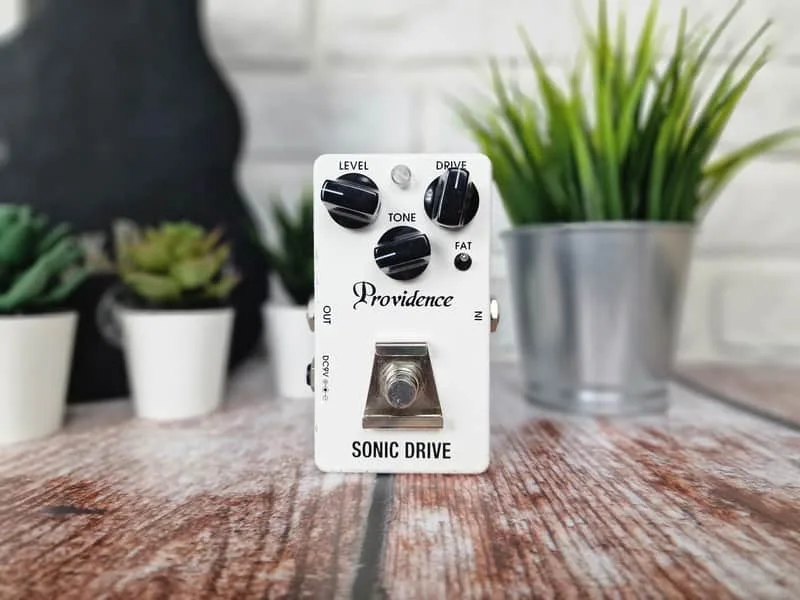
The pedal is aimed at the natural overdrive market, with a control set of just three knobs and a transparency that reviewers have repeatedly singled out. It sits in Providence's drive line alongside pedals like the Sonic Drive, and its circuit later lived on in the Free The Tone SOV-2, a reworking that MusicRadar covered as that company's first pedal3.
An overdrive with a boosted internal voltage
Most overdrive pedals run their circuit at the same 9 volts that come in from the battery or power supply. The SOV-2 does not. Providence's product page explains that "due to a special power supply circuit, the internal operating voltage is boosted from DC9V, making it an overdrive with a wider dynamic range than typical overdrive pedals operating at DC9V"1. MusicRadar reported that early SOV-2s used a circuit boosting the internal voltage to +/-15V, and that the current standard SOV-2 still specs those numbers3. Premier Guitar put the same point in plainer terms: the bipolar supply pumps ±15 volts to the overdrive circuit, more than three times the traditional power on most overdrive stompboxes2.
For a player, the practical idea is headroom. More internal voltage means the circuit can handle a stronger signal before clipping on its own, so the drive comes from the pedal's gain stage rather than from the power supply running out of room. Providence positions the result as natural overdrive that preserves the guitar's inherent characteristics and tone, suited to what RockBoard's PedalPedia listing calls "singing lead tones and solid, chunky rhythms"4.
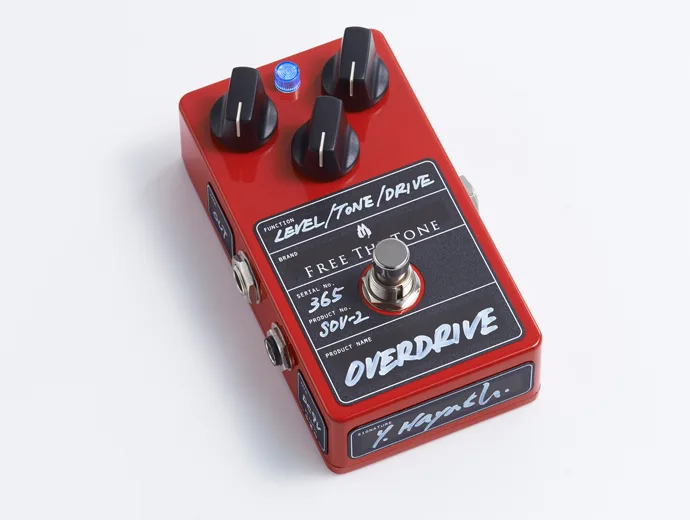
The same circuit family carried forward. Free The Tone's SOV-2, a reworking of the Providence original, uses a high-performance DC-DC converter to boost the 9V DC input to +/-15V DC for the signal circuit, and Free The Tone's own spec sheet for that pedal lists a current draw of about 90 mA35. MusicRadar's review of the Free The Tone version noted that "the 'standard' SOV-2 features remain: level, tone and drive controls and, well, that's it!"3.
Controls
| Control | What it does |
|---|---|
| DRIVE | Sets the amount of overdrive |
| TONE | Shapes the frequency balance |
| LEVEL | Sets the output volume |
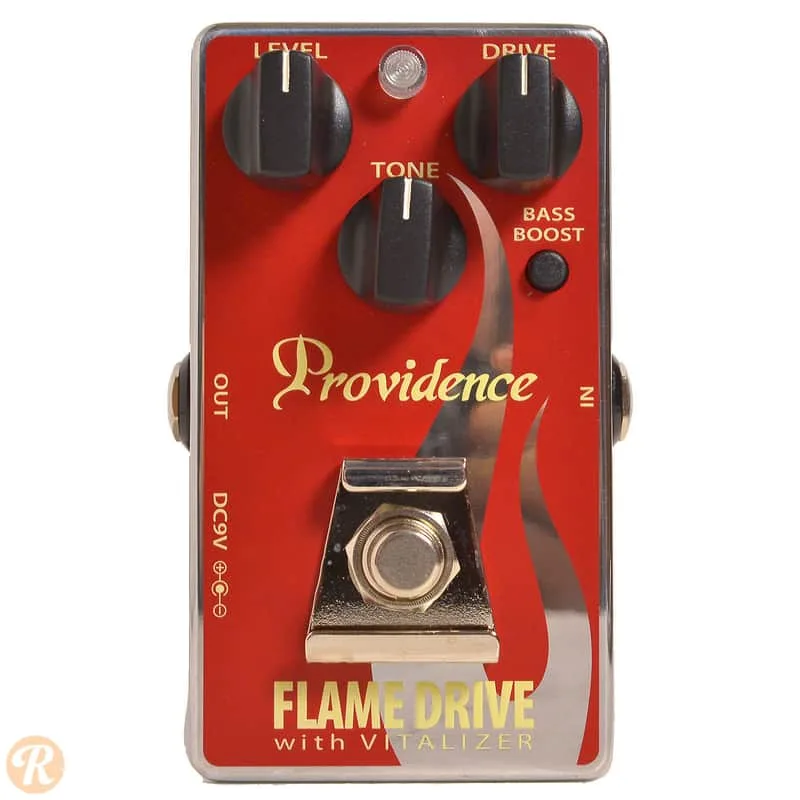
The control set is a simple one. Guitar Techniques' 2010 review described the pedal as having "just three dials; level, drive and tone"6, and a 2011 MusicRadar review of the Flame Drive noted that pedal had "three controls similar to their other drive pedals (eg Stampede OD SOV-2)"7, which points to the same three-knob layout across Providence's drive pedals.
Power, bypass and the battery question
The SOV-2 runs on 9V DC, center negative4. Providence lists power consumption of about 20 mA with the effect on1, while MusicRadar has reported the draw as 90 mA, the figure Free The Tone specs for its own SOV-235.
Either way, batteries are not the way to run this pedal for long21.
Providence states that in units with a serial number earlier than #2001, the battery will be drained rapidly, and recommends using an AC adaptor1. Premier Guitar made the same point from the player's side: the boosted supply "means 9-volt batteries get sucked dry faster than a can of beer in a heat wave," and Providence warns about battery consumption in the manual2. MusicRadar reported around two hours from an alkaline nine-volt battery on the Free The Tone SOV-2, with the advice to use a mains adaptor3, and an earlier MusicRadar review made the same "couple of hours" observation8.
The pedal does give you a warning before the battery dies. The LED provides visual battery power monitoring: Providence says that when the battery voltage drops below 7 volts, the LED becomes dimmer and begins to go out1.
On switching, the SOV-2 uses what Providence calls Single Contact True Bypass, a configuration that ensures the signal passes through only one switch contact when the pedal is bypassed1. MusicRadar described the Free The Tone version as having "a straight true bypass switching design instead of 'HTS'"3, and in a demo video MusicRadar's Yukihiro Hayashi noted that "the original SOV-2 has a true bypass switching system"39.
What reviewers said
The SOV-2 picked up strong press early. MusicRadar noted that the SOV-2 Stampede Overdrive had "gained rave reviews (including from GT and Guitarist magazines last year)"10, and the pedal also had a well-known player in its corner: Matt Schofield "touted its SOV-2 as the best overdrive he'd ever come across"1011.
Premier Guitar's review of the Providence line found the Stampede distinctive, if not for everyone2:
"its overdrive tone is boutique all the way, in fact, I've never played an overdrive pedal like it. With that said, it may be an acquired taste for some used to more traditional overdrives"2
The pedal also has a documented high-profile admirer. Premier Guitar reported that Matt Schofield "touted its SOV-2 as the best overdrive he'd ever come across"11.
On the Free The Tone reworking of the same circuit, MusicRadar's verdict was mixed on value: "Top notch build quality. Great modern overdrive sounds," with the price given as a reason to avoid3. A 2012 MusicRadar review of another Providence drive pedal also credited the SOV-2's transparency, describing a sibling pedal as having "the transparency of the SOV-2 with some of the HBL-3's drive possibilities"12.
Videos
ProvidenceSoundMovie
Brett Kingman
Brett Kingman
Questions
Is the Providence Stampede OD SOV-2 true bypass?
Yes. Providence calls it Single Contact True Bypass, meaning the signal passes through only one switch contact when the effect is bypassed. Reviewers have also described the SOV-2 as having a straight true bypass switching design rather than a buffered or half-bypass arrangement.
How much current does the Providence SOV-2 draw?
Providence's own product page lists power consumption of about 20 mA at 9V DC with the effect on. MusicRadar has reported the SOV-2's current draw as 90 mA, the figure Free The Tone lists for its own SOV-2 reworking, so the two sources disagree on the number.
Does the Providence Stampede OD drain batteries quickly?
Yes. Providence says that in units with serial numbers earlier than #2001 the battery drains rapidly and recommends an AC adaptor. Premier Guitar noted that 9-volt batteries get used up quickly, and MusicRadar reported around two hours of life from an alkaline nine-volt battery on the Free The Tone version.
What controls does the Providence SOV-2 have?
Three knobs: LEVEL, TONE and DRIVE. That is the full control set, which reviewers have pointed out leaves everything to the circuit itself rather than to extra shaping switches or toggles.
How does the Providence SOV-2 battery check LED work?
The LED doubles as a battery monitor. Providence says that when the battery voltage drops below 7 volts the LED becomes dimmer and begins to go out, giving a visual warning that the battery is running down before the sound degrades.
Sources (12)
- PROVIDENCE, Providence, 2026
- Providence Pedal Reviews: Sonic Drive & More, Premier Guitar, 2010-08-05
- Free The Tone SOV-2 Overdrive review, MusicRadar, 2013-02-28
- SOV-2 Stampede OD by Providence, RockBoard PedalPedia, 2026
- OVERDRIVE / SOV-2|Products 商品紹介|Free The Tone, Free The Tone
- Zenkudo and Providence SOV-2 Overdrive pedals, MusicRadar, 2010-05-21
- Providence Flame Drive pedal review, MusicRadar, 2011-01-19
- Hands-on with the Free The Tone Quad Arrow Distortion QA-2, MusicRadar, 2012-11-13
- VIDEO: Free The Tone SOV-2 and MS SOV Special A/B demo, MusicRadar, 2013-06-21
- Providence Distortion and Compression effects utopia!, MusicRadar, 2010-05-21
- Providence Chrono Delay DLY-4 Pedal Review, Premier Guitar, 2011-10-18
- 4 overdrive and distortion pedals from Providence, MusicRadar, 2012-06-21
 Matt Schofield