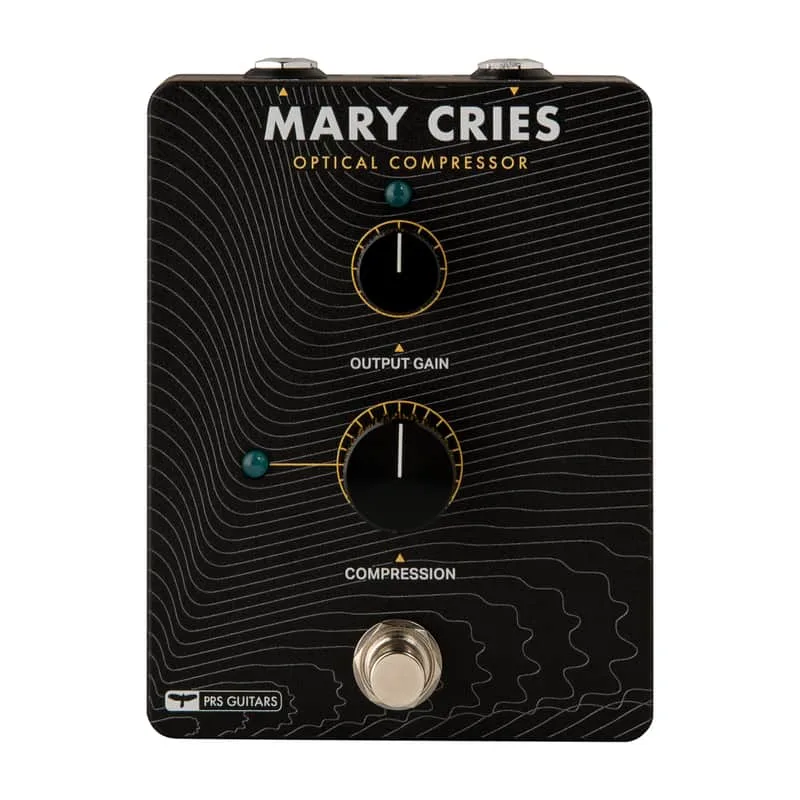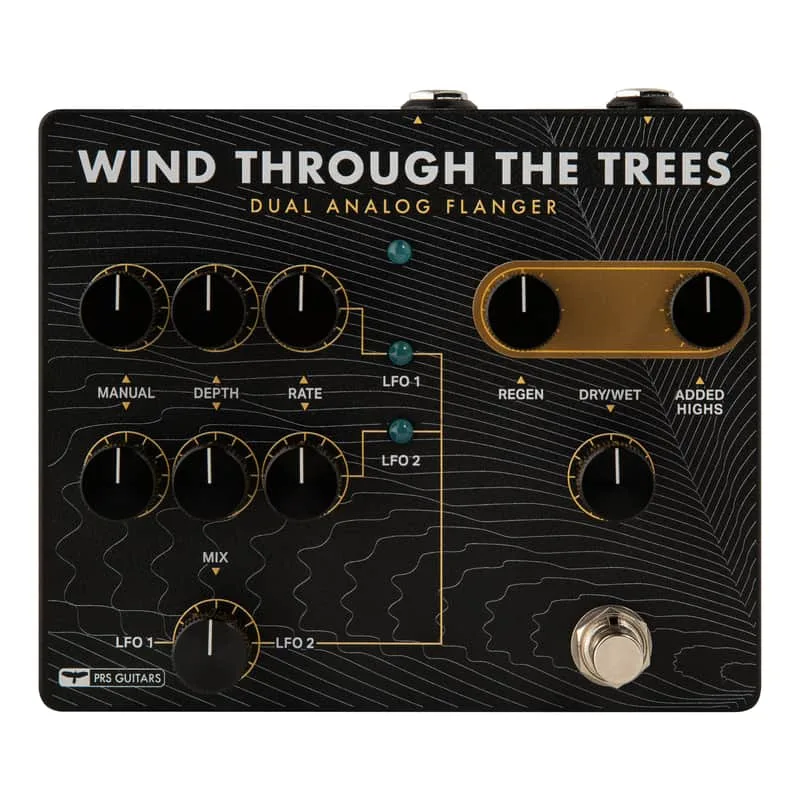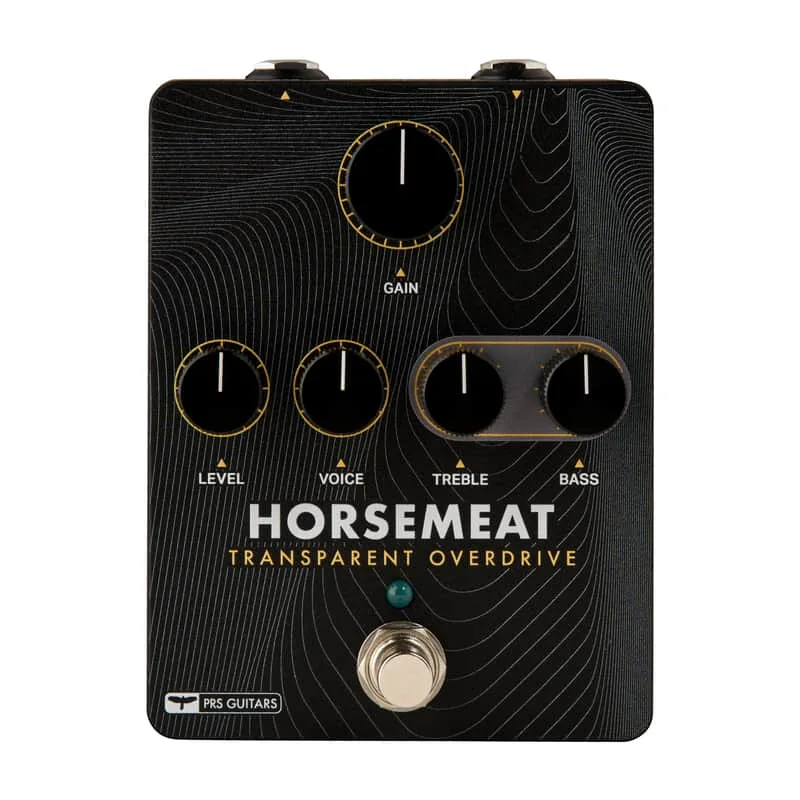


The PRS Horsemeat is a transparent overdrive pedal, one of the first three effects pedals PRS Guitars released when the Maryland company entered the pedal market on September 30, 2022, alongside the Mary Cries compressor and the Wind Through the Trees dual flanger12. It is an all-new design built around a germanium diode rather than a copy of an existing circuit1.
For a player, what that means in practice is a drive that stays true to the guitar and amp behind it. GuitarPlayer's Art Thompson found it "lives up to the transparent overdrive part by sounding true to the guitar driving it," with a clear and balanced core tone without excess midrange coloration and a broad distortion range3. Delicious Audio describes it as adding harmonic midrange richness and overdriving without cutting out your high notes, with more available headroom4.
Controls and how it sounds
The Horsemeat provides what Guitar World's Chris Gill called "a simple but versatile selection of controls: Gain, Level, Voice, Treble and Bass"7. The unusual one is the Voice knob, which affects both the frequency response and the clipping stage: turned anti-clockwise it delivers fuller tones, and turned clockwise the tone becomes progressively glassier4.
| Control | What it does |
|---|---|
| Gain | Sets the amount of drive7 |
| Level | Output volume, with high headroom that allows clean-boost use4 |
| Voice | Affects both frequency response and the clipping stage; fuller anti-clockwise, glassier clockwise4 |
| Treble | High-frequency EQ7 |
| Bass | Low-frequency EQ7 |
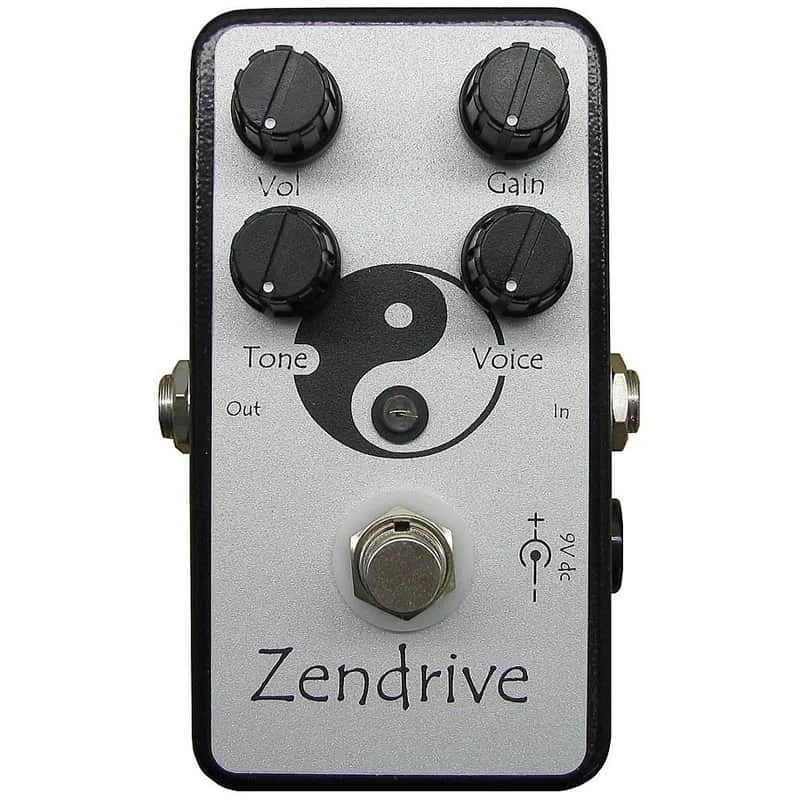
GuitarPlayer's Art Thompson noted that the treble and voice controls "bring to mind the old Hermida-designed pedal," the Zendrive, in the way they interact3. He characterized the pedal overall as "a rich-sounding medium-gain distortion box with flexible EQ and lots of output"3.
Because of its high headroom Volume stage, the Horsemeat can work as more than an overdrive. Depending on the setting, it can be used as a clean boost, a straight overdrive, or to push an amplifier's front end4.
Is it a Klon clone?
Despite a name that might suggest Klon references, the Horsemeat is an overdrive with an original circuit4. Under the hood it uses germanium diodes for clipping2, and Gearnews reported it as an all-new design based around a germanium diode1.
Tone Island's Adam Connell, writing in a Klon-clone buying guide, came away with the same conclusion8:
"I expected more of a Klon clone, but it's definitely got its own thing going on. And in a good way8."
Adam Connell, Tone Island8
So a player shopping among Klon-style overdrives will find the Horsemeat is not a direct clone, but a pedal with its own character8.
Circuit and build
PRS made component quality a priority on all three of its first pedals. Parts are connected to the circuit boards using through-hole soldering, which is more labor-intensive than the cheaper surface-mount construction used in most mass-produced pedals7. PRS's own explanation, quoted by Delicious Audio, was that the company "spent considerable time comparing available electronic components, and through-hole soldering enables us to utilize the best-sounding parts"4. Gearnews confirmed all three designs are offered as high-quality through-hole construction1.
The build details reviewers noted:
- Metal control knobs with ridged edges to facilitate grip7
- Potentiometers with the firm but smooth feel of the controls on high-end studio gear7
- True bypass footswitch2
- Enclosures described as pretty sizeable by modern standards7
Guitar World's Chris Gill summed up the hardware as "Good design, with top-mounted jacks"7. GuitarPlayer's review places the input, output and adapter jacks on the front face to allow placing the pedals close together on a board3; the two reviews describe the jack placement differently, so players may want to look at current production units.
Power and connections
The Horsemeat runs on a 9V power supply drawing 16mA7, a figure Delicious Audio also lists as 16 mA4. It has one 1/4-inch instrument input and one 1/4-inch instrument output7.
Battery power is in question. Tone Island says the Horsemeat "can be powered via a 9v power supply or a 9v battery"8, while Guitar World's review states "An external power source or adapter is necessary (no battery operation)"7. Players who depend on batteries should plan for a 9V DC supply.
Where it came from and who uses it
The Horsemeat was designed by Paul Reed Smith himself, to satisfy his own ear4. The first three entries into the company's pedal range were inspired by his own personal creations and mod jobs2. PRS pedals are designed by PRS Guitars in Stevensville, Maryland, and made in the USA54; GuitarPlayer's review lists the Horsemeat as "Designed and assembled in USA" and describes the pedals as studio-grade devices, reaffirming PRS's own statement on that point3.
Eric Gales is a documented player: speaking to Guitar World in July 2024, he said the Horsemeat Transparent Overdrive was "a [PRS] pedal I started using within the last couple of months"9.
What reviewers said
Published reviews were positive about the design and build. Guitar World found good design with top-mounted jacks and high-quality components throughout7. GuitarPlayer found the pedal true to the guitar driving it, with a clear and balanced core tone and a broad distortion range3. Tone Island's reviewer, expecting a Klon clone, found instead a pedal with its own character, in a good way8. At $249 street, as listed by Premier Guitar in 20236 and $249 in Guitar.com's December 2023 review10, it sits in the mid-range of USA-built overdrives.
Videos
PRS Guitars
The Studio Rats
R.J. Ronquillo
News
Questions
Is the PRS Horsemeat a Klon clone?
No. Although the name might suggest Klon references, the Horsemeat is an overdrive with an original circuit built around a germanium diode. Tone Island's Adam Connell wrote that he expected more of a Klon clone, but found it has its own thing going on, in a good way. Its treble and voice controls have more in common with the Hermida-designed Zendrive.
Can the PRS Horsemeat run on a battery?
It depends on whose account you follow. Tone Island says it can be powered via a 9V power supply or a 9V battery, while Guitar World's review states an external power source or adapter is necessary, with no battery operation. Players who rely on batteries should plan on a 9V DC supply.
Can the Horsemeat be used as a clean boost?
Yes. Thanks to a high headroom Volume stage, the Horsemeat can work as an overdrive or a clean boost. Depending on the setting, it can be used as a clean boost, a straight overdrive, or to push an amplifier's front end.
Where is the PRS Horsemeat made?
PRS pedals are designed by PRS Guitars in Stevensville, Maryland, and made in the USA. GuitarPlayer's review lists the Horsemeat as designed and assembled in the USA, and the pedals are described as studio-grade devices.
Who designed the PRS Horsemeat?
Paul Reed Smith himself, to satisfy his own ear. The first three PRS pedals, the Horsemeat, Mary Cries and Wind Through the Trees, were inspired by his own personal creations and mod jobs.
Sources (10)
- PRS launches new stompbox range with three designs, gearnews.com, 2022-09-30
- PRS announces its entry into the effects pedal world with three all-new stompboxes, Guitar World, 2022-09-29
- PRS Horsemeat Transparent Overdrive, Mary Cries Optical Compressor and Wind Through the Trees Dual Analog Flanger Reviews, GuitarPlayer, 2022-12-14
- PRS Horsemeat Transparent Overdrive, Delicious Audio, 2023-07-28
- PRS Guitars Horsemeat Transparent Overdrive, Pedal of the Day, 2024-06-27
- 10 Klon-Style Guitar Pedals That Are Far More Than Clones, Premier Guitar (www.premierguitar.com), 2023-08-18
- PRS Horsemeat, Mary Cries and Wind Through the Trees pedals review, Guitar World, 2023-01-24
- 9 Best Klon Centaur Clones For 2026 (Includes Klon Inspired Pedals), Tone Island, 2026
- “There's nothing that over-washes the natural sound of the guitar and amp, Guitar World, 2024-07-23
- PRS Horsemeat, Mary Cries, and Wind Through The Trees review, Guitar.com, 2023-12-11