

The Radial Elevator is a combination buffer and power booster from Radial Engineering, announced in March 2014 and made by hand in Canada1. Radial describes it as a boost pedal with a high level of customization, and more precisely as a high performance instrument preamp disguised as a pedal23. It drives your pedals for more consistent volume levels and, by lowering the impedance of the signal, allows cable runs up to 15 meters (about 50 feet)4.
The Elevator has been discontinued and is no longer shipping, so it is now a second-hand purchase2.
What it does, and how you control it
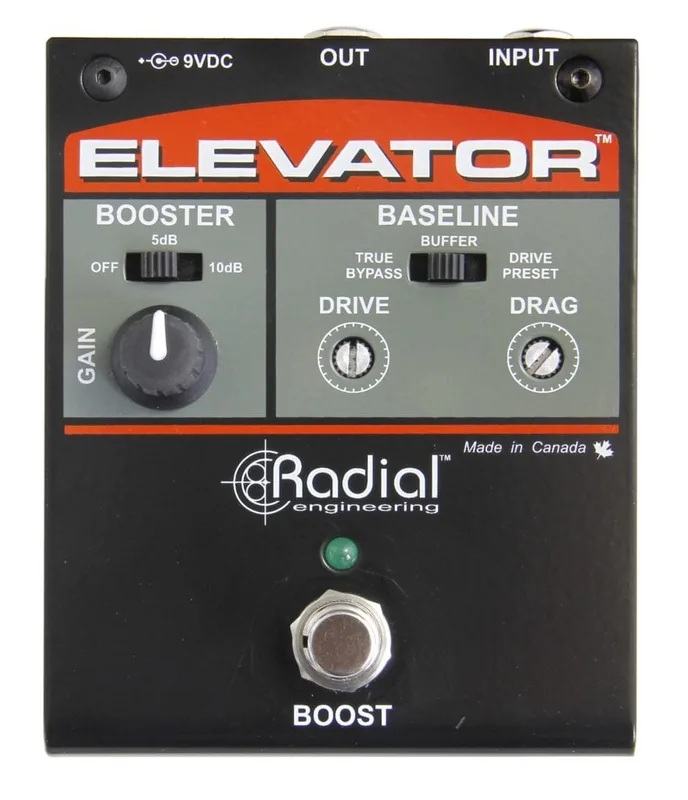
The Elevator is built around two sections. The Baseline section is the input stage: a recessed three-position selector sets it to true bypass, unity-gain buffer, or buffer with extra drive76. In buffer mode the Drag Control load correction is active and the signal is buffered for longer cable runs without noise6. The Booster section, engaged with the footswitch, delivers up to 18dB of clean gain for soloing65.
| Control | What it does |
|---|---|
| Drag Control | Load correction circuit that replicates the tone and feel of being connected directly to your amp6 |
| Baseline Selector | Recessed switch setting the input section to true bypass, buffer, or buffer with extra drive6 |
| Drive | Adds extra punch to the baseline signal and pushes your amp harder6 |
| Level Control | Sets the output level3 |
| Gain | Delivers up to 18dB of clean gain6 |
| Mid Boost | Three-position switch adding midrange for greater sustain and stage presence6 |
| Footswitch | Activates the power booster6 |
The Baseline switch is deliberately recessed so it cannot be knocked mid-performance, since it is a set-and-forget control rather than something you stomp7.
The Drag control
Drag is the feature Radial carried over from its larger products. It is a load correction circuit that lets you replicate the tone and feel of a guitar connected directly to an amp6. Electrically it works by varying the input impedance, from 22K to 1M ohms3, so a bright guitar can be warmed down or a dark one opened up, restoring the loading a pickup sees with a short cable.
True bypass or buffer
Guitar World's review noted the design choice at the heart of the pedal: the True Bypass setting takes the internal circuitry, including the drive and drag controls, completely out of the signal path when the effect is off5. Radial makes true bypass available as an option for players who want it, while the buffer mode is there for long cable runs76. When the boost switch is not engaged, the pedal can be set to true-bypass for tone purists, or the pre-boost gain stage can be used to drive the front end of the amp harder2.
Where wah and fuzz go in the chain
Radial's guidance on placement is straightforward: wah and fuzz pedals sound best when they are coupled directly with the pickup, so putting them before the Elevator results in better tone but more noise7. Placing the Elevator first instead buffers the signal, which allows longer cable lengths with less noise7. The trade-off is between the interactive loading that vintage-style fuzz and wah circuits want and the noise-free long runs a buffer provides.
Power
The Elevator runs on 9V DC through a standard Boss-style power supply connection, drawing 50mA, and works with common multi-pedal power bricks367.
The Elevator cannot be powered with a 9V battery. Unlike efficient chip-based power boosters, it uses a true class-A circuit, so it needs an external supply7.
History: from the JD7 to the Elevator
The Elevator's circuit has a documented lineage. Radial states that all of its power boosters employ the same basic class-A circuit design stemming from the Radial JD7, a rackmount guitar distribution center, with each pedal optimized for size, feature set and application78. The Elevator shares its class-A circuit architecture with the Tonebone Switchbone7.
The immediate ancestor was the Big Shot PB1 power booster. According to Radial president Peter Janis, speaking in the announcement press release, the Elevator came out of a discussion with Hellicaster virtuoso Jerry Donahue:
"during a discussion with Hellicaster virtuoso Jerry Donahue, he asked if there was a way to retain the boost function but then add more."1
The Elevator was announced on March 11, 2014 and started shipping that March1.
Specifications
| Specification | Value |
|---|---|
| Audio circuit type | 100% discrete class-A3 |
| Frequency response | 20Hz to 20KHz3 |
| Dynamic range | >100dB3 |
| Gain | Unity to +18dB3 |
| Input impedance | Variable 22K to 1M ohms3 |
| Output impedance | 1k ohms3 |
| Maximum input | +4dBu3 |
| Clip level | +10dBu3 |
| Total harmonic distortion | 0.02%3 |
| Equivalent input noise | -100dBu3 |
| Construction | 14-gauge steel chassis and outer shell3 |
| Size (L x W x D) | 4.7" x 3.5" x 1.9" (118.8 x 88.9 x 48.9mm)3 |
| Weight | 1.25lbs (567 grams)3 |
| Warranty | Radial 3-year, transferable3 |
| Operating conditions | Dry locations, 5°C to 40°C3 |
What reviewers and players said
Guitar World reviewed the Elevator in August 2014 at a list price of $2205, and its verdict was positive on both counts that matter for a boost pedal:
"The Radial Elevator is a great-sounding boost and extremely useful as well."5
Pete Thorn published a demo in November 2017 showing the pedal with 20 feet of cable from the guitar to the Elevator and another 20 feet from the pedal to the amp, using bridge and neck single coil pickups9. In the demo he walks through the Baseline buffer section with its Drag control and the Booster section with its clean and mid-range boost options, and points players to the product info page at tonebone.com/elevator.php9.
How it compares
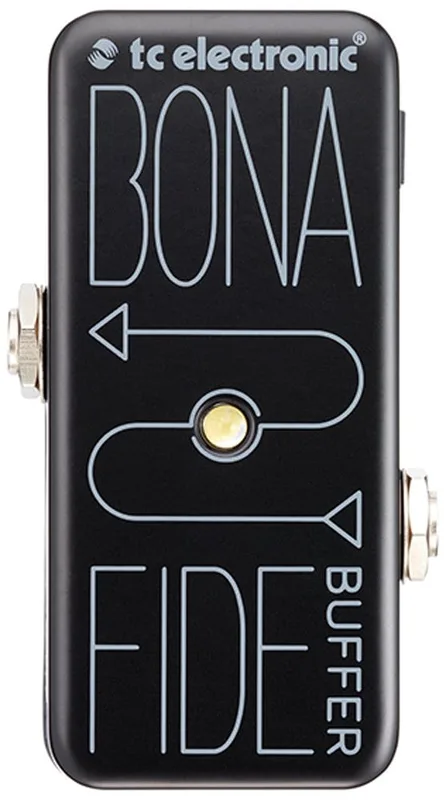
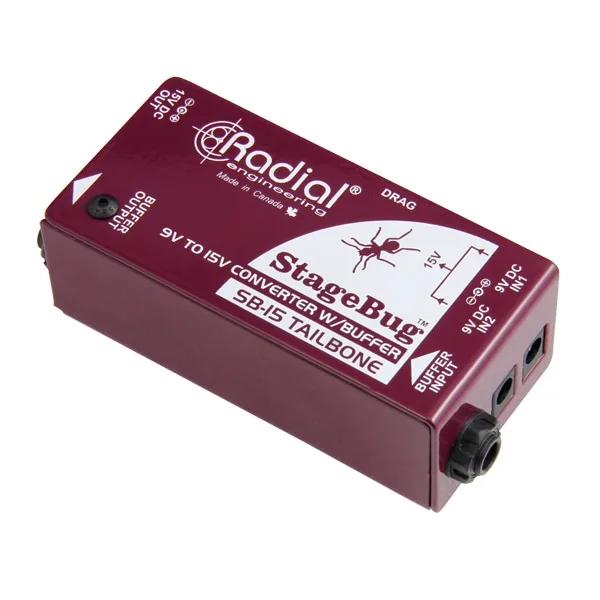
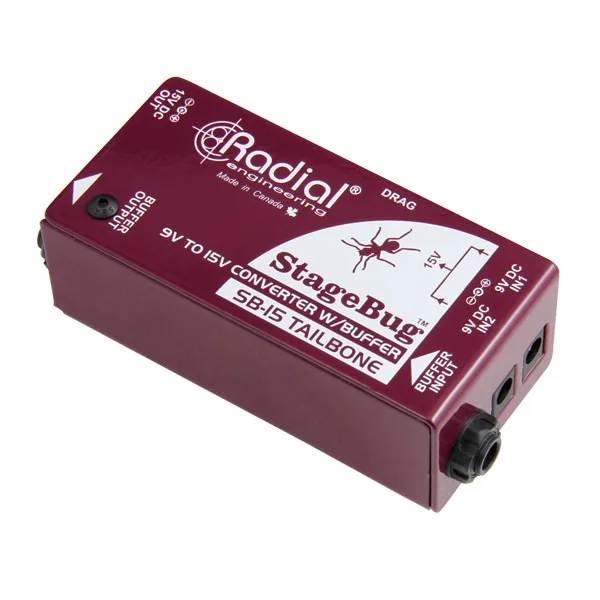
Against a simple buffer pedal like the TC Electronic Bonafide Buffer or the Radial SB-15 Tailbone, the Elevator adds a full boost stage with up to 18dB of gain and a midrange boost36. Against a pure boost pedal, it adds the Drag load correction and the choice of true bypass or buffered operation6. Radial positions it as the customizable option in its power booster line, sharing its class-A circuit with the Switchbone and descending from the JD7's design7.
Videos
Guitar World
Sweetwater
Questions
What does the Drag control on the Radial Elevator do?
Drag is a load correction control. It adjusts the input impedance, from 22K to 1M ohms, so you can replicate the tone and feel you would get with your guitar plugged straight into your amp. It works with the buffer section to let long cable runs sound like a short, direct connection.
Can the Radial Elevator run on a battery?
No. The Elevator uses a true class-A circuit that is not power efficient, unlike chip-based boosters, so it cannot run on a 9V battery. It needs a standard Boss-style 9V DC supply or a multi-pedal power brick, drawing about 50mA.
Is the Radial Elevator true bypass?
It can be. A recessed Baseline selector sets the input section to true bypass, buffer, or buffer with extra drive. In true bypass mode the pedal is taken completely out of the signal path, including the Drag and drive controls, whenever the booster is not engaged.
Should wah and fuzz go before the Radial Elevator?
Radial says wah and fuzz pedals sound best coupled directly with the guitar pickup, so placing them before the Elevator gives better tone at the cost of more noise. Placing the Elevator first buffers the signal, which allows longer cable runs with less noise.
Is the Radial Elevator discontinued?
Yes. Radial Engineering states the Elevator has been discontinued and is no longer shipping. It was announced in March 2014, made by hand in Canada, and listed at $220, so it is now only available on the second-hand market.
Sources (9)
- Radial Elevator: Ultimate Buffer & Power Booster, Premier Guitar, 2014-03-11
- Elevator, Radial Engineering, 2021-03-17
- Elevator Specifications, Radial Engineering, 2018-04-11
- BigShot EFX FAQ, Radial Engineering, 2018-05-14
- Review: Radial Elevator Dual Mode Buffer and Boost, Guitar World, 2014-08-18
- Elevator Features, Radial Engineering, 2018-06-19
- Elevator FAQ, Radial Engineering, 2018-05-14
- Comparing Reampers, Radial Engineering (www.radialeng.com), 2023-09-20
- AWESOME BOOSTER/BUFFER FOR YOUR PEDALBOARD Radial Elevator, YouTube (Pete Thorn channel), 2017-11-10